Executive Intelligence. Industrial Risk. Geopolitics.
Strategic Sparring
for Decision-Makers
Risk intelligence across technology, law, markets and power dynamics.


Verdeckte Geschäftsrisiken, strategische Widersprüche und kritische Abhängigkeiten frühzeitig erkennen.
Kostenlose Analyse starten →
Verdeckte Machtstrukturen, Führungsrisiken und organisatorische Blockaden frühzeitig erkennen.
Kostenlose Analyse starten →
Geopolitische Risiken, globale Abhängigkeiten und kritische Lieferkettenrisiken frühzeitig erkennen.
Kostenlose Analyse starten →
Identify hidden business risks, strategic contradictions and critical dependencies at an early stage.
Start Free Analysis →
Identify hidden power structures, leadership risks and organizational blockers at an early stage.
Start Free Analysis →
Identify geopolitical risks, global dependencies and critical supply-chain vulnerabilities at an early stage.
Start Free Analysis →
Verdeckte Geschäftsrisiken, strategische Widersprüche und kritische Abhängigkeiten frühzeitig erkennen.
Kostenlose Analyse starten →
Verdeckte Machtstrukturen, Führungsrisiken und organisatorische Blockaden frühzeitig erkennen.
Kostenlose Analyse starten →
Geopolitische Risiken, globale Abhängigkeiten und kritische Lieferkettenrisiken frühzeitig erkennen.
Kostenlose Analyse starten →
Identify hidden business risks, strategic contradictions and critical dependencies at an early stage.
Start Free Analysis →
Identify hidden power structures, leadership risks and organizational blockers at an early stage.
Start Free Analysis →
Identify geopolitical risks, global dependencies and critical supply-chain vulnerabilities at an early stage.
Start Free Analysis →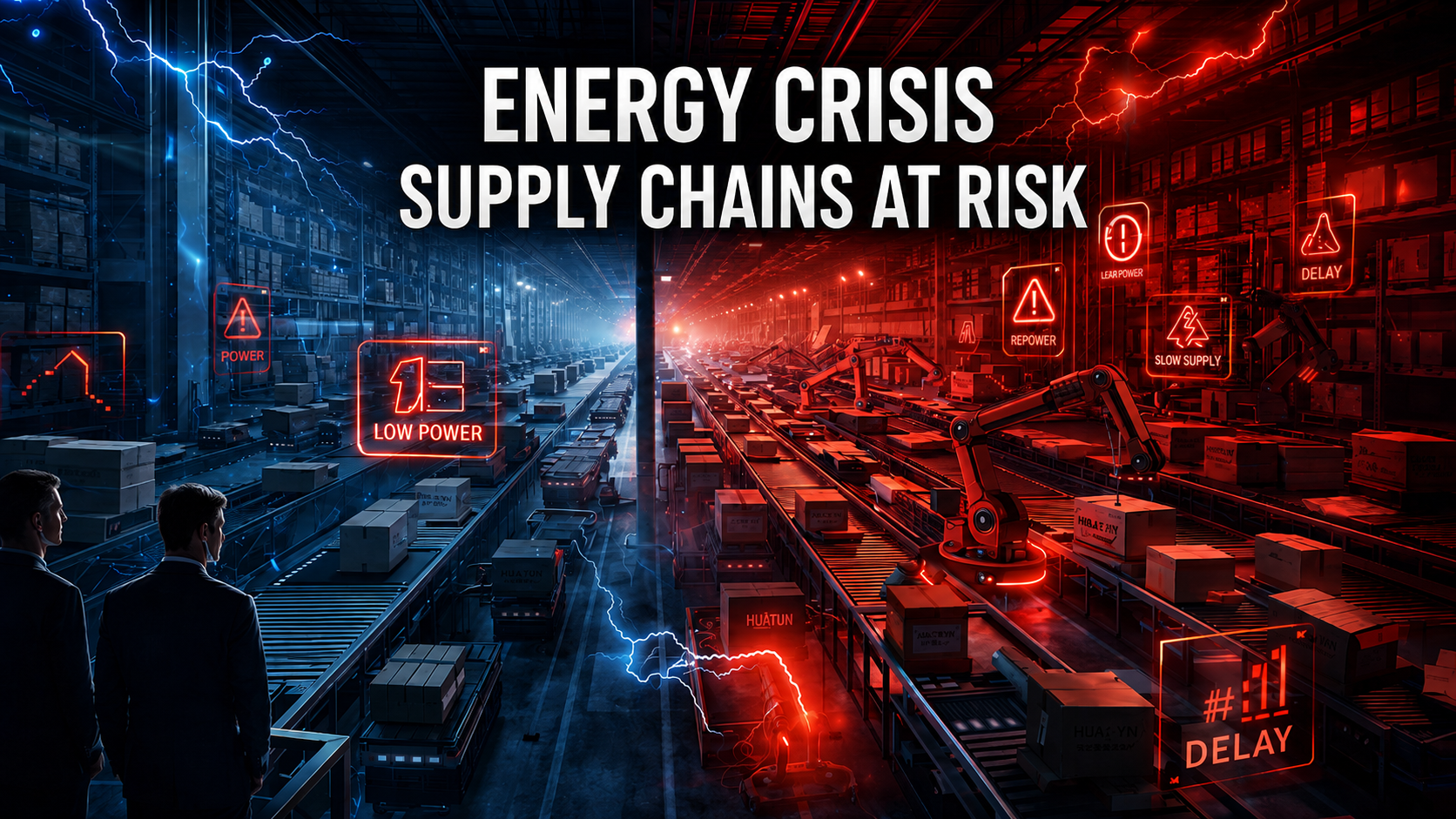
Strategic Risk Intelligence Brief by Global Insight Group.
This analysis is based on the GFDD Framework™ developed by Michaela Schaaf-Hoffelner and is designed for executives, investors and strategic decision-makers.
Updated: March 29, 2026
The Energy Lockdown in spring 2026 is hitting intralogistics particularly hard.
The Iran conflict, severe disruptions around the Strait of Hormuz, persistent shortages of technical components and China’s growing control over critical raw materials are combining into a double stress test for automated warehouses and spare-parts systems.
The problem is not simply rising energy prices.
It is the combination of the spare-parts trap, dependence on electricity, delayed investment and a lack of raw-material sovereignty that Europe cannot resolve in the short term.
Many companies in Europe had hoped that the major energy and supply-chain problems following the pandemic, the war in Ukraine and inflation would gradually stabilise.
That is not what is happening.
Instead, a new shockwave is emerging: Energy Lockdown 2026.
Energy is becoming more expensive again, supply chains are becoming more volatile, and companies once again have no clear idea how long the disruption will last.
The decisive issue is not simply the increase in prices.
The real risk emerges where geopolitical escalation, energy dependency and operational complexity intersect.
This is creating a dangerous combination in 2026 that can reasonably be described as an Energy Lockdown.
The current Iran conflict has placed enormous pressure on energy markets within a very short period.
Whenever military escalation spreads across the Gulf region, markets react immediately.
The reason is simple: the Middle East remains one of the most critical nodes in global oil and gas trade.
For Europe, this is particularly problematic.
Europe may not be completely dependent on the Strait of Hormuz, but it remains heavily exposed indirectly through global pricing, trade flows and market diversion.
When large volumes of oil, LNG or petrochemical feedstocks can no longer move normally, prices rise worldwide.
The Strait of Hormuz is not simply another trade route.
It is one of the world’s most important energy corridors.
When tanker traffic is restricted, delayed or politically controlled, the impact extends far beyond oil.
It affects gas, chemicals, fertilisers, plastics and a wide range of industrial intermediate products.
For companies, this means that even if they do not trade energy directly, they still feel the impact through several channels:
The term Energy Lockdown is useful because the situation is no longer limited to ordinary price fluctuations.
A lockdown in this context describes a situation in which companies formally continue operating, while their operational freedom becomes increasingly restricted:
This is not a complete shutdown.
But it is a state of gradual operational paralysis.
The real question is:
What happens next?
High prices alone would still be manageable for many companies.
Uncertainty is far more dangerous.
When nobody knows:
economic planning becomes extremely difficult.
During periods of severe uncertainty, companies rarely respond immediately with radical measures.
They wait.
That waiting is precisely where the danger begins.
Typical reactions include:
At first glance, this looks like prudent management.
In reality, it signals that confidence in the stability of the system is beginning to disappear.
Many observers reduce the issue to petrol prices, heating costs or electricity bills.
That misses the larger point.
The key issue is not merely that an energy shock creates chain reactions.
The more important development is that the operating logic of intralogistics in Europe is beginning to change visibly.
When energy becomes more expensive and procurement less reliable, the following usually increase as well:
This is not only a problem.
It is also a signal that companies need to change perspective.
Those who recognise the structural shift early can redesign their warehouse strategy, spare-parts planning and investment logic and may even gain a competitive advantage.
That is why the current situation should not only be viewed as a crisis.
It should be understood as a structural shift.
The central danger rarely comes from one dramatic day of crisis.
The critical point is reached when a new stress factor hits a system that is already weakened.
That is exactly the situation facing many parts of Europe in 2026.
Companies are emerging from several years of overlapping crises:
If another energy shock now hits that environment, energy-intensive, low-margin and highly interconnected business models will come under particularly severe pressure.
Intralogistics in 2026 is not simply affected by general cost inflation.
It has reached a point where several dependencies reinforce one another:
This is why intralogistics is not a niche issue in 2026.
It is an early-warning indicator for operational fragility across industry, supply systems and logistics.
Intelligence on Demand
Experience the analytical power of GFDD Diagnostics™ through a concrete business case.
Our proprietary AI was developed around the methodology, knowledge structures and analytical patterns of GFDD Diagnostics™.
Test whether this approach can reveal hidden dependencies, leadership risks and strategic blind spots within your organization.
Test GFDD Diagnostics™
Supply chains for technical components have still not returned to pre-crisis conditions across many areas in 2026.
This is particularly critical in automated warehouses, where highly specialised electronics, power components, scanners, sensors and drive units cannot simply be replaced with alternatives.
The consequences are clearly visible in practice:
The strategic shift from Just-in-Time to Just-in-Case improves resilience for individual companies in the short term.
At the same time, it reduces market availability.
The more large players secure parts in advance, the harder it becomes for smaller businesses and specialised suppliers to obtain those same components.
Intralogistics is more electrified and automated today than ever before.
That is precisely why rising energy prices and uncertainty surrounding electricity supply hit the sector so directly.
The pressure appears on several levels:
Automated warehouses, robots, AGVs, shuttles and conveyor systems only work when energy is consistently available.
Once electricity prices become highly volatile or grid stability becomes uncertain, the business case for many systems can deteriorate much faster than financial models suggest.
The effects go far beyond higher energy costs.
The priorities within intralogistics are already changing.
Companies are investing more heavily in risk management, inventory control and transparency instead of focusing exclusively on cost optimisation.
High energy costs, volatile procurement and uncertain component availability are slowing investment in new energy-efficient conveyor systems and fully automated warehouse solutions.
When energy becomes more expensive, spare parts become harder to obtain and modernisation is postponed, the industry is hit twice:
operationally through higher costs, and strategically through declining competitiveness.
In summary, the industry is currently trying to maintain operations through organisational adjustments and larger inventories, while rapidly rising energy and procurement costs place significant pressure on margins.
Companies are not responding passively in 2026.
In intralogistics in particular, organisations are attempting to reduce their exposure to volatile energy markets and unstable supply chains through technical solutions.
Large sites are expanding photovoltaic systems, battery storage and local energy systems in order to generate part of their electricity themselves.
This can reduce peak loads and lower dependence on the public grid.
Battery-storage systems allow companies to store electricity and reduce peak-load exposure.
Some concepts also use second-life batteries.
Algorithms manage charging and consumption so that robots, forklifts and conveyor systems draw electricity preferentially when sufficient on-site power is available or grid demand is lower.
For heavy fleets, high availability requirements and longer bridging periods, hydrogen is becoming increasingly relevant as a complement to battery solutions.
These measures can reduce pressure.
They do not solve the underlying problem.
Even a warehouse with stronger energy resilience remains dependent on:
In other words, many companies are building buffers against symptoms.
They are not gaining full control over the structural dependencies.
That is why resilience often looks stronger from the outside than it actually is under crisis conditions.
Current Jungheinrich projects illustrate how the industry is trying to respond through organisational intelligence and technical optimisation.
Jungheinrich is developing a new eastern regional warehouse for Mainova in Frankfurt to support spare-parts supply for technical infrastructure.
The concept includes a very-narrow-aisle warehouse, a small-parts warehouse, wide-span storage, cantilever racks and an integrated material flow designed to improve security of supply and efficiency.
The logic is understandable.
At the same time, however, the project creates a new critical node.
The more strongly spare parts, warehouse technology and material flow are concentrated within one integrated system, the greater the operational dependence on energy, technical availability and functioning spare-parts flows.
Jungheinrich Service & Parts manages around 90,000 different spare parts across one central warehouse and five regional warehouses and uses AI-supported inventory planning to improve availability economically and identify shortages earlier.
That approach also makes sense.
But software cannot calculate physical components into existence.
Particularly for sporadic demand, intelligent planning can optimise stock levels.
It cannot prevent a component from being unavailable when raw materials, intermediate products or production capacity further upstream are under pressure.
The decisive point is therefore:
Inventory intelligence improves the response to scarcity. It does not eliminate scarcity itself.
The risk in 2026 no longer concerns only finished spare parts.
An increasingly important question is whether European manufacturers can reliably obtain the raw materials and intermediate products required to manufacture their own components.
Modern conveyor systems, AGVs, shuttles and highly efficient drives often rely on permanent magnets.
Critical rare earths such as dysprosium, terbium and yttrium are relevant for high-performance magnet and motor technologies.
Scanners, control boards, power electronics and optical sensors depend on materials and intermediate products that can quickly become bottlenecks under tighter export rules.
Ironically, the technologies intended to create greater energy independence are themselves dependent on global raw-material supply chains.
Examples include graphite, refined battery materials and electronic contacts.
Mechanical key components are not immune either.
For highly stressed tools, wear parts and specialised metal applications, the availability of intermediate products can become a major problem.
The biggest risk therefore is not necessarily the absence of a finished product from China.
A more dangerous scenario is that European manufacturers themselves suddenly face lead times of several months because they lack intermediate goods, raw materials or export approvals.
Europe is attempting to reduce these dependencies.
The strategy broadly follows three directions:
Strategically, this is the right direction.
In the short term, however, it changes little for intralogistics in 2026.
The decisive weakness lies in the timeline:
This creates the most dangerous phase:
the gap between political response and industrial impact.
Europe is now entering a period in which existing buffers are shrinking while European alternatives are not yet available at sufficient industrial scale.
This is particularly challenging for intralogistics because high-end automation, specialised drives, sensors and power electronics are among the technologies most exposed to delays.
Possible consequences include:
A three-scenario framework helps put the situation into perspective.
The percentages are not precise forecasts.
They represent a strategic weighting of the developments that currently appear most plausible.
Persistent cost, energy and spare-parts pressure without a complete system breakdown
In this scenario, intralogistics remains operational but under significant pressure.
Energy prices remain elevated, specialised spare parts remain difficult to plan for and modernisation projects are postponed more frequently.
Typical consequences:
Additional export restrictions or licensing bottlenecks intensify the supply gap
In this scenario, shortages of materials and intermediate products become significantly more severe.
This does not necessarily require a complete export ban.
More restrictive approvals, longer processing times, geopolitical tension or preferential treatment of other markets could be enough.
Typical consequences:
A simultaneous external shock causes actual operational disruption and market consolidation
This scenario requires several negative factors to occur at the same time:
persistent severe energy-market disruption, additional restrictions on raw materials or components, and insufficient buffers within critical systems.
At that point, the issue would no longer be limited to delayed projects.
Actual warehouse and service processes could be interrupted.
Typical consequences:
The conclusion is clear:
The risks are real even if the extreme scenario does not materialise immediately.
Anyone responsible for intralogistics should not treat the current situation purely as an energy or procurement issue.
The decisive factor is systemic vulnerability.
Key questions include:
This is where genuine operational stability separates itself from reassuring rhetoric.
The industry is responding.
It is expanding energy storage, digitalising inventory planning, centralising spare-parts logistics, strengthening monitoring and seeking greater energy independence.
These measures are sensible and often necessary.
But none of them removes the fundamental problem:
Intralogistics remains highly dependent on energy, specialised components, raw materials and functioning upstream supply chains.
The key question is therefore not whether companies have already taken action.
The more important question is:
How much genuine control do these measures create, and how much stability is merely being simulated?
Energy Lockdown 2026 reveals one central contradiction:
Resilience is being built visibly, while structural fragility continues to increase across many systems.
I analyse precisely these kinds of hidden business dependencies, with a particular focus on intralogistics, spare-parts supply, energy dependency and operational system risk.
If you want to understand where your warehouse, service or spare-parts system is genuinely vulnerable under energy, raw-material or supply-chain stress, you can request a risk check here.
An Energy Lockdown describes a situation in which companies formally remain operational but become increasingly restricted by rising energy costs, uncertain supply and disrupted supply chains.
Because modern intralogistics is highly automated and depends on continuous energy supply and available spare parts.
Even relatively small disruptions can slow down or stop entire systems.
The Strait of Hormuz is a critical chokepoint for global energy trade.
Disruption directly affects energy prices, transportation costs and industrial supply chains.
Because many measures only reduce the symptoms.
Energy storage is one example.
Structural dependence on raw materials, technical components and global supply chains remains in place.
Companies need to evaluate their systems more rigorously for resilience, identify critical dependencies and develop genuine strategic alternatives.
For the rare-earth context, an English version of your broader China analysis is also available:
China, the US and Europe: The Battle for Rare Earths
Identify Systemic Risks Before They Escalate
Author of Global Insight Group Intelligence:
Michaela Schaaf-Hoffelner has more than 35 years of experience in strategic and technical project and product management, particularly in IT, control systems and intralogistics. Through her long-standing work with complex systems, she identifies structural risks and dynamic misalignments at an early stage – risks that are often overlooked in conventional analysis.
Her focus is on making causal relationships and systemic dependencies visible and translating them into concrete strategic advantages for investors and decision-makers. Her analyses combine deep technical systems understanding with geopolitical and economic developments.
GFDD Framework™ and GFDD Diagnostics™ are proprietary analytical concepts developed by Michaela Schaaf-Hoffelner. © 2026 Global Insight Group LLC. All rights reserved.
You are currently viewing a placeholder content from X. To access the actual content, click the button below. Please note that doing so will share data with third-party providers.
More Information