Executive Intelligence. Industrial Risk. Geopolitics.
Strategic Sparring
for Decision-Makers
Risk intelligence across technology, law, markets and power dynamics.


Verdeckte Geschäftsrisiken, strategische Widersprüche und kritische Abhängigkeiten frühzeitig erkennen.
Kostenlose Analyse starten →
Verdeckte Machtstrukturen, Führungsrisiken und organisatorische Blockaden frühzeitig erkennen.
Kostenlose Analyse starten →
Geopolitische Risiken, globale Abhängigkeiten und kritische Lieferkettenrisiken frühzeitig erkennen.
Kostenlose Analyse starten →
Identify hidden business risks, strategic contradictions and critical dependencies at an early stage.
Start Free Analysis →
Identify hidden power structures, leadership risks and organizational blockers at an early stage.
Start Free Analysis →
Identify geopolitical risks, global dependencies and critical supply-chain vulnerabilities at an early stage.
Start Free Analysis →
Verdeckte Geschäftsrisiken, strategische Widersprüche und kritische Abhängigkeiten frühzeitig erkennen.
Kostenlose Analyse starten →
Verdeckte Machtstrukturen, Führungsrisiken und organisatorische Blockaden frühzeitig erkennen.
Kostenlose Analyse starten →
Geopolitische Risiken, globale Abhängigkeiten und kritische Lieferkettenrisiken frühzeitig erkennen.
Kostenlose Analyse starten →
Identify hidden business risks, strategic contradictions and critical dependencies at an early stage.
Start Free Analysis →
Identify hidden power structures, leadership risks and organizational blockers at an early stage.
Start Free Analysis →
Identify geopolitical risks, global dependencies and critical supply-chain vulnerabilities at an early stage.
Start Free Analysis →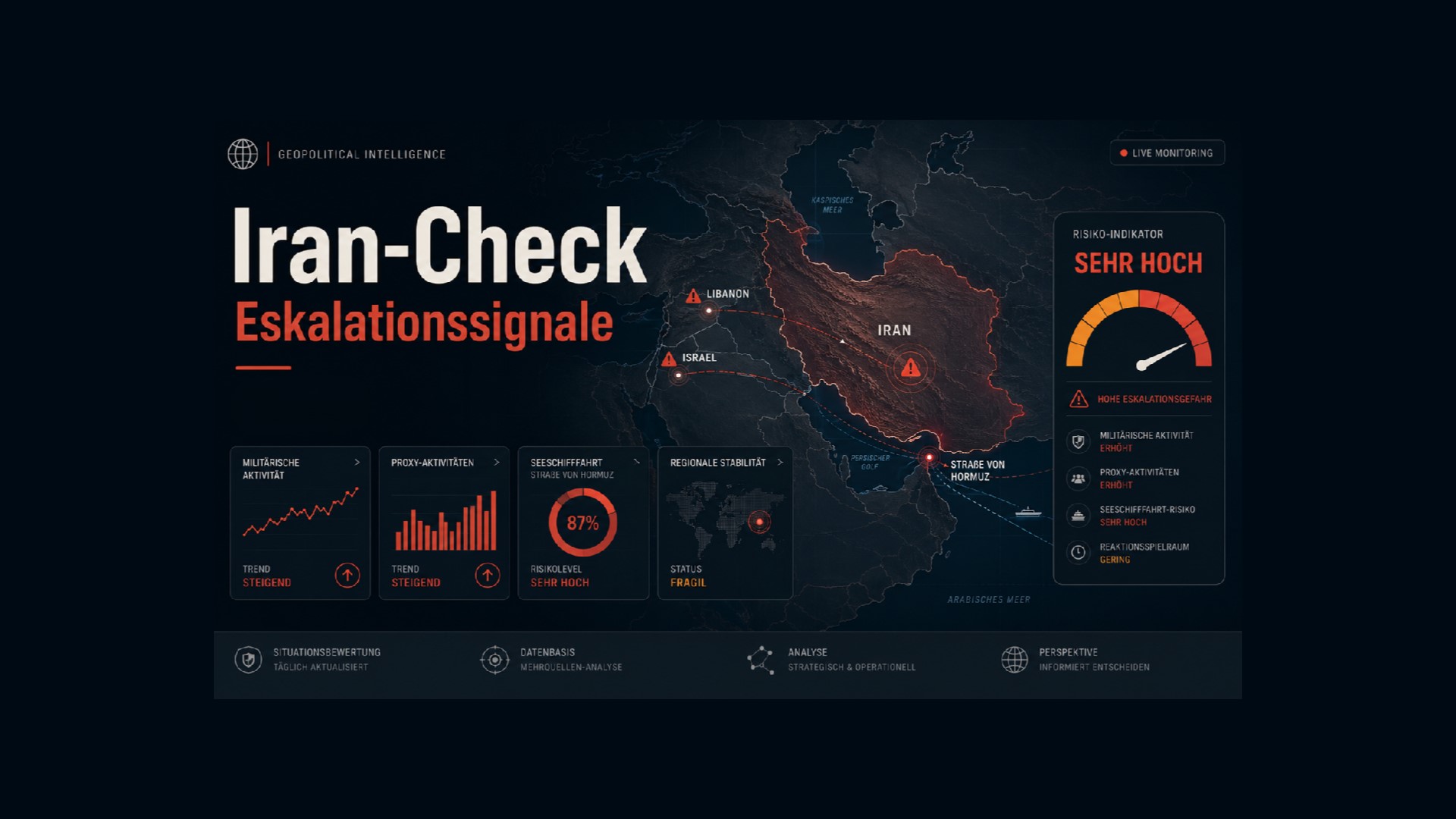
This escalation radar summarises five relevant signals as of September 2, 2026. It focuses on substantiated statements by official bodies, verified events and monitoring sources with potential implications for energy prices, supply chains, markets, maritime security, aviation and regional stability.
US forces strike two Iranian government tankers. Washington describes this as a new “tanker-for-tanker” policy. Around 100 targets are hit in total. Maritime escalation is therefore entering a new direct retaliation cycle.
Iran attacks US targets in Bahrain, Kuwait, Jordan and Iraq with missiles and drones. Kuwait reports damage following a drone strike, while US officials have so far confirmed no US casualties.
Only four merchant vessels transit the Strait of Hormuz on Tuesday, down from ten the previous day. Bab el-Mandeb also remains below average. Both major regional chokepoints therefore remain under simultaneous pressure.
| Actor | Type | Severity | Status | Source / Verification Status | Business Impact |
|---|---|---|---|---|---|
| United States / Iran / US military / IRGC / Hormuz | US directly targets Iranian government tankers under new “tanker-for-tanker” logic | Critical · Level 5/5 | Washington is expanding its military strategy in Hormuz. According to US officials, US drones strike two Iranian government tankers off the Iranian coast and hit their engine rooms. Around 100 Iranian targets are struck in the wider operation, including radar, air-defence, mine-laying, drone and anti-ship systems. The new approach is described as a “tanker-for-tanker” policy. Power dynamics: Washington is no longer responding to attacks on merchant shipping only defensively, but with targeted retaliation against Iranian maritime assets. This creates a direct ship-for-ship escalation logic. | Confirmed by Axios, September 2, 2026 . Verification status: confirmed regarding the attack on two Iranian government tankers and around 100 targets in the latest strike wave. The description as a new “tanker-for-tanker” policy comes from US government officials. Background: Schaaf Media · Middle East Escalation Check from September 1, 2026 . | Critical business impact on Hormuz, tankers, oil, LNG, charter contracts, insurance and war-risk premiums. Direct attacks on state-owned tankers increase the risk that merchant shipping will increasingly become entangled in military retaliation cycles. |
| Iran / United States / Bahrain / Kuwait / Jordan / Iraq | Iran expands military retaliation to US facilities in four states | Critical · Level 5/5 | Iran responds to the latest US strikes with an expanded regional attack wave. Iranian missiles and drones target US facilities in Jordan, Bahrain, Kuwait and Erbil in northern Iraq. Kuwait confirms that an Iranian drone strike damaged a residential complex, but caused no casualties. Bahrain reports intercepted drones. Iran claims heavy US casualties; US officials have not confirmed these claims. Power dynamics: Iran is attempting to distribute the cost of further US attacks across several regional host states and US military facilities simultaneously. This increases the risk of additional Gulf states being drawn directly into the conflict. | Confirmed by Reuters, September 2, 2026 . Verification status: confirmed regarding Iranian attacks on US facilities in Bahrain, Kuwait, Jordan and Iraq. Iranian claims of high US casualties have not been independently confirmed. Background: Schaaf Media · Iran’s Proxies: The Hidden Escalation Map of the Middle East . | Critical business impact on Bahrain, Kuwait, Jordan, Iraq, aviation, logistics, employee travel, insurance and business continuity. Companies must now plan for a broader regional target environment around US military facilities. |
| Iran / Oman / Hormuz / Bab el-Mandeb / international shipowners | Hormuz traffic collapses to four visible merchant vessels | Critical · Level 5/5 | Visible shipping traffic through Hormuz falls on Tuesday to only four merchant vessels. The previous day saw ten, while the ten-day average is around 13. Only one vessel enters the Gulf, while three leave it. At the same time, only 18 merchant vessels transit Bab el-Mandeb, compared with a ten-day average of around 24. The IRGC simultaneously says further US attacks would tighten the “lock” on Hormuz. Power dynamics: Direct US-Iran military attacks are therefore having an immediate impact on two central global trade routes. | Confirmed by Reuters, September 2, 2026 . Verification status: confirmed regarding four visible Hormuz transits and 18 transits through Bab el-Mandeb. AIS shutdowns may mean that some vessel movements are not captured. Further reading: Schaaf Media · Strait of Hormuz Blockade 2026: Strategies for the Chokepoint Shock . | Critical business impact on oil, LNG, LPG, freight rates, Suez, tanker charters, war-risk premiums and Europe-Asia supply chains. Simultaneous pressure on Hormuz and Bab el-Mandeb significantly reduces alternative routing options. |
| Qatar / UAE / Oman / India / Japan / LNG | Qatar and UAE shift LNG between vessels outside Hormuz | High to critical · Level 4/5 | The energy sector is developing new operational bypass mechanisms. Three LNG cargoes from Qatar and the UAE are being transferred between vessels outside Hormuz. These ship-to-ship transfers are taking place partly off Oman. Destination markets include India and Japan. Such transfers are significantly less common for LNG than for crude oil. Power dynamics: Energy companies are beginning not only to wait for political reopening, but to build physical logistics models designed to bypass Hormuz risk. This shows how persistently the market now expects disruption in the strait. | Confirmed by Maritime Professional, September 2, 2026 . Verification status: confirmed regarding three LNG cargoes and ship-to-ship transfers outside Hormuz. The transfer data are based on Vortexa and Kpler. Further reading: Schaaf Media · Oil as a Weapon: Why Energy Dominates Geopolitics and Markets in 2026 . | High to critical business impact on LNG, Qatar, UAE, India, Japan, charter costs, insurance and Asian gas prices. Alternative transfers provide flexibility, but increase operational complexity, costs and security risks. |
| Qatar / Iran / Bahrain / Kuwait / Jordan / regional mediation | Qatar condemns Iranian attacks and warns of damage to diplomacy | High to critical · Level 4/5 | Qatar hardens its political position towards Tehran on September 2. The Foreign Ministry explicitly condemns the Iranian attacks on Jordan, Bahrain and Kuwait. Doha describes them as a dangerous escalation and says they could undermine previous efforts to contain the conflict. Qatar explicitly holds Iran responsible for the consequences and calls for an immediate end to military attacks. Power dynamics: A state that has so far been one of the most important mediators is publicly distancing itself from Tehran’s current military strategy. This narrows Iran’s diplomatic room within the Gulf states. | Confirmed by Qatar Ministry of Foreign Affairs, September 2, 2026 . Verification status: confirmed regarding Qatar’s condemnation, solidarity with the three affected states and the warning of negative consequences for diplomacy. The mandatory alliance review shows no new Iranian accession or security status today. Background: Schaaf Media · Middle East Escalation Check from September 1, 2026 . | High to critical business impact on Gulf risk premiums, LNG, regional investment, diplomacy and location planning. Weaker mediation channels increase the probability that military rather than political mechanisms will determine the next phase. |
The most important new escalation step on September 2, 2026 is the shift in US retaliation strategy. The United States is directly targeting Iranian government tankers in response to attacks on merchant shipping. The maritime conflict is therefore becoming significantly more direct and symmetrical.
Iran is responding with a broad regional attack wave. US facilities in Bahrain, Kuwait, Jordan and Iraq are being targeted with missiles and drones. This increases the risk that additional Gulf states will be operationally drawn into the US-Iran conflict.
At the same time, the actual chokepoint situation is deteriorating further. Only four visible merchant vessels are transiting Hormuz, while Bab el-Mandeb also remains below its average. Simultaneous pressure on both routes intensifies risks for energy, Suez and Europe-Asia supply chains.
The energy industry is increasingly responding with its own bypass mechanisms. LNG from Qatar and the UAE is being transferred between vessels outside Hormuz. At the same time, Qatar is intensifying its political criticism of Iran and warning that mediation could fail. The mandatory alliance review shows no new Iranian alliance status today. EASA has extended the existing CZIBs for Iran, Iraq, Lebanon, the Persian Gulf and the Gulf of Oman until September 30, 2026.
The five most important signals for a European and German risk assessment are: the new US strategy of direct retaliatory strikes against Iranian government tankers, Iran’s expanded missile and drone attacks on US facilities in four states, the collapse of visible Hormuz traffic to only four merchant vessels, the unusual LNG ship-to-ship transfers by Qatar and the UAE outside the strait, and Qatar’s open condemnation of the Iranian attacks and the resulting strain on the regional mediation architecture.
Note: This assessment was prepared with the support of our Geo AI. AI can make mistakes. The analysis is intended as a radar for potential escalation signals and does not replace a fully verified intelligence assessment.
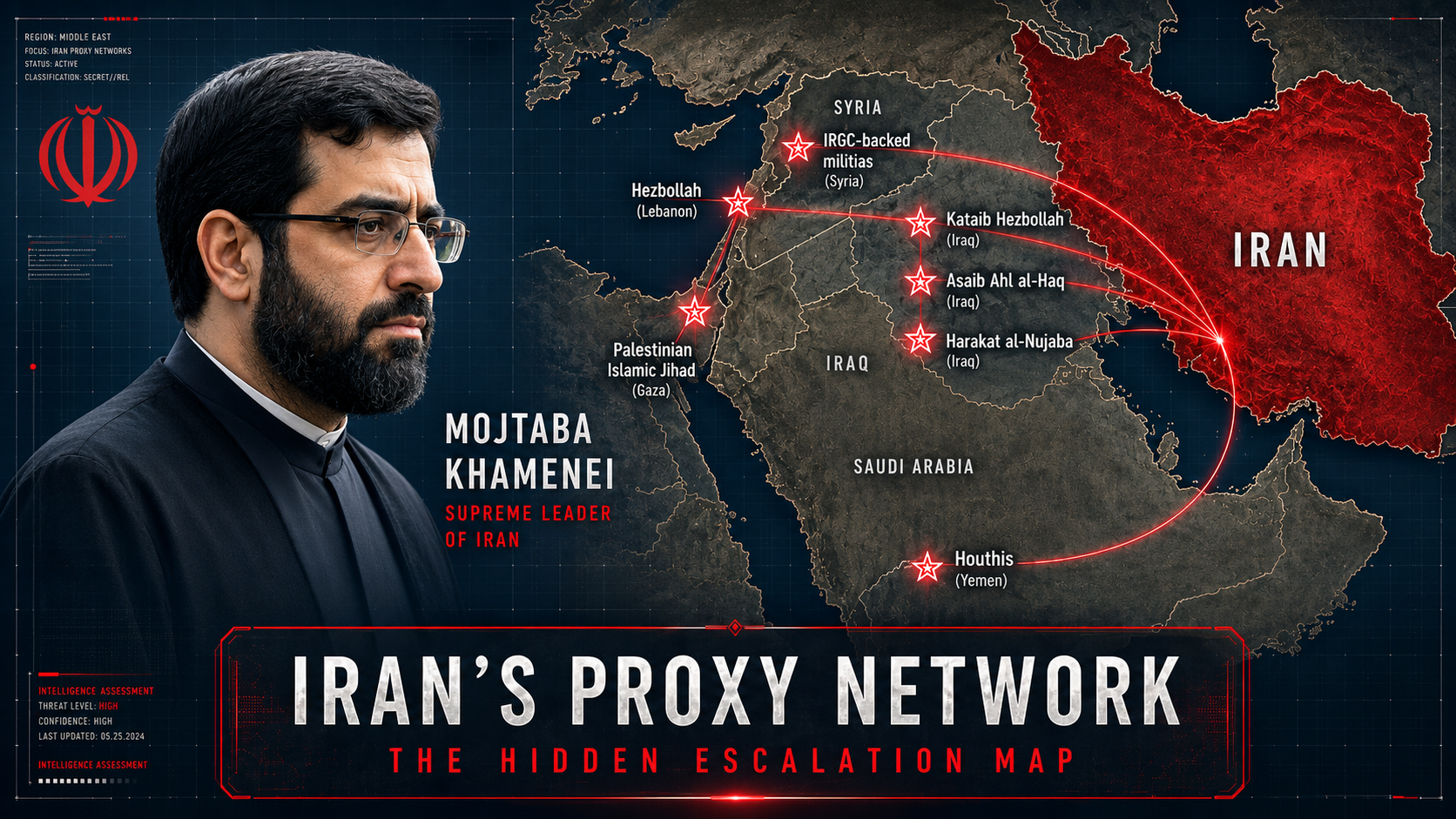
What decision-makers should watch now — before proxy escalation becomes a cost, compliance or supply-chain shock.
This 17-page executive briefing translates Iran’s proxy network into concrete business risks: energy price exposure, maritime chokepoints, war-risk premiums, sanctions, shadow fleets, supply-chain disruption and early-warning indicators for board-level decisions.
You are currently viewing a placeholder content from X. To access the actual content, click the button below. Please note that doing so will share data with third-party providers.
More Information