Executive Intelligence. Industrial Risk. Geopolitics.
Strategic Sparring
for Decision-Makers
Risk intelligence across technology, law, markets and power dynamics.


Verdeckte Geschäftsrisiken, strategische Widersprüche und kritische Abhängigkeiten frühzeitig erkennen.
Kostenlose Analyse starten →
Verdeckte Machtstrukturen, Führungsrisiken und organisatorische Blockaden frühzeitig erkennen.
Kostenlose Analyse starten →
Geopolitische Risiken, globale Abhängigkeiten und kritische Lieferkettenrisiken frühzeitig erkennen.
Kostenlose Analyse starten →
Identify hidden business risks, strategic contradictions and critical dependencies at an early stage.
Start Free Analysis →
Identify hidden power structures, leadership risks and organizational blockers at an early stage.
Start Free Analysis →
Identify geopolitical risks, global dependencies and critical supply-chain vulnerabilities at an early stage.
Start Free Analysis →
Verdeckte Geschäftsrisiken, strategische Widersprüche und kritische Abhängigkeiten frühzeitig erkennen.
Kostenlose Analyse starten →
Verdeckte Machtstrukturen, Führungsrisiken und organisatorische Blockaden frühzeitig erkennen.
Kostenlose Analyse starten →
Geopolitische Risiken, globale Abhängigkeiten und kritische Lieferkettenrisiken frühzeitig erkennen.
Kostenlose Analyse starten →
Identify hidden business risks, strategic contradictions and critical dependencies at an early stage.
Start Free Analysis →
Identify hidden power structures, leadership risks and organizational blockers at an early stage.
Start Free Analysis →
Identify geopolitical risks, global dependencies and critical supply-chain vulnerabilities at an early stage.
Start Free Analysis →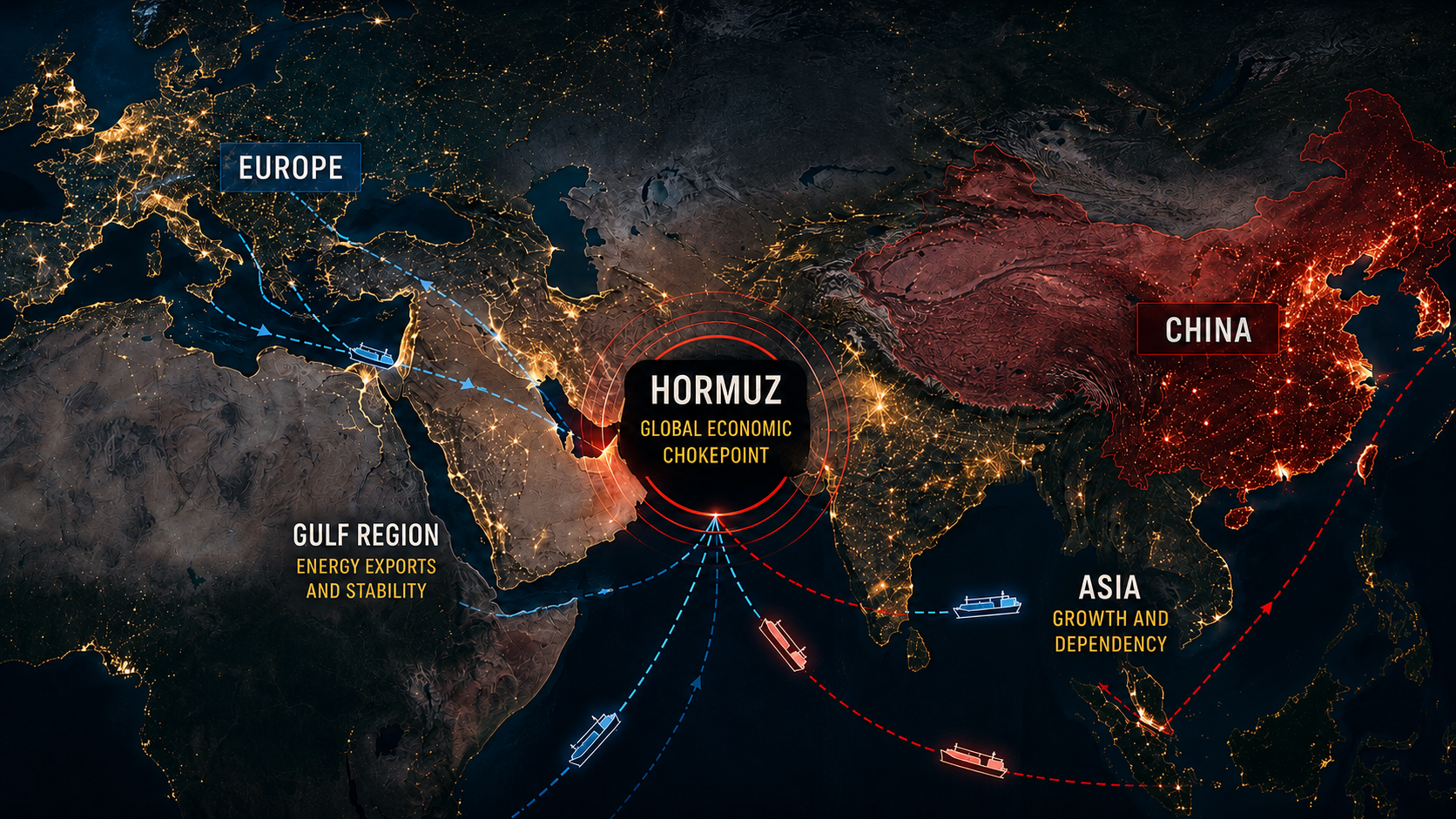
This Chokepoint Check assesses current pressure on the Strait of Hormuz, Bab al-Mandab and the Gulf region’s critical water, power, port and energy infrastructure. The key question is not only whether a route remains geographically open, but whether transport, insurance coverage, energy supply and site operations remain operationally viable.
The route remains geographically open, but visible commercial traffic has again fallen sharply.
Kpler recorded only four commodity-vessel transits through Hormuz on Monday, down from ten on Sunday. Two empty oil tankers entered, while only two bulk carriers exited.
The maritime route remains open, but transit volumes are falling while the Houthi presence along the Red Sea coast becomes more entrenched.
Kpler recorded 21 commodity-vessel transits through Bab al-Mandab on Monday, down from 28 the previous day. Yemeni sources simultaneously report further Houthi consolidation along the western coast.
Saudi Arabia’s main Hormuz-bypass route remains shut despite rising supply risks.
The East-West Pipeline remained offline on September 15. At the same time, Brent and WTI reached around $107 and $103 per barrel respectively.
Kpler recorded only four commodity vessels on Monday, down from ten on Sunday. Vessels with AIS switched off are not included.
Two empty oil tankers entered, while two bulk carriers exited. Visible traffic therefore remains far below pre-war levels.
Low transit capacity keeps chartering, insurance, inventory and lead-time risks for energy and commodities extremely high.
Verification Status: confirmed through current Kpler data from September 15; dark transits remain outside the visible statistics. Reuters / Kpler, 15.09.2026 · SchaafMedia: Chokepoint Risk Analysis – Hormuz & Supply Chain Risks
Saudi Arabia confirmed attacks on Khamis Mushait, Abha and Taif. Thirteen civilians were injured, while homes and vehicles were damaged.
Warnings were temporarily also issued for Jeddah, Jazan, AlUla and the strategically important Red Sea oil port of Yanbu.
The attack footprint increasingly includes civilian areas and strategic Red Sea infrastructure. Site and export continuity remain at risk.
Verification Status: confirmed by the Saudi-led coalition. Individual Houthi target claims regarding military facilities remain self-reported. Saudi Gazette, 15.09.2026 · SchaafMedia: Iran Check – 5 Escalation Signals from September 14, 2026
Saudi Arabia’s East-West Pipeline remained offline on Tuesday. Brent rose to around $106.9, while WTI reached around $102.7.
Saudi Arabia therefore remains without its most important export alternative to the heavily constrained Strait of Hormuz.
Energy, transport and procurement costs remain under pressure. A prolonged pipeline outage would further reduce global export capacity.
Verification Status: confirmed. The continuing outage was reported again by Reuters on September 15. The price reaction is operationally linked to the disruption. Reuters / TBS News, 15.09.2026 · SchaafMedia: Oil as a Weapon – Energy and Geopolitics in 2026
Kpler recorded 21 transits through Bab al-Mandab on Monday, down from 28 on Sunday. Hormuz simultaneously fell to four.
The Houthis are simultaneously consolidating positions along Yemen’s western coast. Bab al-Mandab is not fully closed.
Companies are increasingly unable to compensate for a weak Gulf corridor through a reliably stable Red Sea route.
Verification Status: confirmed for the current transit data. Houthi consolidation is reported by Yemeni government sources. Reuters / Kpler via Emirates 24|7, 15.09.2026 · SchaafMedia: Middle East Escalation Check from September 13, 2026
Oman postponed the planned meeting between Iran and Gulf states. No new date was initially announced.
Trump simultaneously said Washington remained broadly open to talks. Iran, however, continues to insist on its own preconditions.
There is therefore no reliable near-term diplomatic basis for normalised transit or lower insurance risk.
Verification Status: confirmed. The postponement and US willingness to talk are confirmed; no new negotiation process or operational Hormuz agreement is in place. Reuters / Business Recorder, 15.09.2026 · SchaafMedia: Strait of Hormuz Blockade 2026 – Protecting Margins and Supply Chains in the Chokepoint Shock
Hormuz falls to four transits, Bab al-Mandab to 21 and the Saudi bypass pipeline remains offline.
Shipowners, energy companies and insurers must reassess both maritime routes and alternative export channels simultaneously.
Visible transit falls while a key Saudi export pipeline remains unavailable.
Oil, freight, war-risk premiums, inflation and procurement costs remain under simultaneous pressure.
Hormuz has fallen to four visible transits, while Bab al-Mandab is also recording a significant daily decline.
Both chokepoints open · transit capacity and predictability remain significantly constrainedSaudi Arabia’s most important Hormuz-bypass pipeline remains offline following the drone attack.
Critical export infrastructure remains impaired · alternative capacity remains constrainedTwo chokepoints, Saudi energy infrastructure and new Houthi attacks are simultaneously affecting regional export capacity.
Maritime, energy, military and economic risks remain fully interconnectedOverall risk remains critical. Compared with September 13, the most important change is the further decline in actually visible shipping capacity. At the same time, the Saudi bypass pipeline remains offline and renewed Houthi attacks continue to pressure the Red Sea export corridor.
Note: This assessment was produced with support from our Geo-AI. AI can make mistakes. The analysis is intended as a source-based radar for potential escalation signals and does not replace fully verified intelligence, security, insurance or investment advice. In rapidly evolving situations, status, source availability and risk assessments may change at short notice.
Independent of the subject covered in this article, this separate Executive Briefing provides an in-depth analysis of another critical risk domain affecting European companies.
The 27-page Executive Briefing “Black Swan Risk Mapping for Europe’s Next Mobility and Infrastructure Shock” examines how geopolitical, infrastructural and administrative developments that are currently viewed in isolation could reinforce one another.
Based on the GFDD Framework™, the report shows how these dynamics could affect operational continuity, access to critical resources and the strategic resilience of companies.
The briefing includes a structured systemic-shock analysis and a directly applicable Business Exposure Checklist for CEOs, CFOs, COOs, investors and strategy teams.
You are currently viewing a placeholder content from X. To access the actual content, click the button below. Please note that doing so will share data with third-party providers.
More Information