Executive Intelligence. Industrial Risk. Geopolitics.
Strategic Sparring
for Decision-Makers
Risk intelligence across technology, law, markets and power dynamics.

Verdeckte Geschäftsrisiken, strategische Widersprüche und kritische Abhängigkeiten frühzeitig erkennen.
Kostenlose Analyse starten →
Verdeckte Machtstrukturen, Führungsrisiken und organisatorische Blockaden frühzeitig erkennen.
Kostenlose Analyse starten →
Geopolitische Risiken, globale Abhängigkeiten und kritische Lieferkettenrisiken frühzeitig erkennen.
Kostenlose Analyse starten →
Identify hidden business risks, strategic contradictions and critical dependencies at an early stage.
Start Free Analysis →
Identify hidden power structures, leadership risks and organizational blockers at an early stage.
Start Free Analysis →
Identify geopolitical risks, global dependencies and critical supply-chain vulnerabilities at an early stage.
Start Free Analysis →
Verdeckte Geschäftsrisiken, strategische Widersprüche und kritische Abhängigkeiten frühzeitig erkennen.
Kostenlose Analyse starten →
Verdeckte Machtstrukturen, Führungsrisiken und organisatorische Blockaden frühzeitig erkennen.
Kostenlose Analyse starten →
Geopolitische Risiken, globale Abhängigkeiten und kritische Lieferkettenrisiken frühzeitig erkennen.
Kostenlose Analyse starten →
Identify hidden business risks, strategic contradictions and critical dependencies at an early stage.
Start Free Analysis →
Identify hidden power structures, leadership risks and organizational blockers at an early stage.
Start Free Analysis →
Identify geopolitical risks, global dependencies and critical supply-chain vulnerabilities at an early stage.
Start Free Analysis →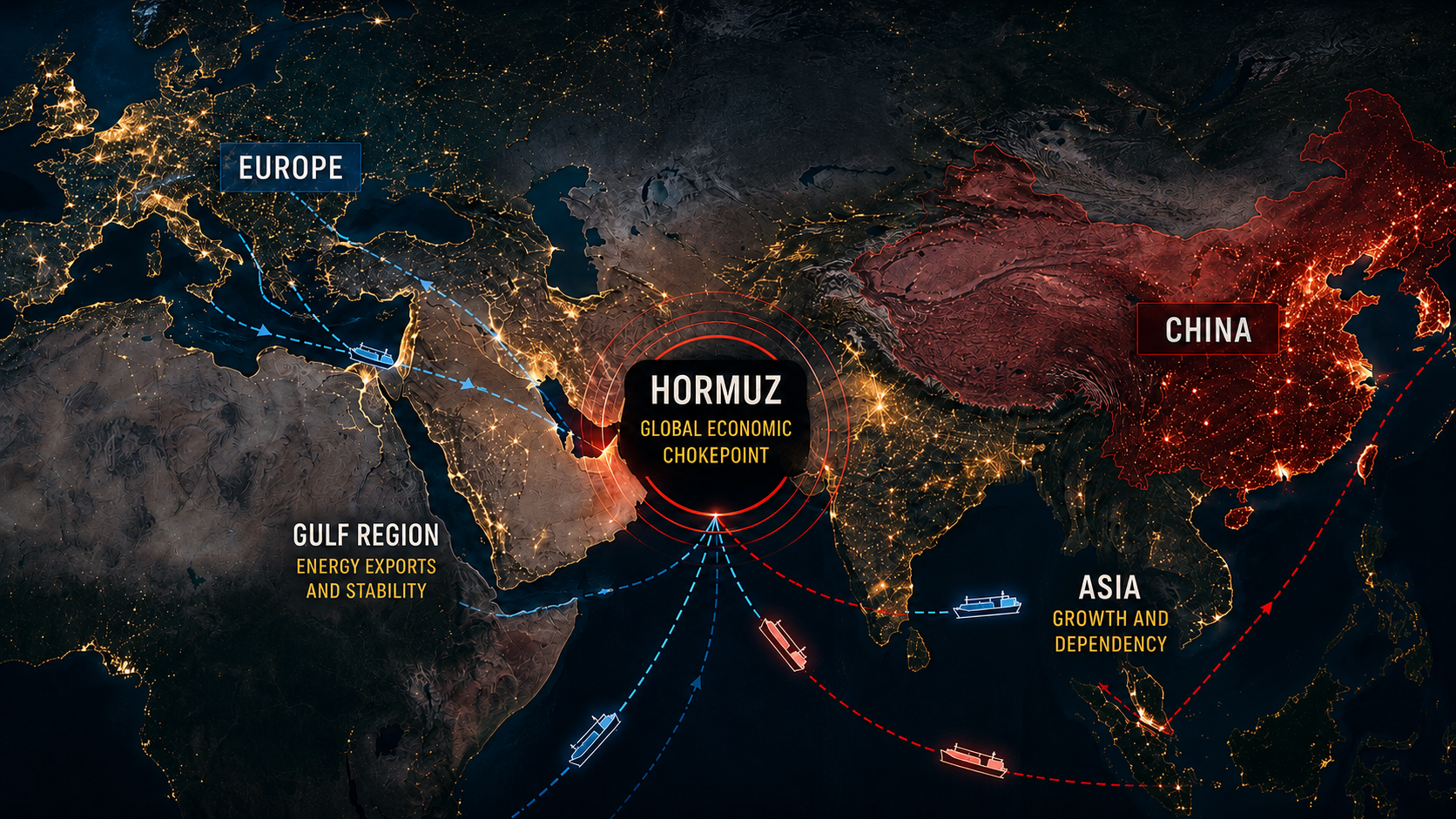
This Chokepoint Check assesses the current pressure on the Strait of Hormuz, Bab al-Mandab and critical water, power, port and energy infrastructure across the Gulf region. The key question is not merely whether a route remains geographically open, but whether transport, insurance, energy supply and site operations remain operationally viable.
The route remains geographically open, while the physical risk to commercial vessels has reached a new level.
Iran said it had attacked the Togo-flagged tanker Trend during a transit. At the same time, Kpler recorded only four visible commodity transits on Thursday.
The sea route remains usable, but individual merchant vessels now require active military escort.
Kpler recorded 23 commodity transits on Thursday, slightly below the ten-day average. At the same time, the Italian frigate Carlo Bergamini escorted the Jolly Oro.
The disruption to Saudi Arabia’s East-West Pipeline is no longer only a regional infrastructure problem.
Saudi Aramco reportedly informed at least two European refinery customers that agreed crude oil deliveries for October would not be supplied.
The Revolutionary Guards said on 18 September that they had attacked the Togo-flagged oil tanker Trend over what they described as an “illegal transit”.
AP was unable to independently confirm the specific attack. UKMTO, however, separately reported further tanker incidents in Hormuz.
Physical risks to vessels are rising. Insurers, shipowners and charterers must prepare for further transit restrictions and higher security costs.
Verification status: partially confirmed. The Iranian claim of an attack is official, but the specific damage to the tanker has not been independently confirmed. Associated Press, 18 September 2026 · SchaafMedia: Iran Check – 5 Escalation Signals, 18 September 2026
Saudi Arabia activated alerts in Riyadh and other areas during the night into 19 September. Explosions were heard in the capital.
The warning for Riyadh is new within the latest escalation. The cause and origin of the explosions have not yet been officially confirmed.
The threat area now extends beyond southern border and energy regions. Corporate locations and aviation in Saudi Arabia’s core economic area become more exposed.
Verification status: confirmed for the alert and subsequent all-clear; the cause of the explosions remains unclear. Saudi Gazette, 19 September 2026 · SchaafMedia: Middle East Escalation Check – 17 September 2026
Aramco reportedly informed at least two European refineries that agreed October deliveries would not be supplied following the pipeline attack.
Three pumping stations along the East-West Pipeline were damaged. Poland is already securing replacement crude from the North Sea, according to Reuters.
The infrastructure disruption is now causing concrete procurement changes at European refineries and increasing replacement and logistics costs.
Verification status: partially confirmed. Reuters was unable to independently verify the Bloomberg information; replacement sourcing in Europe is documented. Reuters, 18 September 2026 · SchaafMedia: Oil as a Power Instrument – Why Energy Dominates Markets in 2026
The Italian frigate Carlo Bergamini escorted the Jolly Oro northbound through Bab al-Mandab on 18 September.
The mission was conducted as part of EU Operation ASPIDES. Italy is simultaneously calling for additional vessels from other EU member states.
Military escort is becoming a concrete instrument for securing European trade flows through the chokepoint.
Verification status: confirmed by the Italian Navy. The escort was carried out within the EU mission ASPIDES. ANSA / Italian Navy, 18 September 2026 · SchaafMedia: Strait of Hormuz Blockade 2026 – Protecting Margins and Supply Chains in the Chokepoint Shock
The Security Council condemned Houthi attacks on Saudi Arabia as well as threats to shipping in the Red Sea and Bab al-Mandab.
The Council reaffirmed Riyadh’s right to self-defence and called for practical cooperation to enforce the arms embargo against the Houthis.
International pressure is increasing, while Saudi Arabia receives additional political backing for defensive countermeasures.
Verification status: confirmed. The Security Council explicitly links the Houthi escalation to risks for global trade and maritime security. Arab News / UN Security Council, 19 September 2026 · SchaafMedia: Iran Check – 5 Escalation Signals, 18 September 2026
Tankers are being attacked in Hormuz, while Saudi pumping stations remain damaged following drone strikes.
Some merchant vessels require military escorts, while refineries secure alternative crude supplies.
Hormuz traffic remains far below normal levels, while Saudi Arabia cannot fully meet agreed deliveries to Europe.
Alternative sourcing, military route protection, freight and insurance risks become part of normal supply-chain planning.
Tankers are being directly attacked in Hormuz, while merchant vessels at Bab al-Mandab are already receiving military escorts.
Both chokepoints remain open · safe commercial use increasingly requires additional protectionDamage to three pumping stations along the East-West Pipeline is now resulting in actual supply disruptions for European refineries.
Critical export infrastructure impaired · consequences are reaching international buyersTanker attacks, air alerts, pipeline outages and EU military escorts are simultaneously affecting energy and trade flows.
Maritime, energy, military and international security risks are fully interconnectedOverall risk remains critical. Compared with 17 September, the focus is shifting from extremely low transit volumes to visible physical and economic consequences: tankers are being attacked, Riyadh is being placed on alert, European refineries are losing scheduled supplies and merchant vessels require military protection.
Disclaimer: This assessment was prepared with support from our Geo AI. AI can make mistakes. This analysis is intended as a source-based radar for potential escalation signals and does not constitute fully verified intelligence, security, insurance or investment advice. In fast-moving situations, status, source availability and risk assessments may change at short notice.
Independent of the subject covered in this article, this separate Executive Briefing provides an in-depth analysis of another critical risk domain affecting European companies.
The 27-page Executive Briefing “Black Swan Risk Mapping for Europe’s Next Mobility and Infrastructure Shock” examines how geopolitical, infrastructural and administrative developments that are currently viewed in isolation could reinforce one another.
Based on the GFDD Framework™, the report shows how these dynamics could affect operational continuity, access to critical resources and the strategic resilience of companies.
The briefing includes a structured systemic-shock analysis and a directly applicable Business Exposure Checklist for CEOs, CFOs, COOs, investors and strategy teams.
You are currently viewing a placeholder content from X. To access the actual content, click the button below. Please note that doing so will share data with third-party providers.
More Information