Executive Intelligence. Industrial Risk. Geopolitics.
Strategic Sparring
for Decision-Makers
Risk intelligence across technology, law, markets and power dynamics.


Verdeckte Geschäftsrisiken, strategische Widersprüche und kritische Abhängigkeiten frühzeitig erkennen.
Kostenlose Analyse starten →
Verdeckte Machtstrukturen, Führungsrisiken und organisatorische Blockaden frühzeitig erkennen.
Kostenlose Analyse starten →
Geopolitische Risiken, globale Abhängigkeiten und kritische Lieferkettenrisiken frühzeitig erkennen.
Kostenlose Analyse starten →
Identify hidden business risks, strategic contradictions and critical dependencies at an early stage.
Start Free Analysis →
Identify hidden power structures, leadership risks and organizational blockers at an early stage.
Start Free Analysis →
Identify geopolitical risks, global dependencies and critical supply-chain vulnerabilities at an early stage.
Start Free Analysis →
Verdeckte Geschäftsrisiken, strategische Widersprüche und kritische Abhängigkeiten frühzeitig erkennen.
Kostenlose Analyse starten →
Verdeckte Machtstrukturen, Führungsrisiken und organisatorische Blockaden frühzeitig erkennen.
Kostenlose Analyse starten →
Geopolitische Risiken, globale Abhängigkeiten und kritische Lieferkettenrisiken frühzeitig erkennen.
Kostenlose Analyse starten →
Identify hidden business risks, strategic contradictions and critical dependencies at an early stage.
Start Free Analysis →
Identify hidden power structures, leadership risks and organizational blockers at an early stage.
Start Free Analysis →
Identify geopolitical risks, global dependencies and critical supply-chain vulnerabilities at an early stage.
Start Free Analysis →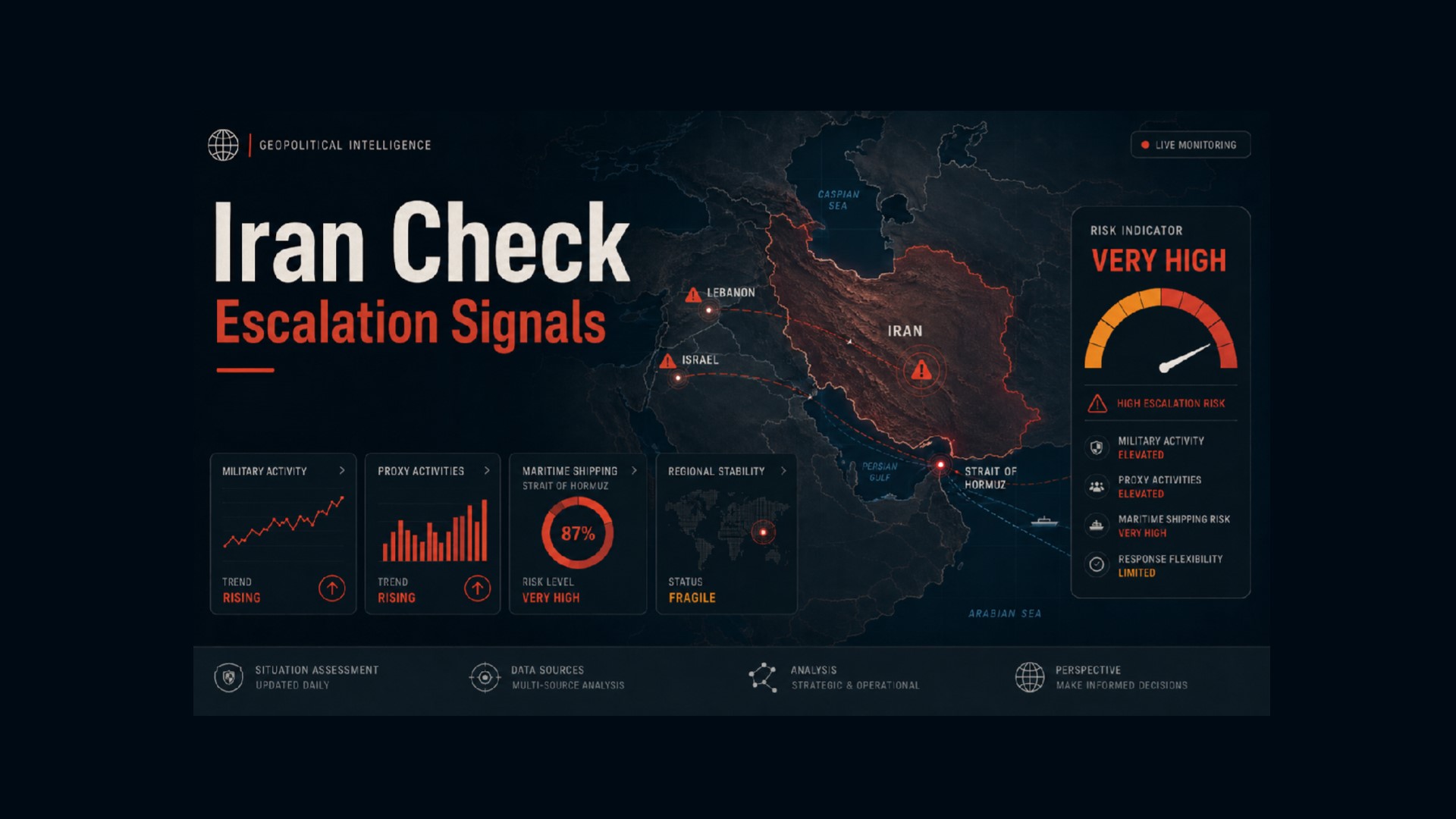
This escalation radar summarizes five relevant signals as of September 26, 2026. The focus is on verifiable statements by official sources, confirmed events and monitoring data with potential implications for energy prices, supply chains, markets, maritime security, aviation and regional stability.
Tehran is offering to reopen the Strait of Hormuz to normal shipping within seven days. Following reports that Trump rejected the proposal, Iran is still awaiting an official U.S. response.
The military chiefs of Saudi Arabia, Pakistan and Türkiye want to translate the pact’s mutual-defence commitments explicitly and immediately into effective military cooperation.
Parliament Speaker Kurtulmuş says the defence pact could evolve into a broader alliance across the Muslim world, potentially including Iran in the future.
| Actor | Type | Severity | Status | Source / Verification | Business Impact |
|---|---|---|---|---|---|
| Iran / United States / Qatar / Hormuz | Iran presents concrete seven-day plan to reopen Hormuz | Critical · Level 5/5 | The negotiations are entering a new phase. Foreign Minister Abbas Araghchi says Iran has submitted a concrete seven-day plan to the United States via Qatar. If Iran’s conditions are met, normal shipping through Hormuz could be restored within one week. At the same time, the Wall Street Journal reports that President Trump rejected the proposal. Iran says on September 26 that it is still waiting for an official U.S. response. Power dynamics: Hormuz remains Iran’s strongest negotiating lever, but is now being linked for the first time to a concrete timetable for reopening. | Current negotiation situation: Reuters, September 26, 2026 . Regional confirmation: Arab News / AFP, September 26, 2026 . Verification status: confirmed for the Iranian proposal and the seven-day timeframe. No formal U.S. acceptance or officially confirmed final rejection has yet been issued. Further analysis: Schaaf Media · Strait of Hormuz Blockade 2026: Protecting Margins and Supply Chains in the Chokepoint Shock . | Critical business impact on crude oil, LNG, tanker logistics, freight rates, marine insurance and inflation. A credible agreement could reduce risk premiums quickly. Failure would further entrench Hormuz as a political and economic pressure lever. |
| Saudi Arabia / Pakistan / Türkiye / Houthis | Makkah pact to be translated immediately into effective military cooperation | Critical · Level 5/5 | The regional defence pact is moving from political commitment into operational planning. The military chiefs of Saudi Arabia, Pakistan and Türkiye meet in Riyadh to discuss the current threat environment. They agree to strengthen intelligence sharing, military coordination and the integration of military capabilities. Particularly significant: the states say they intend to translate their commitments under the Makkah Joint Defence Agreement immediately into effective military cooperation. Power dynamics: A mutual-defence clause is therefore evolving into an increasingly practical regional defence structure. | Official Pakistani account: Radio Pakistan, September 26, 2026 . Additional reporting: Business Recorder / Reuters, September 26, 2026 . Verification status: confirmed for the meeting, the collective-defence commitment and plans for closer military integration. Specific troop deployments or new operational orders have not been confirmed. Background: Schaaf Media · Middle East Escalation Check – September 25, 2026 . | Critical business impact on Saudi Arabia, the defence industry, military logistics, energy infrastructure and investment risk. Institutionalized cooperation strengthens Saudi defensive capabilities, but could also further internationalize the conflict. |
| Türkiye / Iran / Saudi Arabia / Pakistan | Turkish parliament speaker raises Iran as potential future participant in Makkah pact | High to Critical · Level 4/5 | The alliance architecture is gaining a strategically surprising new option. Turkish Parliament Speaker Numan Kurtulmuş says the Makkah defence pact could eventually evolve into a broader alliance across the Muslim world. He explicitly names Iran as a potential participant. The existing pact between Türkiye, Saudi Arabia and Pakistan treats an attack on one member in principle as an attack on all. Status: political proposition, no official invitation, no confirmed accession talks and no Iranian application. Power dynamics: Future Iranian participation would fundamentally alter the current regional bloc structure. | Current reporting: Pakistan Today / Reuters, September 26, 2026 . Original Reuters reporting: The Business Standard / Reuters, September 25, 2026 . Verification status: confirmed for Kurtulmuş’ public statement. Not confirmed are a formal invitation, consultations, accession negotiations or an Iranian application. Further analysis: Schaaf Media · Iran War: How the West Is Fighting While Losing Its Dominance . | High to critical business impact on regional security architecture, sanctions, investment risk, military logistics and Gulf relations. Actual Iranian membership would fundamentally reshape existing friend-foe structures and deterrence logic. |
| Saudi Arabia / Houthis / Iran / Riyadh / Khamis Mushait | Saudi Arabia intercepts new Houthi drones and ballistic missile | Critical · Level 5/5 | The direct Saudi-Houthi confrontation remains highly active operationally. The Saudi-led coalition says on September 26 that it intercepted two Houthi drones heading towards Riyadh. In addition, a ballistic missile heading towards Khamis Mushait was destroyed. Saudi Civil Defence activates warnings for parts of the southwest. The Houthis are therefore continuing attacks against Saudi political and military targets. Power dynamics: Despite growing international support, Riyadh has not yet been able to fully reduce the sustained attack pressure. | Reuters reporting: Times of Israel / Reuters, September 26, 2026 . Regional confirmation: Gulf News, September 26, 2026 . Verification status: confirmed for two intercepted drones heading towards Riyadh and one ballistic missile heading towards Khamis Mushait. No impacts on the ground were reported. Background: Schaaf Media · Iran’s Proxies: The Hidden Escalation Map of the Middle East . | Critical business impact on Riyadh, civil aviation, military sites, insurance and business continuity. Repeated attacks keep Saudi air-defence assets continuously engaged and increase operating costs and risk premiums. |
| United States / China / Iran / Taiwan / sanctions | Trump warns Xi against supporting Iran – Beijing gives assurances | High to Critical · Level 4/5 | The Iran conflict is becoming further integrated into the U.S.-China relationship. U.S. Ambassador David Perdue says on September 26 that President Trump explicitly warned Xi Jinping against providing direct or indirect support to Iran. Washington says it received assurances from Beijing that China would not support Iran. At the same time, a senior Iranian official says China assured Tehran that bilateral relations would not be restricted. The backdrop includes reports of Chinese air-defence systems and support for Iranian oil and sanctions channels. Power dynamics: Iran is therefore becoming a direct test of the strategic U.S.-China relationship. | Additional regional reporting: Arab News / Reuters, September 25, 2026 . Verification status: confirmed for the U.S. warning and the Chinese assurances as described by Washington. The scope and actual implementation of any Chinese restrictions remain unclear. Further analysis: Schaaf Media · China, the United States & Europe: The Battle for Rare Earths . | High to critical business impact on China-U.S. relations, Iranian oil flows, sanctions, technology trade and global supply chains. Any actual reduction in Chinese support would constrain Iran’s economic and military room for manoeuvre. |
The most important strategic development on September 26, 2026 is Iran’s concrete seven-day plan for Hormuz. Tehran is setting out a clear timetable for the resumption of normal shipping for the first time. At the same time, Iran is still waiting for the official U.S. response following reports that Trump rejected the proposal. Hormuz therefore remains the central negotiating lever.
At the same time, the regional security architecture is becoming more operational. Saudi Arabia, Pakistan and Türkiye want to translate the commitments under the Makkah pact directly into effective military cooperation. Intelligence sharing, military coordination and capability integration are to be expanded.
Strategically, the openly discussed Iran option is particularly significant. Türkiye’s parliamentary leadership is naming Iran as a potential future participant in an expanded Makkah pact. There is currently no invitation or accession negotiation. However, the public discussion alone shows how fluid regional bloc formation has become.
Operationally, Saudi Arabia remains under Houthi pressure. Two drones heading towards Riyadh and a ballistic missile heading towards Khamis Mushait have been intercepted. In parallel, Washington is increasing pressure on China not to support Iran militarily or economically. EASA CZIBs for Iran, Iraq, Jordan, Lebanon, the Persian Gulf and Gulf of Oman remain active until September 30, 2026; no new revision was published on September 26.
The five most important signals for a European risk assessment are: Iran’s concrete seven-day plan to reopen the Strait of Hormuz, the immediate translation of the Makkah defence pact into effective military cooperation, the first openly stated possibility of future Iranian participation in the Makkah pact, the new Houthi drone and missile attacks against Saudi Arabia, and direct U.S. pressure on China to restrict its support for Iran.
Note: This assessment was prepared with support from our Geo-AI. AI can make mistakes. The analysis is intended as a radar for potential escalation signals and does not replace a fully verified intelligence assessment.
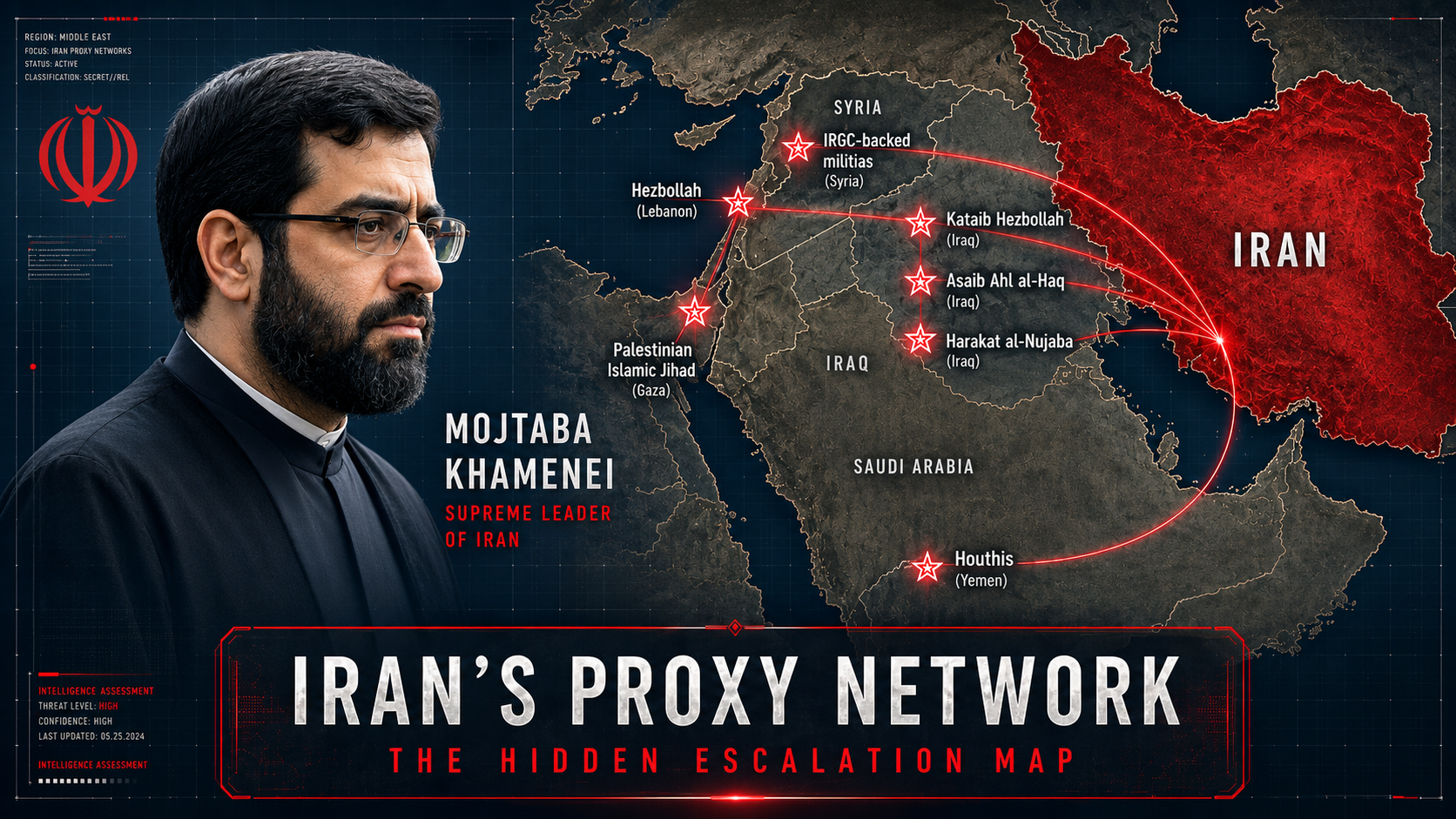
What decision-makers should watch now — before proxy escalation becomes a cost, compliance or supply-chain shock.
This 17-page executive briefing translates Iran’s proxy network into concrete business risks: energy price exposure, maritime chokepoints, war-risk premiums, sanctions, shadow fleets, supply-chain disruption and early-warning indicators for board-level decisions.
You are currently viewing a placeholder content from X. To access the actual content, click the button below. Please note that doing so will share data with third-party providers.
More Information