Executive Intelligence. Industrial Risk. Geopolitics.
Strategic Sparring
for Decision-Makers
Risk intelligence across technology, law, markets and power dynamics.

Verdeckte Geschäftsrisiken, strategische Widersprüche und kritische Abhängigkeiten frühzeitig erkennen.
Kostenlose Analyse starten →
Verdeckte Machtstrukturen, Führungsrisiken und organisatorische Blockaden frühzeitig erkennen.
Kostenlose Analyse starten →
Geopolitische Risiken, globale Abhängigkeiten und kritische Lieferkettenrisiken frühzeitig erkennen.
Kostenlose Analyse starten →
Identify hidden business risks, strategic contradictions and critical dependencies at an early stage.
Start Free Analysis →
Identify hidden power structures, leadership risks and organizational blockers at an early stage.
Start Free Analysis →
Identify geopolitical risks, global dependencies and critical supply-chain vulnerabilities at an early stage.
Start Free Analysis →
Verdeckte Geschäftsrisiken, strategische Widersprüche und kritische Abhängigkeiten frühzeitig erkennen.
Kostenlose Analyse starten →
Verdeckte Machtstrukturen, Führungsrisiken und organisatorische Blockaden frühzeitig erkennen.
Kostenlose Analyse starten →
Geopolitische Risiken, globale Abhängigkeiten und kritische Lieferkettenrisiken frühzeitig erkennen.
Kostenlose Analyse starten →
Identify hidden business risks, strategic contradictions and critical dependencies at an early stage.
Start Free Analysis →
Identify hidden power structures, leadership risks and organizational blockers at an early stage.
Start Free Analysis →
Identify geopolitical risks, global dependencies and critical supply-chain vulnerabilities at an early stage.
Start Free Analysis →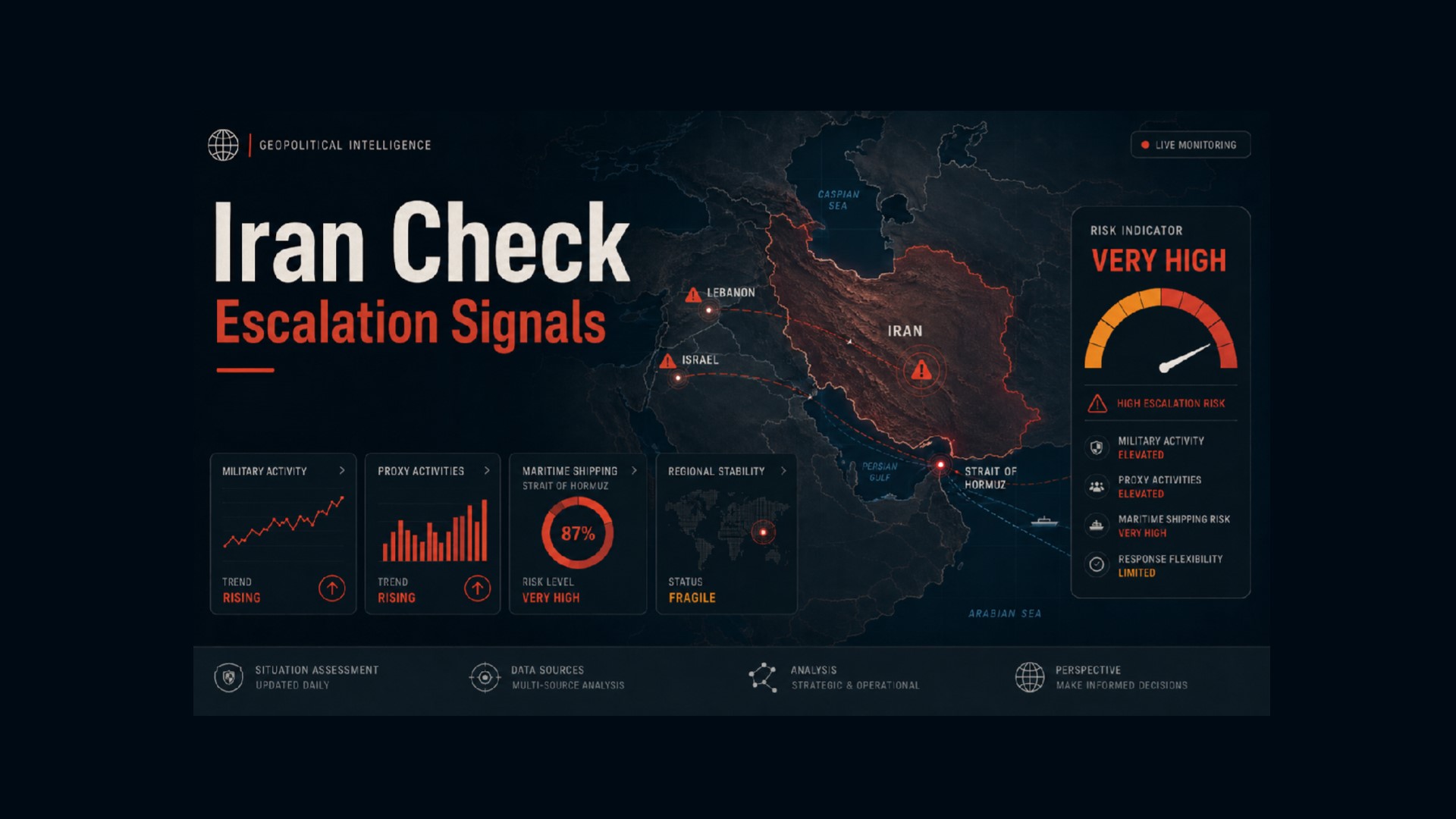
This escalation radar summarizes five relevant signals from June 18, 2026. The focus is on verifiable official statements and events with potential impact on energy prices, supply chains, markets, and regional security.
The agreement is intended to end the war, ease oil sanctions, reopen the Strait of Hormuz, and launch a 60-day negotiation phase.
Iran and Hezbollah link de-escalation to the question of an Israeli withdrawal, while Israel emphasizes its security interests in Lebanon.
The first major tanker movements through the Strait of Hormuz signal easing, but insurers, shipping companies, and energy markets remain cautious.
| Actor | Type | Severity | Status | Source / Verification status | Business impact |
|---|---|---|---|---|---|
| Iran / Masoud Pezeshkian / Iranian government | Signing of the US-Iran agreement and 60-day negotiation phase | High to critical · Level 4/5 | According to AP, the US-Iran agreement was signed by US President Donald Trump and is intended to take effect immediately. It provides for an end to hostilities, a 60-day negotiation phase on Iran’s nuclear program, the reopening of the Strait of Hormuz, and US sanctions waivers allowing Iran to sell oil freely. For Iran, the deal is therefore both a military de-escalation signal and an economic relief channel. | Confirmed by Associated Press, June 17, 2026. Verification status: confirmed for the reported signing, the 60-day negotiation phase, oil sanctions waivers, and the Hormuz component; practical implementation, monitoring, and political durability remain open. | High relevance for sanctions, oil and gas prices, Iran exposure, payment flows, commodity markets, maritime security, political risk premiums, and companies with Middle East or energy exposure. |
| USA / Pete Hegseth / US administration | Warning of renewed military action if Iran breaches the agreement | High to critical · Level 4/5 | According to The Guardian, US Defense Secretary Pete Hegseth said the United States would resume military action and reimpose a blockade if Iran failed to uphold its commitments under the signed agreement. This keeps the deal explicitly tied to hard red lines. The signal is twofold: de-escalation, but not strategic all-clear. | Confirmed by The Guardian, June 18, 2026. Verification status: confirmed for Hegseth’s warning of renewed military action and blockade; unclear which specific Iranian violations Washington would define as triggers. | Increased risk of market volatility, oil price premiums, sanctions risk, defense and security planning pressure, supply-chain exposure, insurance costs, and risks for companies with Gulf, Iran, or Israel exposure. |
| Israel / Benjamin Netanyahu / Israeli government | Political rejection and Lebanon security zone as conflict point | High to critical · Level 4/5 | According to Axios, Israel reacted tensely to Trump’s Iran deal. Netanyahu and his allies see the agreement as a strategic and political setback. The Lebanon complex is especially critical: according to Axios, the MOU includes a ceasefire also for the fighting between Israel and Hezbollah, while a Netanyahu adviser said Israel does not consider itself bound by that part and will not withdraw from southern Lebanon as long as Hezbollah is not disarmed. | Confirmed by Axios, June 18, 2026. Verification status: confirmed for the political tension between Israel and the US administration and for the Lebanon dispute; open whether Washington can push Israel toward concrete withdrawal steps. | High risk for Lebanon, northern Israel, air traffic, infrastructure, evacuations, insurance, banks, regional supply chains, investment decisions, and companies with Israel or Levant exposure. |
| Lebanon / Hezbollah / Lebanese front | Withdrawal demand, sovereignty warning, and ceasefire test | High · Level 3/5 | Hezbollah welcomed the Iran-US agreement but demanded a complete Israeli withdrawal from Lebanese territory. The group said it would not accept any violation of Lebanese sovereignty and remained committed to defending the country until a full withdrawal is achieved and prisoners are returned. Lebanon therefore remains the most important operational test of whether the US-Iran deal can stabilize dynamics beyond the bilateral level. | Confirmed by Anadolu Agency, June 15, 2026. Verification status: confirmed for Hezbollah’s public withdrawal demand, sovereignty warning, and reference to the Lebanese front; the source is from June 15, 2026, but remains relevant for June 18 because the Lebanon complex remains a central conflict point. | High risk for Lebanon, humanitarian conditions, reconstruction, banks, insurance, transport routes, energy supply, political stability, and regional investment decisions. |
| Hormuz / USA / Iran / energy and financial markets | First major tanker movements after deal signing | Critical · Level 5/5 | After the signing of the US-Iran deal, according to Reuters, three Saudi supertankers carrying a total of around six million barrels of crude oil passed through the Strait of Hormuz. Additional vessel movements were also reported, including tankers and an LNG vessel. At the same time, shipping and insurers remain cautious: they are seeking clear security guarantees, mine clearance, and clarity on sanctions, terrorism legislation, and possible tolls. | Confirmed by Reuters, June 18, 2026. Verification status: confirmed for the first major tanker passages, additional vessel movements, and the still cautious insurance and shipping environment; unclear whether traffic volumes will normalize sustainably. | Direct business impact on oil, LNG, tanker routing, marine insurance, Gulf markets, supply-chain costs, inflation risks, freight rates, commodity prices, and risk premiums. |
You are currently viewing a placeholder content from X. To access the actual content, click the button below. Please note that doing so will share data with third-party providers.
More Information