Executive Intelligence. Industrial Risk. Geopolitics.
Strategic Sparring
for Decision-Makers
Risk intelligence across technology, law, markets and power dynamics.


Verdeckte Geschäftsrisiken, strategische Widersprüche und kritische Abhängigkeiten frühzeitig erkennen.
Kostenlose Analyse starten →
Verdeckte Machtstrukturen, Führungsrisiken und organisatorische Blockaden frühzeitig erkennen.
Kostenlose Analyse starten →
Geopolitische Risiken, globale Abhängigkeiten und kritische Lieferkettenrisiken frühzeitig erkennen.
Kostenlose Analyse starten →
Identify hidden business risks, strategic contradictions and critical dependencies at an early stage.
Start Free Analysis →
Identify hidden power structures, leadership risks and organizational blockers at an early stage.
Start Free Analysis →
Identify geopolitical risks, global dependencies and critical supply-chain vulnerabilities at an early stage.
Start Free Analysis →
Verdeckte Geschäftsrisiken, strategische Widersprüche und kritische Abhängigkeiten frühzeitig erkennen.
Kostenlose Analyse starten →
Verdeckte Machtstrukturen, Führungsrisiken und organisatorische Blockaden frühzeitig erkennen.
Kostenlose Analyse starten →
Geopolitische Risiken, globale Abhängigkeiten und kritische Lieferkettenrisiken frühzeitig erkennen.
Kostenlose Analyse starten →
Identify hidden business risks, strategic contradictions and critical dependencies at an early stage.
Start Free Analysis →
Identify hidden power structures, leadership risks and organizational blockers at an early stage.
Start Free Analysis →
Identify geopolitical risks, global dependencies and critical supply-chain vulnerabilities at an early stage.
Start Free Analysis →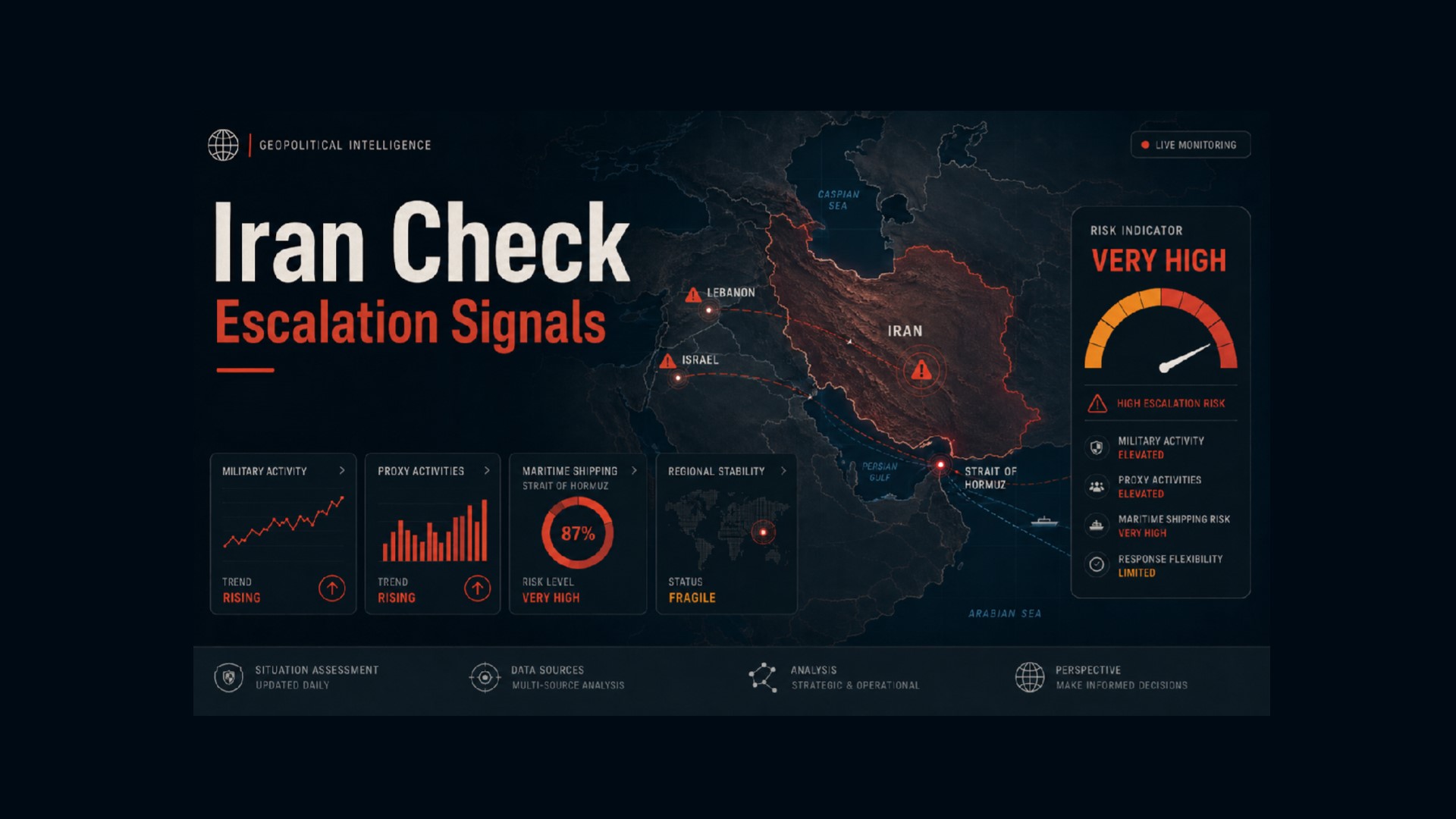
This escalation radar summarises five relevant signals as of August 23, 2026. It focuses on substantiated statements by official bodies, verified events and monitoring sources with potential implications for energy prices, supply chains, markets, maritime security, aviation and regional stability.
Security chief Mohsen Rezaei warns neighbouring states against joining the US economic campaign. Iran could target not only Hormuz, but also alternative oil transport routes in the Persian Gulf. Tehran is therefore extending its deterrence logic beyond the chokepoint itself.
Iran is allowing several tankers carrying Iraqi oil to transit Hormuz. Access to the strait is therefore becoming increasingly selective and politically negotiated. Other exporters do not receive comparable automatic access.
Defence Minister Israel Katz orders an acceleration of Israeli operations in southern Lebanon. At the same time, the IDF launches new waves of strikes. The Lebanon sub-theatre therefore remains highly active.
| Actor | Type | Severity | Status | Source / Verification Status | Business Impact |
|---|---|---|---|---|---|
| Iran / United States / Gulf states / Rezaei / Persian Gulf | Iran extends retaliation threat to alternative oil transport routes | Critical · Level 5/5 | Iran’s new security chief Mohsen Rezaei hardens Tehran’s economic and military deterrence posture on August 23. Neighbouring states that join the US economic campaign against Iran would be regarded as hostile states. Iran could then target their interests and prevent oil from being exported from the Persian Gulf altogether. Rezaei also states that reopening Hormuz is currently not under discussion. Power dynamics: Tehran is shifting its threat from the chokepoint itself to the broader regional energy architecture. Alternative routes could therefore also become part of Iran’s retaliation logic. | Confirmed by NourNews, August 23, 2026 . Verification status: confirmed regarding Rezaei’s threat, his statement that Hormuz will remain closed and his warning to neighbouring states joining the US economic campaign. No specific new attack operation against alternative oil routes has yet been confirmed. Background: Schaaf Media · Middle East Escalation Check from August 22, 2026 . | Critical business impact on Saudi Arabia, the UAE, Qatar, Oman, oil terminals, pipelines, tankers, insurance and energy prices. Companies can no longer assume that bypassing Hormuz automatically removes the military risk. |
| Iraq / Iran / Hormuz / Iraqi oil industry | Iran grants selective special passage through Hormuz to Iraqi oil tankers | Critical · Level 5/5 | Iran has allowed several vessels carrying Iraqi oil to transit Hormuz after repeated requests from Baghdad. The decision provides Iraq with limited relief, while wider energy traffic remains severely restricted. The key issue is the mechanism: passage is increasingly based on bilateral political approval rather than generally open international transit. Power dynamics: Iran thereby gains additional leverage over the export capacity of other Gulf producers. Hormuz is increasingly evolving from an international shipping lane into a politically negotiated access system. | Confirmed by The Business Standard, August 23, 2026 . Verification status: confirmed regarding the special permission for a limited number of Iraqi oil tankers. The scope, potential concessions and duration of the arrangement are not fully known. Further reading: Schaaf Media · Oil as a Weapon: Why Energy Dominates Geopolitics and Markets in 2026 . | Critical business impact on Iraq, OPEC supply capacity, tanker charters, refineries, oil prices and contractual risk. Selective passage also increases exporters’ political dependence and makes long-term supply planning more difficult. |
| Israel / Hezbollah / Iran / southern Lebanon | Israel accelerates systematic destruction of Hezbollah infrastructure | Critical · Level 5/5 | Israeli Defence Minister Israel Katz orders an acceleration on August 23 of efforts to destroy Hezbollah infrastructure in southern Lebanon. In parallel, the IDF launches further waves of strikes in the region. According to Israel, weapons depots, command centres, observation posts, launch sites and underground infrastructure are being destroyed. Israel is also building new operational access routes for troops and military supplies. Power dynamics: Israel is therefore moving beyond limited retaliation towards systematic alteration of the military infrastructure of southern Lebanon. This increases the risk of a larger Hezbollah response and therefore of closer feedback into the Iran conflict. | Confirmed by The Jerusalem Post, August 23, 2026 . Verification status: confirmed regarding Katz’s directive and the accelerated Israeli operations. The classification of individual sites as Hezbollah infrastructure is partly based on Israeli military information. Background: Schaaf Media · Iran’s Proxies: The Hidden Escalation Map of the Middle East . | Critical business impact on Lebanon and Israel, aviation, ports, land logistics, personnel movements, evacuations, insurance and site continuity. Prolonged Israeli destruction of infrastructure also significantly increases reconstruction and investment risk. |
| Saudi Arabia / France / Oman / Europe / Hormuz | Saudi Arabia and France advance structural alternatives to Hormuz | High to critical · Level 4/5 | France and Saudi Arabia are moving the search for lasting alternatives to Hormuz to the government level. Options under review include greater use of Omani ports outside the Gulf, additional or expanded Saudi pipelines and new rail connections. A joint task force on energy and logistics links between the Middle East and Europe is scheduled to meet at ministerial level on Monday. Power dynamics: Western and Gulf states are therefore no longer reacting only tactically to the blockade. They are beginning to reshape regional infrastructure in ways that could reduce Iran’s chokepoint leverage over the longer term. | Confirmed by AP News, August 23, 2026 . Verification status: confirmed regarding the planned talks and the pipeline, port and rail options under review. Some of the projects remain at the planning or financing stage and do not provide a complete short-term alternative to Hormuz. Further reading: Schaaf Media · Hormuz Blockade 2026: Strategies for the Chokepoint Shock . | High to critical business impact on European energy security, Saudi exports, Oman, ports, pipelines, rail logistics, infrastructure investment and supply chains. The conflict is beginning to drive long-term investment decisions about the region’s transport geography. |
| Pakistan / Iran / United States / Asim Munir / regional mediation | Pakistan’s army chief travels to Tehran to continue mediation | High · Level 3/5 | Iran’s Foreign Ministry confirms on August 23 that Pakistan’s army chief, Field Marshal Asim Munir, will travel to Tehran on Monday. The visit is intended to continue Pakistan’s efforts towards peace and regional security. Pakistan is one of the key mediators between Iran and the United States and has already participated in earlier negotiation formats. Power dynamics: While Iran is hardening its threat posture towards Washington and the Gulf states, a diplomatic channel through Islamabad remains open. Notably, the visitor is not only a diplomat but Pakistan’s most powerful military figure. | Confirmed by Reuters, August 23, 2026 . Verification status: confirmed regarding the announced visit and Pakistan’s continuing mediation role. No concrete new negotiating commitments from Iran or the United States have yet been announced. Background: Schaaf Media · Iran Check: 5 Escalation Signals from August 21, 2026 . | High business impact on political risk premiums, oil prices, Hormuz scenarios, Gulf investment and medium- to long-term planning. A substantive mediation breakthrough could significantly change the risk picture; so far, however, only the diplomatic channel is confirmed. |
The most important escalation shift on August 23, 2026 is the expansion of Iran’s deterrence logic beyond Hormuz itself. Tehran is now explicitly threatening that if regional states join the US economic campaign, alternative oil transport routes and their interests could also be targeted. Even bypass routes are therefore becoming part of the strategic conflict.
At the same time, access to Hormuz is becoming increasingly political and selective. Iraq is receiving special passage for individual oil tankers, while a general reopening remains off the table. A system of politically negotiated transit rights is increasingly replacing reliably open international passage.
In parallel, the direct Iran-Hezbollah-Israel nexus is intensifying. Israel is accelerating the systematic destruction of Hezbollah military infrastructure in southern Lebanon while simultaneously expanding its own operational freedom of movement. This increases the risk of another major retaliation cycle.
At the same time, major states are beginning to structurally plan around the consequences of the Hormuz crisis. France and Saudi Arabia are examining pipelines, Omani ports and new rail links, while Pakistan is keeping the diplomatic channel to Tehran open. EASA CZIBs for Iran, Iraq, Jordan, Lebanon, the Persian Gulf and the Gulf of Oman remain active until August 31, 2026; no new tightening was issued on August 23.
The five most important signals for a European and German risk assessment are: Iran’s new threat against neighbouring states and alternative oil transport routes, the selective special passage granted to Iraqi oil tankers through Hormuz, Israel’s accelerated destruction of Hezbollah infrastructure in southern Lebanon, the French-Saudi plans for long-term alternatives to Hormuz, and the announced Tehran visit by Pakistan’s army chief to continue mediation efforts.
Note: This assessment was prepared with the support of our Geo AI. AI can make mistakes. The analysis is intended as a radar for potential escalation signals and does not replace a fully verified intelligence assessment.
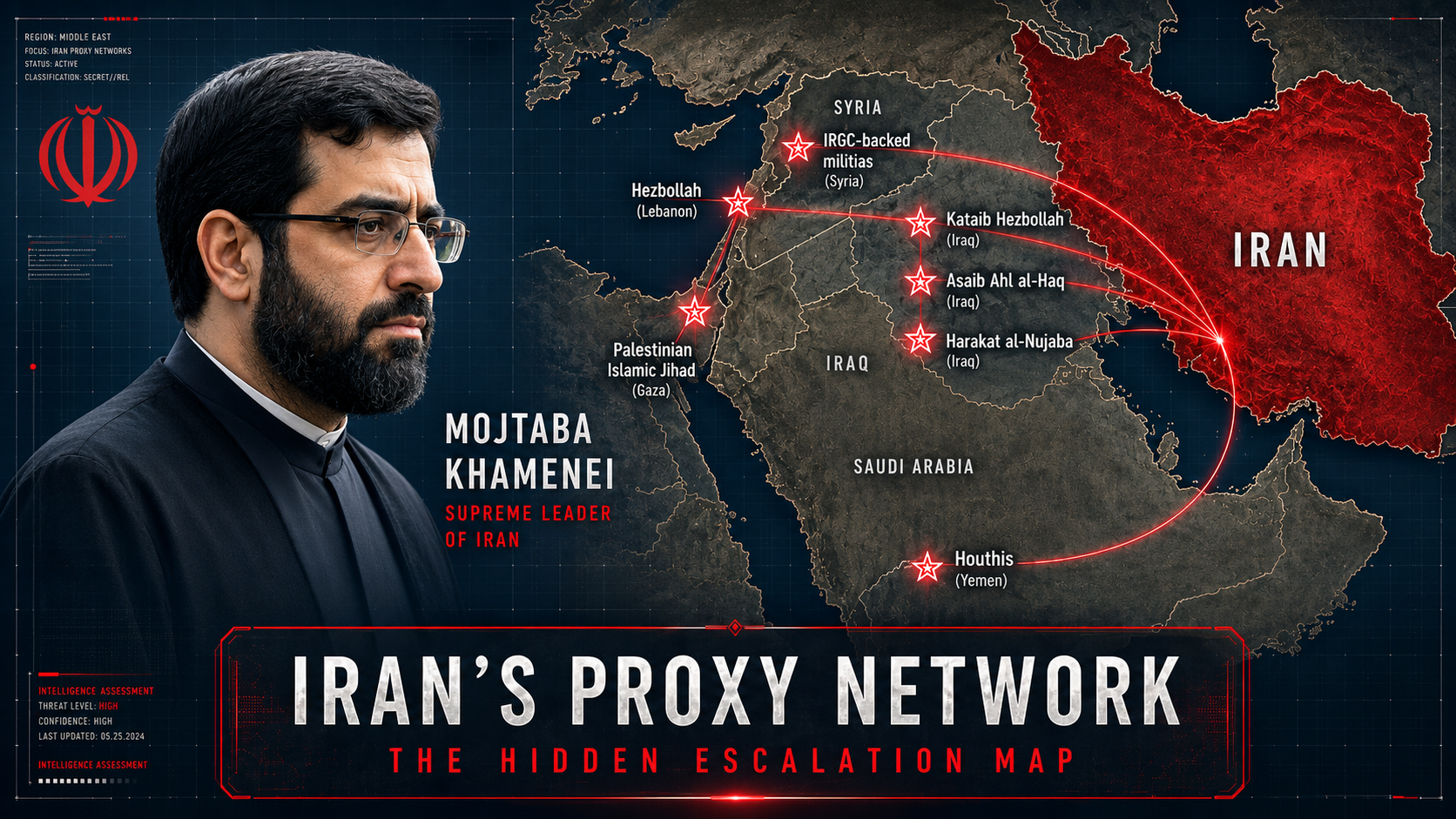
What decision-makers should watch now — before proxy escalation becomes a cost, compliance or supply-chain shock.
This 17-page executive briefing translates Iran’s proxy network into concrete business risks: energy price exposure, maritime chokepoints, war-risk premiums, sanctions, shadow fleets, supply-chain disruption and early-warning indicators for board-level decisions.
You are currently viewing a placeholder content from X. To access the actual content, click the button below. Please note that doing so will share data with third-party providers.
More Information