Executive Intelligence. Industrial Risk. Geopolitics.
Strategic Sparring
for Decision-Makers
Risk intelligence across technology, law, markets and power dynamics.

Verdeckte Geschäftsrisiken, strategische Widersprüche und kritische Abhängigkeiten frühzeitig erkennen.
Kostenlose Analyse starten →
Verdeckte Machtstrukturen, Führungsrisiken und organisatorische Blockaden frühzeitig erkennen.
Kostenlose Analyse starten →
Geopolitische Risiken, globale Abhängigkeiten und kritische Lieferkettenrisiken frühzeitig erkennen.
Kostenlose Analyse starten →
Identify hidden business risks, strategic contradictions and critical dependencies at an early stage.
Start Free Analysis →
Identify hidden power structures, leadership risks and organizational blockers at an early stage.
Start Free Analysis →
Identify geopolitical risks, global dependencies and critical supply-chain vulnerabilities at an early stage.
Start Free Analysis →
Verdeckte Geschäftsrisiken, strategische Widersprüche und kritische Abhängigkeiten frühzeitig erkennen.
Kostenlose Analyse starten →
Verdeckte Machtstrukturen, Führungsrisiken und organisatorische Blockaden frühzeitig erkennen.
Kostenlose Analyse starten →
Geopolitische Risiken, globale Abhängigkeiten und kritische Lieferkettenrisiken frühzeitig erkennen.
Kostenlose Analyse starten →
Identify hidden business risks, strategic contradictions and critical dependencies at an early stage.
Start Free Analysis →
Identify hidden power structures, leadership risks and organizational blockers at an early stage.
Start Free Analysis →
Identify geopolitical risks, global dependencies and critical supply-chain vulnerabilities at an early stage.
Start Free Analysis →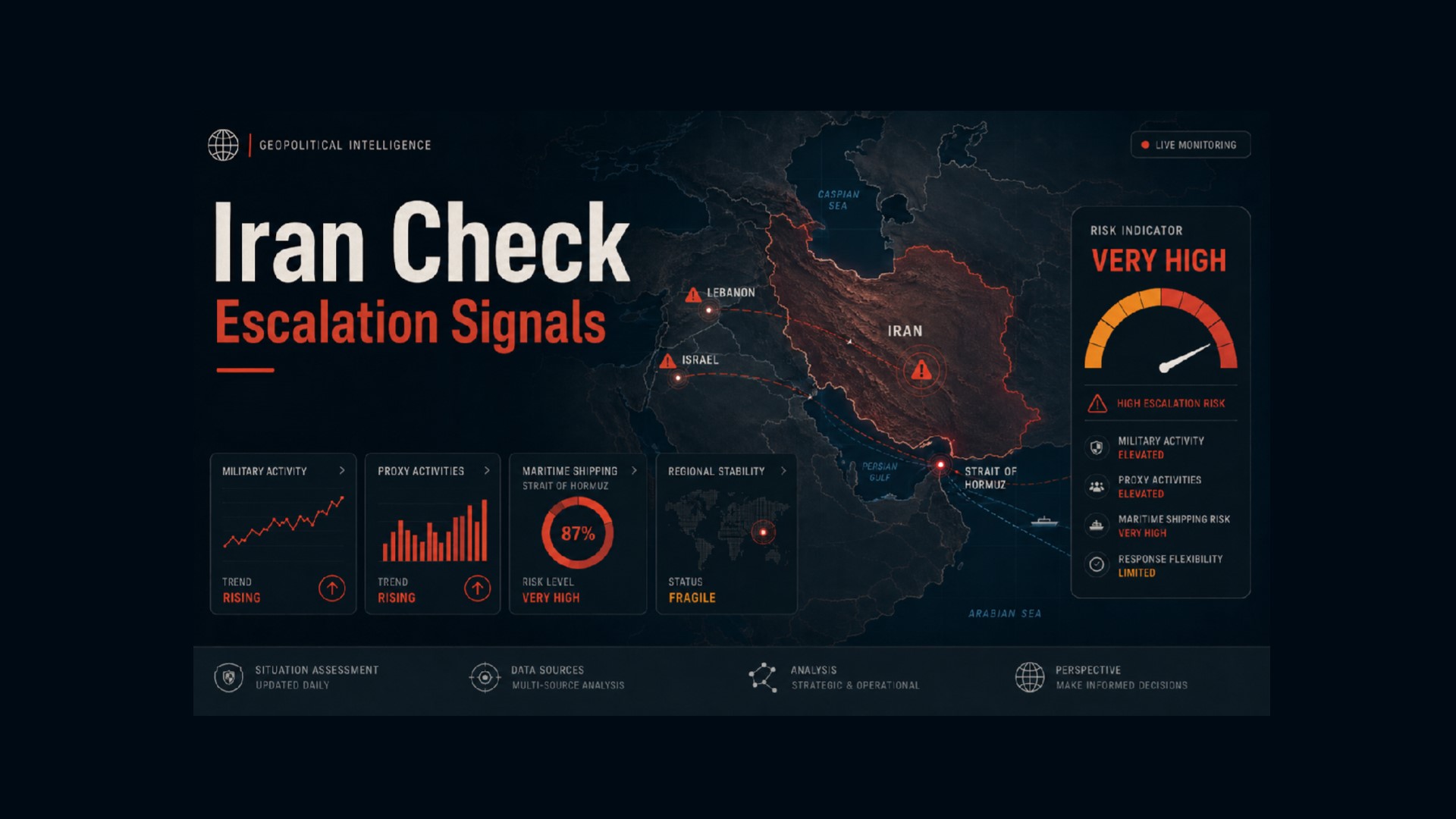
This escalation radar summarizes five relevant signals from June 24, 2026. The focus is on verifiable official statements, confirmed events, and monitoring sources with potential impact on energy prices, supply chains, markets, maritime security, and regional stability.
Oman is setting up temporary routes. This is an easing signal, but not normalization: vessels still depend on risk checks, AIS discipline, and coordinated passage.
Israeli and Lebanese positions show that the ceasefire remains fragile not only militarily, but also politically and emotionally.
The United States, Iran, Israel, and Gulf states are not only negotiating security issues, but also control, face-saving, fees, and regional spheres of influence.
| Actor | Type | Severity | Status | Source / Verification status | Business impact |
|---|---|---|---|---|---|
| Oman / Iran / USA / Hormuz | Temporary shipping routes, no tolls, and controlled passage | Critical · Level 5/5 | Oman is opening two temporary shipping routes north and south of the previous route through the Strait of Hormuz. According to the report, no tolls will be charged. At the same time, the existing traffic separation route is considered unsafe, meaning vessels are being grouped, contacted individually, and guided through after waiting positions in international waters. The signal: Hormuz is formally open, but operationally not yet a normal, freely calculable trade route. | Confirmed by Reuters, June 24, 2026. Verification status: confirmed for temporary routes, no tolls, coordinated passage, and AIS/risk-check requirements; open whether transit conditions will normalize sustainably. | Direct business impact on tanker routing, LNG, oil, shipping companies, marine insurance, supply-chain costs, freight rates, port planning, and companies with Gulf or energy exposure. |
| Israel / Lebanon / Hezbollah / USA | Washington talks, ceasefire, and security narratives | High to critical · Level 4/5 | Ahead of the Washington talks, the Lebanon complex remains the political stress test of the US-Iran process. Israeli and Lebanese officials are not only negotiating security mechanisms, but also sovereignty, deterrence, and domestic credibility. From a human-dynamics perspective, the situation is especially fragile: every side must show strength without being seen as the trigger of a renewed regional relapse. | Confirmed by Al Jazeera, June 23, 2026. Verification status: source is from June 23, 2026, but relevant for June 24 because it describes positions ahead of the Washington talks; the power-dynamics layer is an analytical interpretation based on the reported statements. | Increased risk for Lebanon, northern Israel, evacuations, air traffic, regional supply chains, political predictability, insurance, and companies with Levant or Middle East exposure. |
| USA / Gulf states / Iran | Rubio Gulf trip, toll question, and regional control logic | High to critical · Level 4/5 | US Secretary of State Marco Rubio is stressing to Gulf partners that the Strait of Hormuz must remain toll-free. This is more than a pricing issue: it is about control over a global chokepoint, US credibility with Gulf states, and whether Iran can turn the new easing into economic or military leverage. The power dynamic therefore remains ambivalent: de-escalation is being offered, but mistrust continues to structure every detail. | Confirmed by The Guardian, June 23, 2026. Verification status: source is from June 23, 2026, but relevant for June 24 because it frames Rubio’s Gulf trip, the toll issue, and US security assurances to regional partners. | High relevance for energy prices, political risk premiums, Gulf investments, LNG, oil trade, sanctions risk, maritime fee models, and strategic supply-chain planning. |
| EASA / Iran / Iraq / Lebanon / Gulf region | Airspace risk despite de-escalation and spillover danger | High to critical · Level 4/5 | EASA updated its conflict-zone warning for the Middle East and the Persian Gulf on June 24, 2026 and extended it until July 1, 2026. The affected areas include Iran, Iraq, Israel, Jordan, Lebanon, Oman, Qatar, the UAE, Saudi Arabia, Kuwait, and Bahrain. This shows that even if the maritime situation eases, the regional security architecture remains fragile. Aviation, cargo, insurance, and crisis planning still need to account for military spillover and abrupt restrictions. | Confirmed by EASA Conflict Zone Information Bulletin, June 24, 2026. Verification status: official EU aviation source; confirmed for active warning status, affected airspaces, extension until July 1, 2026, and continuing risk recommendations. | High relevance for air cargo, airlines, insurance, rerouting, delivery times, spare-parts chains, crisis logistics, business travel, and companies with Middle East or Gulf exposure. |
| Hormuz / Windward / AIS and shipping risk | Transit data, AIS risk indicators, and operational chokepoint picture | High to critical · Level 4/5 | Windward Daily Intelligence reports current transit movements through the Strait of Hormuz and points to elevated risk indicators in the Gulf region. Particularly relevant are AIS behavior, dark activity, high-risk indicators, and regional movement patterns. The signal remains: Hormuz is not only a political chokepoint, but an operational area where shipowners, insurers, and charterers must continuously weigh risk against delivery pressure. | Confirmed by Windward Daily Intelligence, June 22–24, 2026. Verification status: maritime OSINT/AIS monitoring source; not a classic single news article, but an ongoing situation picture. Relevant for June 24 because transit and AIS data change daily. | High relevance for oil, LNG, freight rates, marine insurance, transport costs, inventories, energy-intensive industries, logistics, chemicals, industrial production, and European companies. |
You are currently viewing a placeholder content from X. To access the actual content, click the button below. Please note that doing so will share data with third-party providers.
More Information