Executive Intelligence. Industrial Risk. Geopolitics.
Strategic Sparring
for Decision-Makers
Risk intelligence across technology, law, markets and power dynamics.


Verdeckte Geschäftsrisiken, strategische Widersprüche und kritische Abhängigkeiten frühzeitig erkennen.
Kostenlose Analyse starten →
Verdeckte Machtstrukturen, Führungsrisiken und organisatorische Blockaden frühzeitig erkennen.
Kostenlose Analyse starten →
Geopolitische Risiken, globale Abhängigkeiten und kritische Lieferkettenrisiken frühzeitig erkennen.
Kostenlose Analyse starten →
Identify hidden business risks, strategic contradictions and critical dependencies at an early stage.
Start Free Analysis →
Identify hidden power structures, leadership risks and organizational blockers at an early stage.
Start Free Analysis →
Identify geopolitical risks, global dependencies and critical supply-chain vulnerabilities at an early stage.
Start Free Analysis →
Verdeckte Geschäftsrisiken, strategische Widersprüche und kritische Abhängigkeiten frühzeitig erkennen.
Kostenlose Analyse starten →
Verdeckte Machtstrukturen, Führungsrisiken und organisatorische Blockaden frühzeitig erkennen.
Kostenlose Analyse starten →
Geopolitische Risiken, globale Abhängigkeiten und kritische Lieferkettenrisiken frühzeitig erkennen.
Kostenlose Analyse starten →
Identify hidden business risks, strategic contradictions and critical dependencies at an early stage.
Start Free Analysis →
Identify hidden power structures, leadership risks and organizational blockers at an early stage.
Start Free Analysis →
Identify geopolitical risks, global dependencies and critical supply-chain vulnerabilities at an early stage.
Start Free Analysis →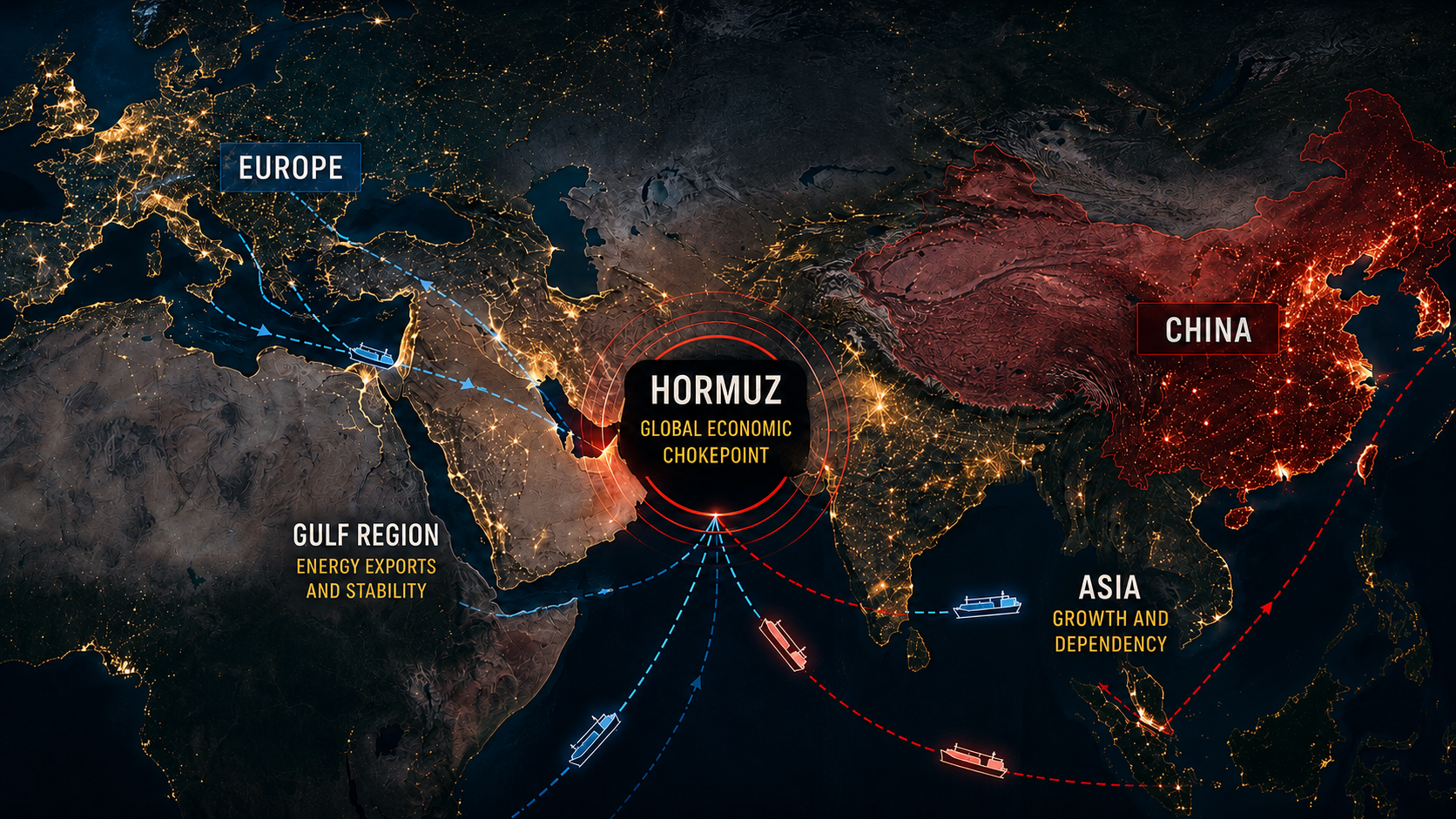
This Chokepoint Check assesses the current pressure on the Strait of Hormuz, the Bab al-Mandab, and critical water, power, port, and energy infrastructure across the Gulf region. The assessment focuses not only on whether a shipping route remains geographically open, but also on whether transport, supply, insurance coverage, and site operations remain operationally viable.
The military pause has not yet normalised commercial traffic.
Only seven vessel transits through the Strait of Hormuz were recorded on Sunday. Traffic therefore remained below ten daily passages even during the provisional pause in direct US-Iranian attacks. Three of the recorded vessels had links to Iran. Some ships also switched off their transponders. The route therefore remains geographically passable but is still barely operationally viable for regular, transparent, and insurable large-scale transport.
Following attacks on Saudi oil infrastructure, traffic has fallen to its lowest level in months.
Only eleven commodity vessels passed through the Bab al-Mandab on Sunday. According to Kpler, this was the lowest daily figure in months. Seven of the eleven vessels were oil tankers. Although individual VLCCs and supertankers carrying Saudi crude continued to transit the strait, the overall volume indicates clear operational caution. The route is not closed, but it is visibly losing reliability and transport capacity.
Saudi Arabia’s Red Sea energy infrastructure has become a direct military target.
The Houthis stated that they had attacked Aramco facilities in Jizan and Yanbu using ballistic missiles, cruise missiles, and drones. Reports indicated that two missiles targeting oil installations in Yanbu were intercepted. Reports of damage to an oil depot in Jizan were not initially fully and independently verified. These attacks target the exact infrastructure Saudi Arabia relies on to bypass Hormuz.
The Houthis stated that they had attacked Saudi Aramco facilities in Yanbu and Jizan using ballistic missiles, cruise missiles, and drones. Two missiles targeting Yanbu were reportedly intercepted. Possible damage to an oil depot in Jizan was also reported.
The attacks target the core Saudi redundancy architecture designed to compensate for disruption at Hormuz. Yanbu is the western terminus of the East-West Pipeline and is therefore strategically important for Saudi exports through the Red Sea. An attack at this level is more systemically significant than an isolated threat against individual vessels.
Companies must prepare for heightened risks to loading, storage, port operations, and export planning. Even intercepted attacks can trigger temporary security shutdowns, inspections, personnel disruptions, and stricter insurance requirements.
Verification status: confirmed for the Houthi attack claim and the reported interceptions near Yanbu. The actual extent of damage in Jizan was not initially fully and independently verified. AP News, July 26, 2026 · Previous-day exception with operational impact on July 27
According to Kpler, only eleven commodity vessels passed through the Bab al-Mandab on Sunday. Seven were oil tankers. Three tankers entered the Red Sea, including two VLCCs. Four vessels exited, including two supertankers carrying a combined total of approximately four million barrels of Saudi crude oil to China.
The strait is not fully closed. However, the fall to eleven passages shows that the Houthi threat and attacks on Saudi energy targets are already changing real transport decisions. Individual transits must not be equated with normal operational capacity.
Lower transit volumes tie up shipping capacity and increase the risk of longer delivery times. Crude oil, refined products, container traffic, and time-sensitive industrial inputs moving between Asia, the Middle East, and Europe are particularly exposed.
Verification status: confirmed for the Kpler-recorded transits on July 26. AIS and tracking data may not fully capture vessels operating with deactivated transponders or concealed military movements. Reuters, July 27, 2026
The United States and Iran suspended direct attacks for a second or third consecutive period. Despite this, commercial traffic through Hormuz remained at a three-week low. The US blockade of Iranian ports remains in place, while discussions continue over easing shipping restrictions.
Political de-escalation has not yet produced operational de-escalation. Shipowners, insurers, and charterers appear to be waiting for reliable rules governing passage, control, blockade enforcement, and liability. The strait therefore remains a politically and militarily controlled corridor.
Energy buyers cannot yet plan for a reliable resumption of regular oil and LNG shipments. Delays, coverage risks, and short-notice routing decisions remain in place.
Verification status: confirmed for the bilateral pause in attacks, ongoing mediation efforts, and the three-week low in commercial traffic. A permanent ceasefire or reopening under normal conditions has not been confirmed. AP News, July 27, 2026
Brent fell by approximately 4.7 percent at one point on Monday to around USD 92 per barrel. WTI declined by approximately five percent to just below USD 85. The move was driven by the pause in direct US-Iranian attacks and hopes for further talks.
The price decline is a relevant political de-escalation signal, but it is not evidence that supply security has been restored. Hormuz remains weakly utilised, while traffic through the Bab al-Mandab is falling following attacks on Saudi oil facilities.
Companies should not interpret lower short-term futures prices as an all-clear for physical procurement, freight, insurance, or delivery times. The market is currently pricing diplomatic optimism faster than operational normalisation.
Verification status: confirmed for the market movement and the bilateral pause in attacks. The sustainability of the price decline depends on the actual restoration of commercial shipping. Reuters, July 27, 2026
EASA continues to maintain active conflict-zone warnings for the Persian Gulf and Gulf of Oman, as well as for Jordan and Lebanon. The warning for the Gulf region was most recently revised on July 22 and remains valid until August 31, 2026.
The regulatory and security environment confirms that the current pause in attacks is not yet being treated as stable aviation de-escalation. Missiles, drones, interception activity, misidentification, and short-notice airspace restrictions remain operational risks.
Airlines and companies must prepare for diversions, longer flight times, higher fuel consumption, and more difficult personnel rotations. This is particularly relevant for sites, project teams, and time-sensitive air cargo across the Gulf region.
Verification status: officially confirmed for the status, revision date, and validity of the EASA bulletins. The warnings represent a risk assessment and do not mean that all listed airspace is fully closed. EASA Conflict Zone Information Bulletins, accessed July 27, 2026
Houthis attack Saudi oil facilities in Yanbu and Jizan.
Ports, loading, security inspections, and vessel planning come under pressure.
Bab al-Mandab transit falls to eleven vessels; Hormuz remains below ten.
Delivery times, risk premiums, and capacity constraints remain elevated.
Bab al-Mandab traffic fell to eleven commodity vessels. Hormuz remained below ten daily passages despite the pause in attacks. Both chokepoints are therefore experiencing significant operational transport disruption simultaneously.
Dual Transit Loss ConfirmedHouthi missiles and drones targeted Aramco facilities in Yanbu and Jizan. Even without a confirmed large-scale outage, Saudi Arabia’s core Red Sea export infrastructure is now directly exposed to military attack.
Strategic Energy Infrastructure Directly TargetedThe primary route and the alternative route remain constrained simultaneously. Oil prices are already reacting strongly to political signals, while the physical shipping and infrastructure environment shows no comparable recovery.
Market Prices Decoupled from Supply SecurityPolitically, the situation has eased slightly compared with July 25, but operationally it has not. The pause in direct US-Iranian attacks has lowered oil prices, yet neither Hormuz nor the Bab al-Mandab is showing a reliable normalisation. At the same time, Yanbu and Jizan, the very Saudi energy and export locations intended to compensate for disruption at Hormuz, have been targeted. The overall operational environment therefore remains critical.
Notice: This assessment was prepared with the support of our Geo AI. AI systems can make mistakes. This analysis serves as a source-based radar for potential escalation signals and does not replace comprehensively verified intelligence, security, insurance, or investment advice. In a dynamic environment, the status, source situation, and risk assessment may change at short notice.
Independent of the subject covered in this article, this separate Executive Briefing provides an in-depth analysis of another critical risk domain affecting European companies.
The 27-page Executive Briefing “Black Swan Risk Mapping for Europe’s Next Mobility and Infrastructure Shock” examines how geopolitical, infrastructural and administrative developments that are currently viewed in isolation could reinforce one another.
Based on the GFDD Framework™, the report shows how these dynamics could affect operational continuity, access to critical resources and the strategic resilience of companies.
The briefing includes a structured systemic-shock analysis and a directly applicable Business Exposure Checklist for CEOs, CFOs, COOs, investors and strategy teams.
You are currently viewing a placeholder content from X. To access the actual content, click the button below. Please note that doing so will share data with third-party providers.
More Information