Executive Intelligence. Industrial Risk. Geopolitics.
Strategic Sparring
for Decision-Makers
Risk intelligence across technology, law, markets and power dynamics.


Verdeckte Geschäftsrisiken, strategische Widersprüche und kritische Abhängigkeiten frühzeitig erkennen.
Kostenlose Analyse starten →
Verdeckte Machtstrukturen, Führungsrisiken und organisatorische Blockaden frühzeitig erkennen.
Kostenlose Analyse starten →
Geopolitische Risiken, globale Abhängigkeiten und kritische Lieferkettenrisiken frühzeitig erkennen.
Kostenlose Analyse starten →
Identify hidden business risks, strategic contradictions and critical dependencies at an early stage.
Start Free Analysis →
Identify hidden power structures, leadership risks and organizational blockers at an early stage.
Start Free Analysis →
Identify geopolitical risks, global dependencies and critical supply-chain vulnerabilities at an early stage.
Start Free Analysis →
Verdeckte Geschäftsrisiken, strategische Widersprüche und kritische Abhängigkeiten frühzeitig erkennen.
Kostenlose Analyse starten →
Verdeckte Machtstrukturen, Führungsrisiken und organisatorische Blockaden frühzeitig erkennen.
Kostenlose Analyse starten →
Geopolitische Risiken, globale Abhängigkeiten und kritische Lieferkettenrisiken frühzeitig erkennen.
Kostenlose Analyse starten →
Identify hidden business risks, strategic contradictions and critical dependencies at an early stage.
Start Free Analysis →
Identify hidden power structures, leadership risks and organizational blockers at an early stage.
Start Free Analysis →
Identify geopolitical risks, global dependencies and critical supply-chain vulnerabilities at an early stage.
Start Free Analysis →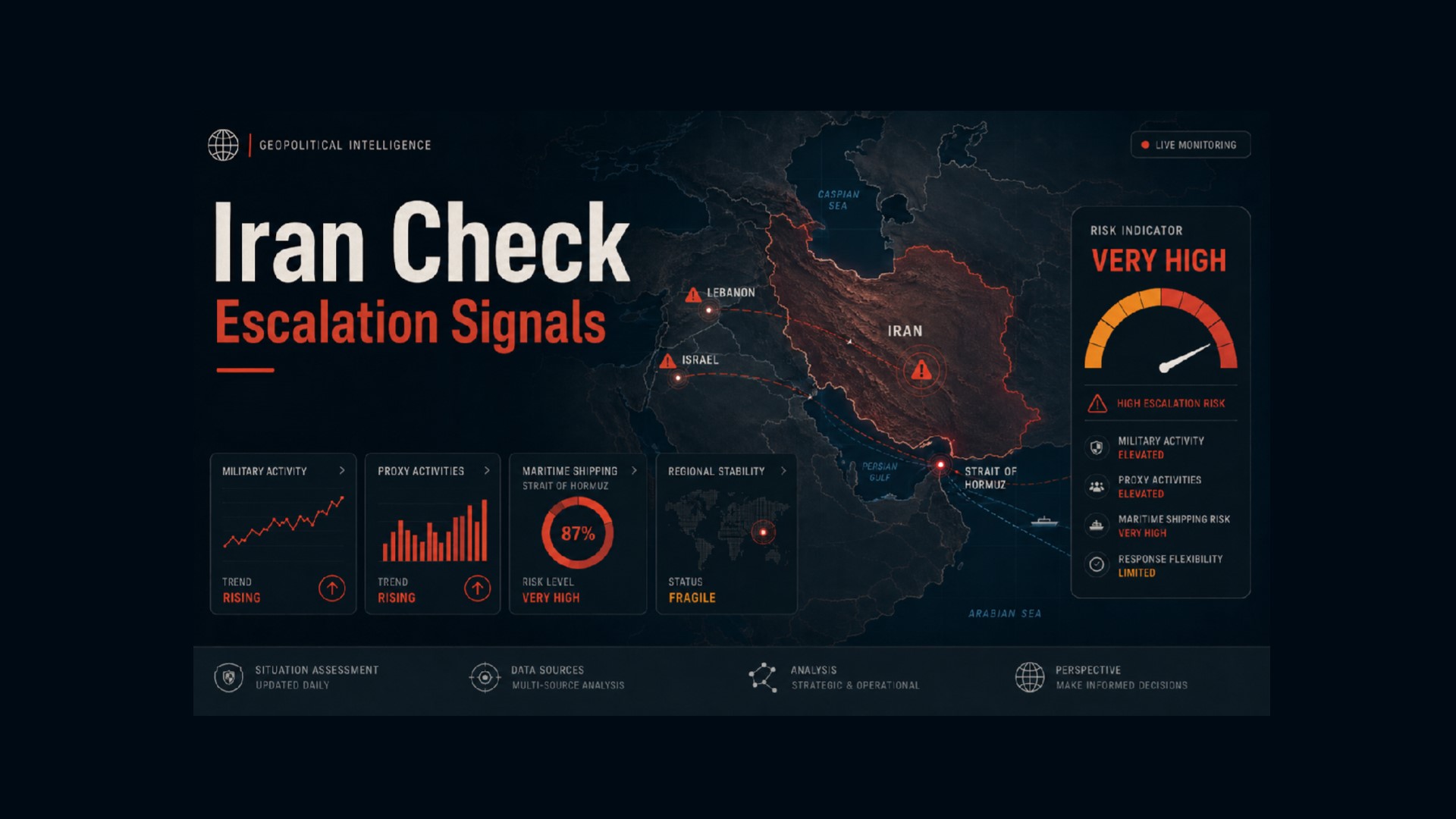
This escalation radar summarizes five relevant signals as of June 30, 2026. The focus is on verifiable statements by official actors, confirmed events and monitoring sources with potential impact on energy prices, supply chains, markets, maritime security and regional stability.
Despite new de-escalation channels, the Strait of Hormuz remains the most critical lever: attacks, routing questions, potential fees and control over safe passage directly affect oil, LNG, freight and insurance.
The United States and Iran are moving toward Doha, but publicly contradict each other on the purpose and format of the talks. This is not a stable peace process, but a power negotiation under pressure.
Israel links withdrawal to Hezbollah’s disarmament. Hezbollah rejects exactly that. This creates a political knot that could prolong Israel’s military presence in southern Lebanon.
| Actor | Type | Severity | Status | Source / verification status | Business impact |
|---|---|---|---|---|---|
| United States / Iran / Doha / Hormuz | Negotiations under escalation pressure and contradictory signals on de-escalation | Critical · Level 5/5 | Reuters reports that U.S. and Iranian representatives are heading toward Doha, while Iran publicly states that no direct talks with the United States are planned. This creates a contradictory signal even before potential talks begin: there is movement toward negotiation, but no reliable political agreement yet. At the same time, mutual accusations over violated understandings and new attacks in the Gulf are weighing on the situation. The underlying power dynamic is clear: Washington wants to demonstrate control and operational capability, while Tehran does not want to appear as if it is yielding. For the operational environment, this means that even if diplomatic channels are opened, the Gulf region remains risky in the short term. | Confirmed by Reuters, June 29, 2026. Verification status: confirmed for the contradictory information on Doha, mutual accusations and the relevance of Hormuz; details of the actual format of the talks remain partly open. | Very high business impact on oil prices, LNG, tanker routing, war-risk premiums, port planning, freight costs, energy procurement, inflation assumptions and short-term scenario planning. |
| Iran / Oman / France / Hormuz | Control over shipping corridors, de-mining capability and maritime power projection | High to critical · Level 4/5 | The Guardian reports that commercial vessels temporarily made very limited use of the southern Omani corridor and that Iran is pushing ships toward a northern corridor approved by Tehran. In addition, it remains unclear who controls security, navigation, fees and mine-clearing in the Strait of Hormuz. The power logic is clear: Iran is trying to turn the military situation into a maritime control position. For companies, this is not merely a diplomacy issue, but an operational supply chain risk. | Confirmed by The Guardian, June 29, 2026. Verification status: confirmed for the reported routing and control questions in the Hormuz area; the scope, duration and concrete costs of possible fee models remain unclear. | Direct impact on ocean freight, tanker insurance, oil and LNG procurement, delivery times, security costs, route planning and companies with exposure to the Gulf, energy or raw materials. |
| Israel / Lebanon / Hezbollah / United States | Israel-Lebanon deal, disarmament demand and risk of political stalemate | High to critical · Level 4/5 | Reuters reports that the Israel-Lebanon agreement links Israel’s withdrawal from southern Lebanon to Hezbollah’s disarmament. This condition is considered extremely difficult to implement: Hezbollah rejects disarmament, while the Lebanese state is hardly in a military or political position to enforce it. The power dynamic: Israel gains political room for a longer security presence, Lebanon carries the implementation burden, and Hezbollah can use its rejection as a resistance narrative. This does not immediately increase every operational supply chain disruption, but it keeps Lebanon open as an escalation arena. | Confirmed by Reuters, June 29, 2026. Verification status: confirmed for the structure of the agreement, the link to Hezbollah’s disarmament and doubts about implementation; the escalation effect is an analytical assessment. | High relevance for Levant risk, northern Israel, Lebanon exposure, evacuation planning, aviation, political risk premiums, insurance and investment decisions in the region. |
| Israel / IDF / Hezbollah / southern Lebanon | Ongoing military operations despite agreement framework | High to critical · Level 4/5 | Sky News reports that Israel says it has destroyed Hezbollah infrastructure in southern Lebanon, including a tunnel containing weapons and launch equipment. Netanyahu stated that Israel would continue to destroy terrorist infrastructure and remove threats to northern communities. At the same time, Hezbollah leader Naim Qassem is reported to have rejected the security agreement as a capitulation to Israel and to have called for continued armed resistance. The power dynamic: neither side is speaking like an actor that has already entered a stable post-war order; both are speaking like actors securing their red lines militarily. | Confirmed by Sky News, June 30, 2026. Verification status: confirmed for Israeli statements on Hezbollah infrastructure and the reported rejection by Naim Qassem; individual operational image and detail claims are not fully independently verified according to the source. | Increased risk for aviation over Lebanon and Israel, business travel, crisis logistics, local security, insurance, evacuation options and short-term disruptions to regional supply chains. |
| EASA / Iran / Iraq / Lebanon / Gulf region | Airspace risk and operational restrictions for aviation and air freight | High to critical · Level 4/5 | The EASA conflict zone warning for the Middle East and the Persian Gulf remains active and is valid until July 1, 2026. EASA recommends that aircraft operators avoid the airspace of Iran, Iraq and Lebanon at all flight levels and exercise increased caution in Bahrain, Kuwait, Israel, Jordan, Qatar, Oman, the UAE and Saudi Arabia. This is the clearest operational point in the radar: even if diplomatic talks are underway, flight routes, air freight, spare parts chains and business travel remain dependent on short-term restrictions and security assessments. | Confirmed by EASA Conflict Zone Information Bulletin 2026-03-R13, revision dated June 24, 2026. Verification status: official EU aviation source; not newly issued on June 30, but still valid and operationally relevant on June 30 until July 1, 2026, unless reviewed earlier. | High relevance for air freight, airlines, insurance, rerouting, delivery times, spare parts chains, crisis logistics, business travel and companies with exposure to the Middle East or the Gulf. |
The central escalation knot on June 30, 2026 lies in the simultaneity of negotiation and coercion. The United States and Iran are moving toward Doha, but both sides continue to use pressure points: Washington through military deterrence, Tehran through Hormuz, maritime control and regional leverage. This means the political situation is not frozen; it is actively being negotiated under escalation pressure.
For companies, the operational situation matters more than the diplomatic headline. The most immediate risk lies in Hormuz, shipping, energy prices, aviation and insurance. The Lebanon complex, by contrast, is primarily a long-term political-military knot: Israel wants security control, Hezbollah wants to preserve armed credibility, and the Lebanese state is caught between obligations it can barely enforce.
The five most important signals for a German business risk picture are: the contradictory Doha situation between the United States and Iran, Iran’s attempt to secure control over Hormuz routes and maritime security rules, the structurally fragile Israel-Lebanon agreement, ongoing Israeli operations against Hezbollah infrastructure, and the still-active EASA warning situation for aviation, air freight and crisis logistics in the Middle East and Gulf region.
Note: This assessment was created with support from our Geo-AI. AI can make mistakes. The analysis is intended as a radar for potential escalation signals and does not replace a fully verified situation assessment.
Identify where the new energy reality may already be eroding margin, liquidity, working capital and ROCE.
Energy costs, maritime chokepoints, compliance pressure and supply-chain fragility are no longer isolated operational issues. They are becoming balance-sheet variables. This board-level intelligence report translates geopolitical energy fragmentation into concrete C-level risk questions, financial exposure logic, 2026–2028 scenarios and immediate action steps.
Spot hidden margin pressure from LNG volatility, infrastructure lock-in and energy cost instability
Assess chokepoint exposure, war-risk premiums, insurability and supply-chain interruption risk
Use the Executive Audit Matrix to challenge blind spots before they become financial damage
Strategic information only. Not financial, legal, tax, energy or investment advice.
You are currently viewing a placeholder content from X. To access the actual content, click the button below. Please note that doing so will share data with third-party providers.
More Information