Executive Intelligence. Industrial Risk. Geopolitics.
Strategic Sparring
for Decision-Makers
Risk intelligence across technology, law, markets and power dynamics.


Verdeckte Geschäftsrisiken, strategische Widersprüche und kritische Abhängigkeiten frühzeitig erkennen.
Kostenlose Analyse starten →
Verdeckte Machtstrukturen, Führungsrisiken und organisatorische Blockaden frühzeitig erkennen.
Kostenlose Analyse starten →
Geopolitische Risiken, globale Abhängigkeiten und kritische Lieferkettenrisiken frühzeitig erkennen.
Kostenlose Analyse starten →
Identify hidden business risks, strategic contradictions and critical dependencies at an early stage.
Start Free Analysis →
Identify hidden power structures, leadership risks and organizational blockers at an early stage.
Start Free Analysis →
Identify geopolitical risks, global dependencies and critical supply-chain vulnerabilities at an early stage.
Start Free Analysis →
Verdeckte Geschäftsrisiken, strategische Widersprüche und kritische Abhängigkeiten frühzeitig erkennen.
Kostenlose Analyse starten →
Verdeckte Machtstrukturen, Führungsrisiken und organisatorische Blockaden frühzeitig erkennen.
Kostenlose Analyse starten →
Geopolitische Risiken, globale Abhängigkeiten und kritische Lieferkettenrisiken frühzeitig erkennen.
Kostenlose Analyse starten →
Identify hidden business risks, strategic contradictions and critical dependencies at an early stage.
Start Free Analysis →
Identify hidden power structures, leadership risks and organizational blockers at an early stage.
Start Free Analysis →
Identify geopolitical risks, global dependencies and critical supply-chain vulnerabilities at an early stage.
Start Free Analysis →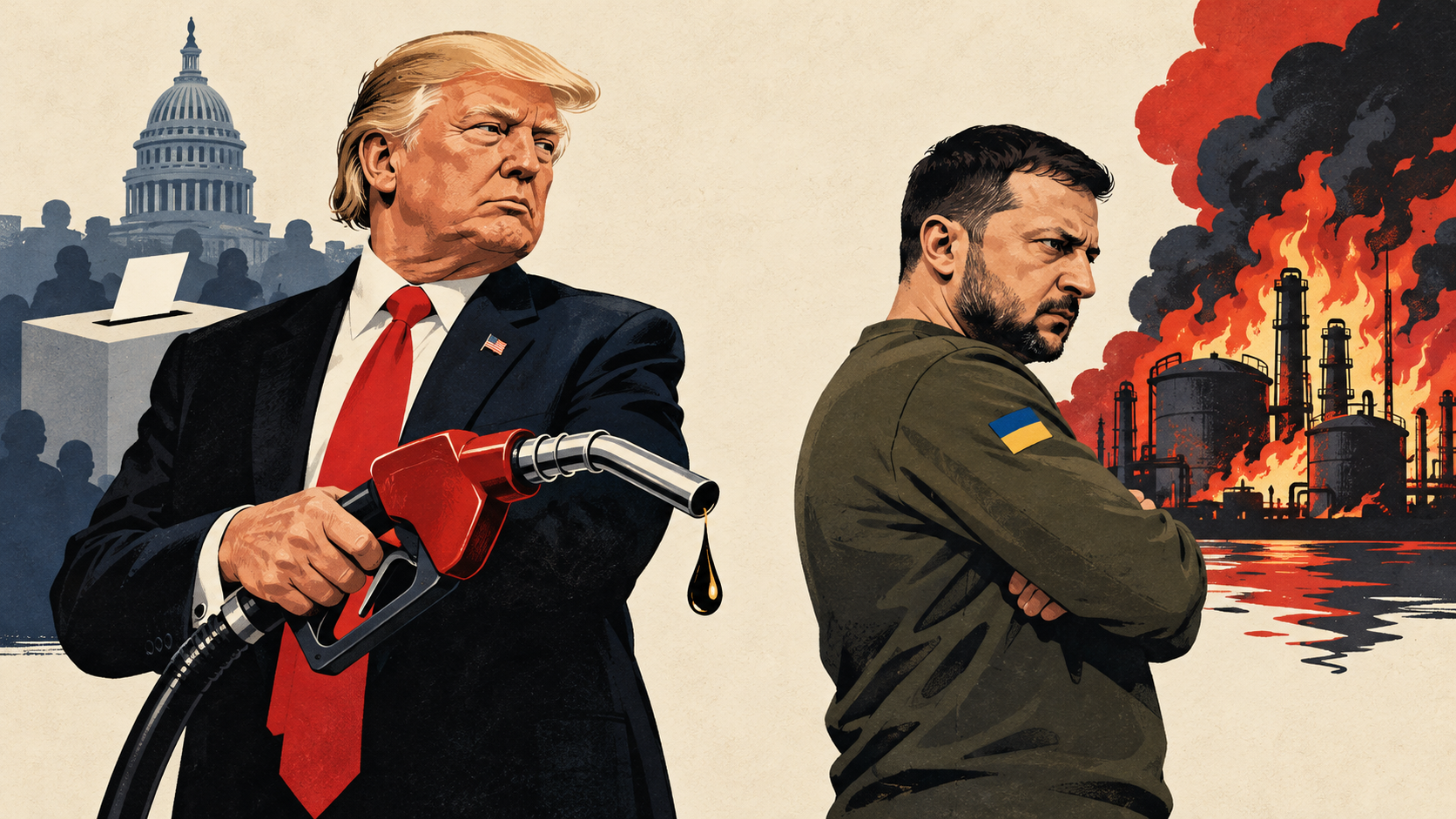
Strategic Risk Intelligence Brief by Global Insight Group.
This analysis is based on the GFDD Framework™ developed by Michaela Schaaf-Hoffelner and is designed for executives, investors and strategic decision-makers.
Updated: October 11, 2026
Ukraine is targeting Russian refineries and fuel infrastructure to weaken Vladimir Putin’s war economy. At the same time, US President Donald Trump is trying to bring diesel prices down ahead of the November 3, 2026 midterm elections. To do so, he suddenly needs more Russian diesel on the global market.
What makes strategic sense from Ukraine’s military perspective is therefore developing into a domestic political problem for Washington. The more pressure Russia’s energy infrastructure comes under, the harder it becomes to calm an already tight global diesel market.
This raises a critical question: Could Ukraine’s successful campaign against Russia’s war economy become a midterm dilemma for Trump?
US diesel prices are at exceptionally high levels. According to Reuters, they have risen by around 70 percent since the start of the US-Israeli war against Iran, reaching approximately $6.28 per gallon.
Diesel affects the economy differently from gasoline. Trucks, agriculture, logistics and many industrial processes depend directly on it. Higher diesel prices therefore do not only increase fuel bills. They feed into transportation and production costs across large parts of the economy.
For Trump, the timing is particularly difficult. The US midterm elections take place on November 3. High energy prices directly affect farmers, trucking companies and other sectors where fuel costs are highly visible and difficult to absorb.
Kyiv is pursuing a different strategic logic. Russian refineries, oil depots and fuel networks support not only the civilian economy but also Russia’s armed forces while generating important export revenues.
Ukrainian drone attacks have repeatedly targeted facilities deep inside Russian territory. In early October, one of the largest attacks on the Moscow region reportedly hit an important fuel depot, while Russian military bloggers also reported a possible attack on the Moscow refinery. Reuters described the strikes as part of Ukraine’s broader strategy to weaken Russia’s fuel infrastructure and war financing.
From Kyiv’s perspective, this economic damage is not an unintended consequence. It is part of the objective.
That is precisely where Ukraine’s strategy begins to conflict with Washington’s priorities.
On October 9, Trump announced after talks with Vladimir Putin that Russia would immediately make more than 300,000 tonnes of diesel available to the US and global markets, with further deliveries expected to follow. At the same time, the United States temporarily eased sanctions affecting Russian fuel exports. The stated objective was to increase supply and reduce diesel prices. Reuters
This creates a striking contradiction.
Ukraine is trying to weaken Russia’s energy sector and war economy, while Trump is simultaneously trying to bring Russian diesel back onto the global market.
According to a US government official cited by Axios, Trump’s agreement with Putin followed repeated US requests for President Volodymyr Zelenskyy to halt attacks on Russian refineries.
Trump is therefore caught between two competing objectives: maintaining economic pressure on Russia while ensuring that enough Russian fuel remains available to help bring global diesel prices down.
The political significance lies in a chain of effects that extends far beyond the military value of individual strikes:
Ukraine attacks refineries → Russia’s fuel sector comes under pressure → the global diesel market remains tight → US diesel prices stay high → Trump faces greater pressure ahead of the midterms → Washington eases restrictions on Russian diesel.
Paradoxically, Ukraine’s strategy to weaken Russia can therefore contribute to conditions that give Moscow greater economic room elsewhere.
Zelenskyy sharply criticised the deal. Speaking to Axios, he argued that easing sanctions benefits Russia without Moscow making any visible concessions toward ending the war.
Germany has also made clear that it intends to maintain sanctions against Russia despite Washington’s shift in policy. Reuters
The Ukraine war is not the only factor driving the problem. The conflict involving Iran has placed additional pressure on global oil and refined fuel markets. Reuters identifies both the Iran conflict and the Russia-Ukraine war as factors contributing to tight diesel supply.
This also helps explain why Trump’s Iran policy is increasingly connected to energy prices. On October 8, Trump said the United States would not launch another attack on Iran before the midterm elections. At the same time, the Pentagon had already instructed CENTCOM to complete preparations for possible further operations. Axios
A major new escalation could push oil and fuel prices even higher.
Ukraine, Russia and Iran are therefore increasingly converging around the same economic bottleneck: global energy and refined fuel supply.
The core conflict is not simply Trump versus Zelenskyy. It is a collision between two different strategic logics.
Ukraine wants to inflict as much damage as possible on Russia’s ability to finance and sustain its war. Trump, by contrast, needs more energy supply and lower prices in the short term.
That is what creates the midterm dilemma: Measures that weaken Russia militarily can simultaneously increase economic and political pressure on Washington.
Diesel is therefore becoming more than an ordinary fuel. It is turning into a geopolitical lever. And the US election calendar is suddenly influencing how much economic pressure Washington is prepared to maintain on Russia.
Author of Global Insight Group Intelligence:
Michaela Schaaf-Hoffelner has more than 35 years of experience in strategic and technical project and product management, particularly in IT, control systems and intralogistics. Through her long-standing work with complex systems, she identifies structural risks and dynamic misalignments at an early stage – risks that are often overlooked in conventional analysis.
Her focus is on making causal relationships and systemic dependencies visible and translating them into concrete strategic advantages for investors and decision-makers. Her analyses combine deep technical systems understanding with geopolitical and economic developments.
GFDD Framework™ and GFDD Diagnostics™ are proprietary analytical concepts developed by Michaela Schaaf-Hoffelner. © 2026 Global Insight Group LLC. All rights reserved.
You are currently viewing a placeholder content from X. To access the actual content, click the button below. Please note that doing so will share data with third-party providers.
More Information