Executive Intelligence. Industrial Risk. Geopolitics.
Strategic Sparring
for Decision-Makers
Risk intelligence across technology, law, markets and power dynamics.


Verdeckte Geschäftsrisiken, strategische Widersprüche und kritische Abhängigkeiten frühzeitig erkennen.
Kostenlose Analyse starten →
Verdeckte Machtstrukturen, Führungsrisiken und organisatorische Blockaden frühzeitig erkennen.
Kostenlose Analyse starten →
Geopolitische Risiken, globale Abhängigkeiten und kritische Lieferkettenrisiken frühzeitig erkennen.
Kostenlose Analyse starten →
Identify hidden business risks, strategic contradictions and critical dependencies at an early stage.
Start Free Analysis →
Identify hidden power structures, leadership risks and organizational blockers at an early stage.
Start Free Analysis →
Identify geopolitical risks, global dependencies and critical supply-chain vulnerabilities at an early stage.
Start Free Analysis →
Verdeckte Geschäftsrisiken, strategische Widersprüche und kritische Abhängigkeiten frühzeitig erkennen.
Kostenlose Analyse starten →
Verdeckte Machtstrukturen, Führungsrisiken und organisatorische Blockaden frühzeitig erkennen.
Kostenlose Analyse starten →
Geopolitische Risiken, globale Abhängigkeiten und kritische Lieferkettenrisiken frühzeitig erkennen.
Kostenlose Analyse starten →
Identify hidden business risks, strategic contradictions and critical dependencies at an early stage.
Start Free Analysis →
Identify hidden power structures, leadership risks and organizational blockers at an early stage.
Start Free Analysis →
Identify geopolitical risks, global dependencies and critical supply-chain vulnerabilities at an early stage.
Start Free Analysis →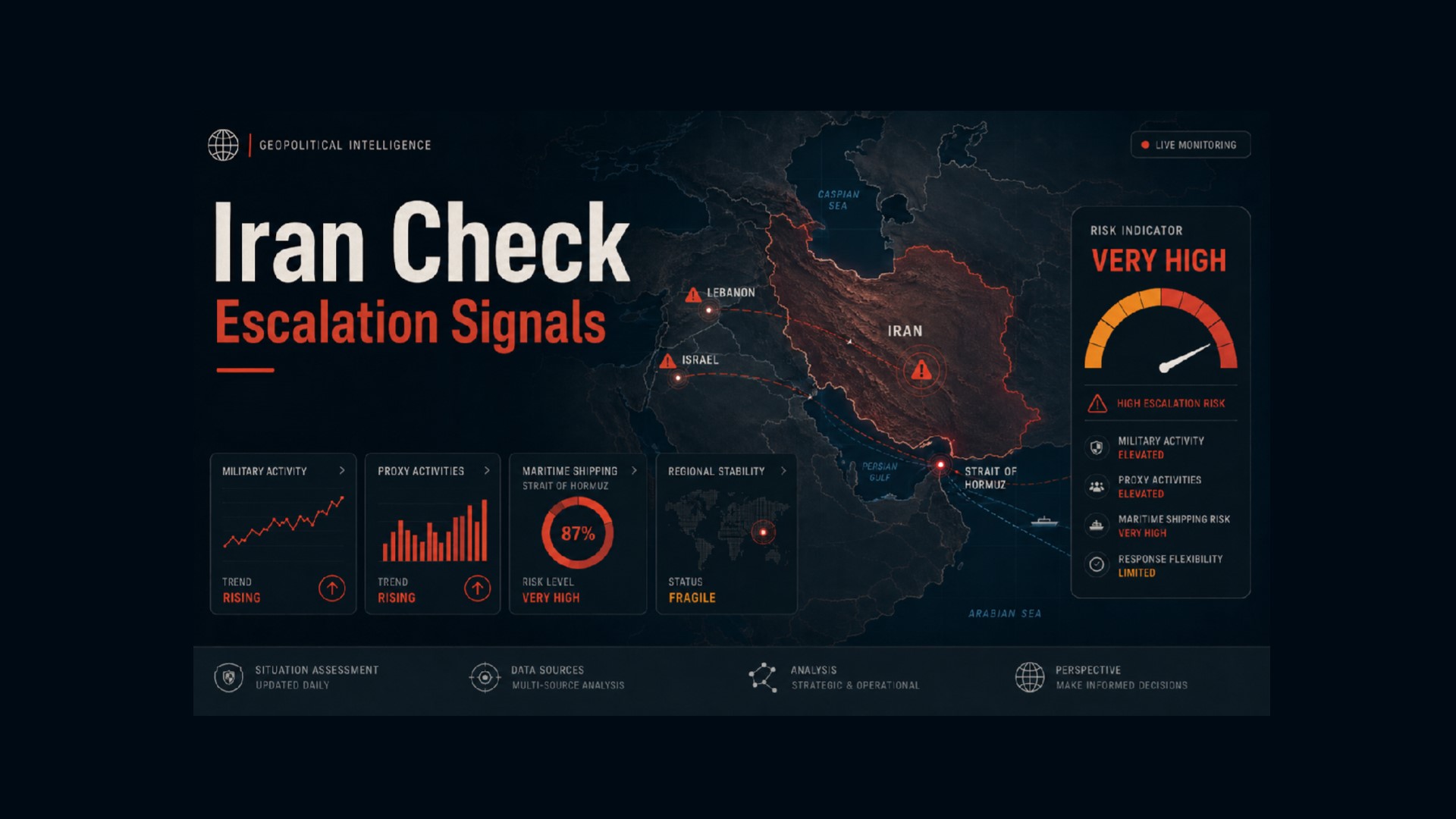
This escalation radar summarizes five relevant signals as of October 22, 2026. The focus is on verifiable statements by official sources, confirmed events and monitoring data with potential implications for energy prices, supply chains, markets, maritime security, aviation and regional stability.
Netanyahu calls for the Iranian threat to be eliminated, while Katz threatens a strike “at full force”. Dozens of Israeli fighter jets and tanker aircraft simultaneously fly toward the Iranian border.
Four vessels are said to be burning following Iranian attacks, while three others reportedly struck mines west of Hormuz. The IRGC threatens Washington with a broader regional response.
An attack on King Fahd Airport causes deaths and injuries, while drone debris at the Shaybah oil field kills two more people. Washington subsequently reduces its diplomatic presence.
| Actor | Type | Severity | Status | Source / Verification | Business Impact |
|---|---|---|---|---|---|
| Israel / Iran / United States | Israel threatens major strike on Iran and demonstrates operational reach | Critical · Level 5/5 | The Israel-Iran front is escalating significantly again. Prime Minister Netanyahu says on October 21 that Iran’s leadership has not learned its lesson. He states that the objective is to eliminate the Iranian threat once and for all. Defence Minister Katz simultaneously warns Tehran that Israel is prepared to strike Iran “at full force” if it attacks. In parallel, dozens of Israeli fighter jets and tanker aircraft fly over Syria and Iraq toward the Iranian border. The aircraft turn back before entering Iranian airspace. Israel informs Washington in advance and describes the operation as an exercise and show of force. The flight profile, however, resembles that of a potential strike on Iran. An actual strike order has not been confirmed. Power dynamics: Israel is combining an explicit deterrence threat with a visible demonstration of operational reach. | Confirmed by Times of Israel / Reuters, October 21, 2026 . Verification status: confirmed for the Israeli threats, the flight of Israeli fighter and tanker aircraft toward Iran and Israel’s description of the mission as an exercise and deterrence signal. It has not been confirmed that a specific strike is immediately imminent. Background: Schaaf Media · Iran War: How the West Is Losing Its Dominance . | Critical business impact on Iran, Israel, Gulf states, energy, aviation, shipping, insurance and investment planning. The key issue is the combination of political threat and demonstrated military reach. A false alarm or Iranian misinterpretation could trigger a rapid response. |
| Iran / IRGC / United States / Hormuz / Persian Gulf | IRGC reports seven vessels affected and threatens U.S. bases | Critical · Level 5/5 | Maritime escalation reaches a new threshold on October 22. The IRGC says four vessels in the northern Persian Gulf were monitored, then attacked simultaneously and set on fire. Tehran accuses them of illegal oil transfers. Three other vessels are said to have struck sea mines west of the Strait of Hormuz. Their identities, flags and crews are initially not disclosed. Even more significant: The IRGC warns U.S. forces that further provocations could trigger a broader Iranian response against American bases in the region. Power dynamics: Iran is once again clearly linking maritime enforcement with a direct regional threat against U.S. bases. | Confirmed by Reuters, October 22, 2026 . Verification status: partially confirmed. Confirmed are the official IRGC statements and the threat against U.S. bases. Neither all seven incidents nor the claimed mine involvement have yet been independently confirmed. Further analysis: Schaaf Media · Strait of Hormuz Blockade 2026: Protecting Margins and Supply Chains in the Chokepoint Shock . | Critical business impact on tankers, oil, LNG, marine insurance, crew safety, U.S. military sites and delivery times. Particularly relevant: A connection between attacks on vessels and potential strikes on U.S. bases could rapidly expand the escalation from the maritime domain across the wider Gulf region. |
| Houthis / Saudi Arabia / United States / Dammam / Shaybah | New deadly attacks lead to withdrawal of U.S. embassy personnel | Critical · Level 5/5 | The security situation in Saudi Arabia is worsening again. King Fahd International Airport near Dammam is attacked. Saudi Arabia’s aviation authority reports one fatality and eight injuries. At the same time, a drone is intercepted over Aramco’s Shaybah oil field. Falling debris kills two foreign workers and injures two others. According to the Saudi Energy Ministry, operations at the field continue. Washington responds with a significant security measure: non-essential personnel and family members are instructed to leave Saudi Arabia. Other U.S. diplomatic missions in the Gulf region are also being reduced. Power dynamics: The attacks are now generating direct diplomatic and site-security consequences. | Confirmed by Reuters, October 22, 2026 . Verification status: confirmed for the U.S. withdrawal order, Saudi casualties and the worsening regional security situation. Responsibility for individual attacks has not been independently confirmed in every case. Background: Schaaf Media · Middle East Escalation Check – October 21, 2026 . | Critical business impact on Saudi Arabia, aviation, Aramco, oil, expatriates, business travel, insurance and site continuity. The withdrawal of U.S. personnel is a strong signal that Washington is not viewing this as a series of isolated attacks, but as a structurally deteriorating security environment. |
| Yemen / Houthis / Taiz / Marib / Saudi coalition | Yemen government reports 835 strikes within 24 hours | Critical · Level 5/5 | The ground and air offensive against the Houthis is being sharply intensified. Yemen’s armed forces say that as part of “Dawn of Yemen” they conducted 835 strikes within just 24 hours. The operation reportedly involved fighter aircraft, drones, artillery, rocket launchers and sniper units. Around 285 Houthi fighters and commanders were reportedly killed or wounded. Around 190 vehicles, weapons platforms and drones were reportedly destroyed or damaged. In Taiz, Houthi advances are said to have been repelled. Further operations are also under way west of Marib. Power dynamics: The government is attempting to disrupt Houthi supply lines and freedom of movement across several fronts simultaneously. | Current regional source: Yemen Monitor, October 22, 2026 . Verification status: partially confirmed. Confirmed is the official statement by Yemen’s armed forces. Casualty figures, destroyed equipment and all claimed tactical successes have not been independently verified. Further analysis: Schaaf Media · Iran’s Proxies: The Hidden Escalation Map of the Middle East . | Critical business impact on Yemen, Bab el-Mandeb, Red Sea, ports, energy, humanitarian logistics and insurance. A further expansion of the offensive raises the risk that fighting could again move closer to coastal and transport corridors. |
| United States / Iran / Shadow Fleet / Europe / Singapore / UAE | United States targets Iranian shadow-fleet network through service providers | High to Critical · Level 4/5 | Washington is expanding economic pressure on Iran’s remaining trade routes. As part of “Operation Economic Outcast”, the U.S. Treasury sanctions a Panama- and Greece-based legal and corporate network. Also targeted are shipping agents in Singapore and the UAE, as well as several cargo vessels. Washington accuses them of moving Iranian oil, petrochemicals and steel through front companies and shadow-fleet structures. Particularly relevant: FinCEN is examining possible relationships between a Greek bank and Iranian actors. Treasury also warns that non-U.S. companies and financial institutions may be exposed to secondary sanctions. Power dynamics: The conflict is shifting more strongly toward international service providers, banks and logistics companies. | Published on October 21 and immediately effective on October 22: U.S. Department of the Treasury, October 21, 2026 . Verification status: confirmed. The sanctions, affected companies, vessels and investigative measures are officially published. Further analysis: Schaaf Media · Iran War: How the West Is Losing Its Dominance . | High to critical business impact on banks, shipping companies, commodity trading, insurance, compliance, Singapore, UAE and European service providers. The risk is increasingly shifting from direct business with Iran toward indirect business relationships and service-provider chains. |
The most strategically important development on October 22, 2026 is the simultaneous escalation of Israel-Iran and Iran-U.S. deterrence. Netanyahu calls for the Iranian threat to be eliminated once and for all. Defence Minister Katz threatens Tehran with a strike “at full force”. At the same time, the Israeli Air Force demonstrates its operational reach with fighter jets and tanker aircraft flying toward the Iranian border. No concrete strike order, however, has been confirmed.
In parallel, the maritime situation is escalating. The IRGC reports seven affected vessels. Four are said to have been deliberately attacked, while three others reportedly struck mines. Even more important is the new threat: further U.S. activity could, according to the IRGC, trigger a broader Iranian response against American regional bases.
At the same time, Saudi Arabia’s security situation is continuing to deteriorate. King Fahd Airport is attacked. At the Shaybah oil field, two people are killed by falling drone debris. Washington responds by withdrawing non-essential embassy personnel and family members. The risk has therefore reached a new diplomatic and operational threshold.
Yemen is also escalating significantly. Government forces report 835 strikes within just 24 hours. Around 285 Houthis are said to have been killed or wounded. At the same time, Washington is expanding economic pressure on Iran’s shadow fleet. New measures target international law firms, shipping agents, banking relationships and cargo vessels. The mandatory alliance review shows no new Iranian membership, partner or observer status as of October 22. Saudi Arabia and Jordan, however, are deepening institutional coordination and emphasizing maritime security in Hormuz and Bab el-Mandeb. EASA continues to maintain active advisories for Iran, Saudi Arabia, the Persian Gulf/Gulf of Oman, Iraq, Lebanon and Yemen; no new revision was identified on October 22.
The five most important signals for a European risk assessment are: Israel’s new threat of attack against Iran combined with a demonstration of military reach by fighter jets and tanker aircraft toward the Iranian border, the IRGC’s claims of seven affected vessels as well as its explicit threat of a broader response against U.S. bases, the renewed deadly attacks on Saudi aviation and energy targets followed by the withdrawal of U.S. embassy personnel, Yemen’s massive counteroffensive with 835 reported strikes within 24 hours and fighting in Taiz and Marib, and the expansion of the U.S. sanctions strategy to international shadow-fleet service providers, banking relationships and logistics companies.
Note: This assessment was prepared with support from our Geo-AI. AI can make mistakes. The analysis is intended as a radar for potential escalation signals and does not replace a fully verified intelligence assessment.
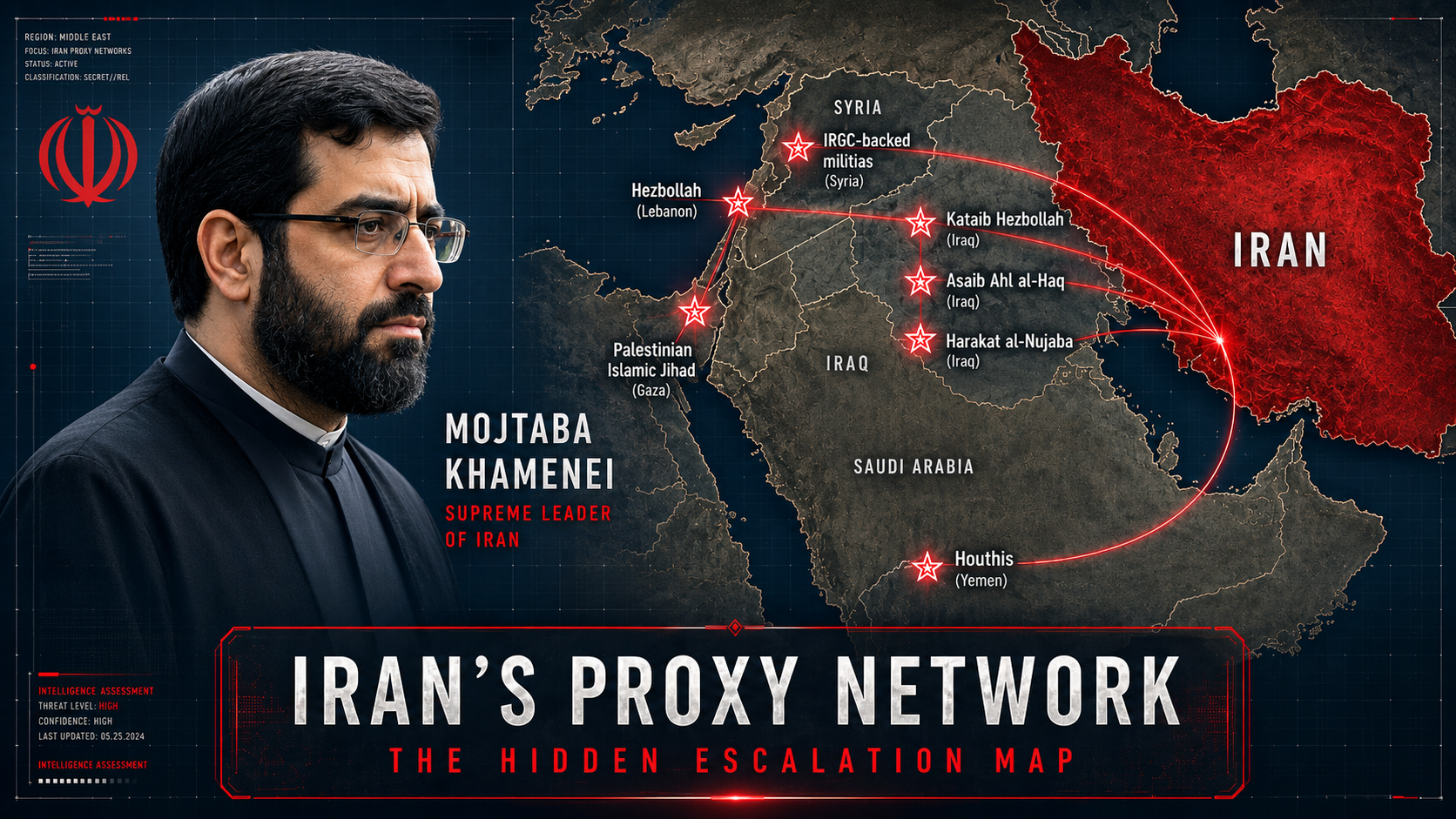
What decision-makers should watch now — before proxy escalation becomes a cost, compliance or supply-chain shock.
This 17-page executive briefing translates Iran’s proxy network into concrete business risks: energy price exposure, maritime chokepoints, war-risk premiums, sanctions, shadow fleets, supply-chain disruption and early-warning indicators for board-level decisions.
You are currently viewing a placeholder content from X. To access the actual content, click the button below. Please note that doing so will share data with third-party providers.
More Information