Executive Intelligence. Industrial Risk. Geopolitics.
Strategic Sparring
for Decision-Makers
Risk intelligence across technology, law, markets and power dynamics.


Verdeckte Geschäftsrisiken, strategische Widersprüche und kritische Abhängigkeiten frühzeitig erkennen.
Kostenlose Analyse starten →
Verdeckte Machtstrukturen, Führungsrisiken und organisatorische Blockaden frühzeitig erkennen.
Kostenlose Analyse starten →
Geopolitische Risiken, globale Abhängigkeiten und kritische Lieferkettenrisiken frühzeitig erkennen.
Kostenlose Analyse starten →
Identify hidden business risks, strategic contradictions and critical dependencies at an early stage.
Start Free Analysis →
Identify hidden power structures, leadership risks and organizational blockers at an early stage.
Start Free Analysis →
Identify geopolitical risks, global dependencies and critical supply-chain vulnerabilities at an early stage.
Start Free Analysis →
Verdeckte Geschäftsrisiken, strategische Widersprüche und kritische Abhängigkeiten frühzeitig erkennen.
Kostenlose Analyse starten →
Verdeckte Machtstrukturen, Führungsrisiken und organisatorische Blockaden frühzeitig erkennen.
Kostenlose Analyse starten →
Geopolitische Risiken, globale Abhängigkeiten und kritische Lieferkettenrisiken frühzeitig erkennen.
Kostenlose Analyse starten →
Identify hidden business risks, strategic contradictions and critical dependencies at an early stage.
Start Free Analysis →
Identify hidden power structures, leadership risks and organizational blockers at an early stage.
Start Free Analysis →
Identify geopolitical risks, global dependencies and critical supply-chain vulnerabilities at an early stage.
Start Free Analysis →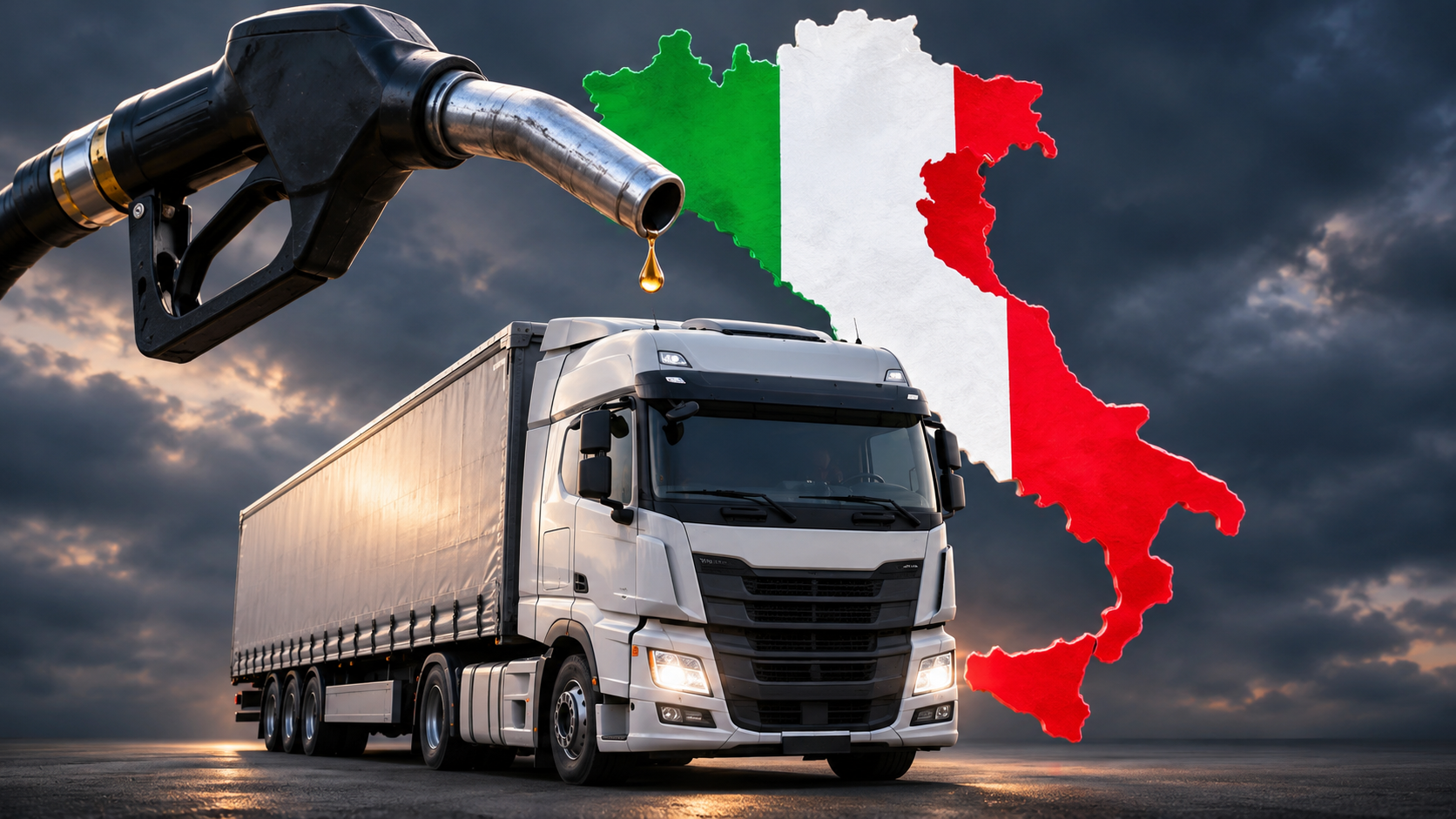
Updated: November 11, 2026
Strategic Risk Intelligence Brief by Global Insight Group.
This analysis is based on the GFDD Framework™ developed by Michaela Schaaf-Hoffelner and is designed for executives, investors and strategic decision-makers.
Empty fuel stations, blocked highways, suspended production and food deliveries failing to reach supermarkets. What happened in southern Italy in mid-October 2026 may have gone largely unnoticed by many people in Germany and Austria. Yet within days, the region experienced a supply crisis that extended far beyond a conventional transport strike.
While international attention remained focused on the Iran war and the Strait of Hormuz, the economic consequences of the energy crisis were becoming painfully tangible in Italy. Truck drivers protested against soaring diesel prices, while farmers demonstrated over rising fuel and fertilizer costs. At the same time, separate labor disputes disrupted regional fuel distribution.
The result was a dangerous chain reaction. Not because Italy had suddenly run out of goods, but because those goods could no longer reach their destinations. The immediate crisis eased by late October, but against the backdrop of today’s unstable geopolitical environment, one critical question remains: How little would it take for a similar supply crisis to happen again elsewhere in Europe?
From mid-October, protests involving truck drivers and farmers spread across several southern Italian regions. Puglia, Calabria, Campania, Sicily and Basilicata were among the hardest hit. Trucks blocked or obstructed major roads and logistics hubs, while farmers took to the streets with their tractors to protest against rising operating costs.
As early as October 15, Italian news agency ANSA reported that fuel stations in Calabria, Basilicata and Puglia had run out of fuel. Long queues formed at stations that still had petrol or diesel available.
The protests intensified over the following days. Delivery vehicles could no longer transport goods according to schedule, food remained stranded in warehouses, and supermarkets increasingly reported empty shelves.
According to Reuters, two regional airports in Calabria were also experiencing aviation fuel supply problems by October 21. What had begun as an economically motivated protest movement had evolved into a regional supply disruption.
The underlying causes went much deeper than a single strike. The Iran war had driven international energy prices sharply higher. According to the Associated Press, diesel prices in Italy were approximately one-third higher than before the war began.
For transport operators, such an increase translates directly into higher operating costs. Smaller logistics companies are particularly vulnerable when existing transport contracts do not allow them to pass on sudden fuel price increases in full.
The situation was even more complex for farmers. On October 14, approximately 5,000 farmers demonstrated in Bari, according to the Italian agricultural association Coldiretti Puglia. They protested against rising agricultural diesel, fertilizer and water costs, alongside declining incomes and mounting financial pressures.
This meant that several cost increases were hitting the same sector simultaneously. Agricultural machinery depends on diesel, many fertilizers depend on natural gas as both a feedstock and an energy source, and harvested crops must subsequently be transported to processors and markets.
One distinction is essential: The sharp rise in fertilizer prices was a documented driver of the farmers’ protests. However, this does not establish that southern Italy was experiencing a widespread physical shortage of fertilizers.
Italy’s crisis was intensified by several disruptions occurring independently of one another. Alongside the transport protests, an industrial dispute emerged around the former Ilva steelworks in Taranto.
Demonstrators blocked access to a nearby Eni refinery that supplies fuel stations across several southern Italian regions. According to Reuters, more than 50 of the approximately 300 fuel stations supplied by the refinery had already run out of fuel by October 13.
This created a particularly critical situation. While transport companies were protesting against the rising cost of fuel, the regional distribution of that same fuel was being disrupted.
That is precisely what makes the Italian events so revealing. A supply crisis can emerge even when goods and raw materials remain physically available. What matters is whether refineries, roads, logistics hubs and transport operators can continue functioning as an interconnected system.
When several critical components fail simultaneously, the consequences can become far more severe than those of any individual disruption.
The vulnerability of industrial production to transport disruptions became particularly visible in the food industry.
On October 20, Reuters reported that Italian pasta manufacturer Rummo had been forced to suspend production because essential raw material deliveries had failed to arrive. La Molisana also reported significant production constraints and had to rely on existing inventories.
The situation was even more serious for buffalo mozzarella producers in Campania. According to the Associated Press, approximately one million liters of buffalo milk could not be processed in a single day. The industry association estimated economic losses of around €3 million within just 24 hours.
The consequences are particularly severe for perishable products. Delayed deliveries cannot simply be rescheduled indefinitely. Milk, fruit, vegetables and other fresh products lose quality or become unusable.
The crisis demonstrated how quickly a logistics breakdown can affect industrial production, agricultural incomes and food availability.
The connection between southern Italy’s supply disruptions and the Iran war runs primarily through international energy prices.
Before the war, approximately 20 million barrels of crude oil and petroleum products passed through the Strait of Hormuz every day, according to the International Energy Agency (IEA). That represented roughly one-fifth of global oil consumption.
Following the outbreak of war in late February 2026, international energy and transport flows were severely disrupted. Diesel, aviation fuel and liquefied natural gas were among the products particularly affected at various stages of the conflict.
The consequences were not limited to countries importing oil directly from the Gulf region. Crude oil and refined petroleum products are traded internationally. When significant supply volumes are disrupted, prices also change in markets that obtain their energy from other regions.
This explains how a conflict thousands of kilometers away could undermine the economic viability of Italian transport operators and agricultural businesses.
However, attributing all of Italy’s supply disruptions directly to the Strait of Hormuz would be misleading. Higher energy prices increased economic pressure, while the actual interruptions to deliveries resulted from protests, blockades and additional local labor disputes.
The geopolitical shock collided with existing economic and logistical vulnerabilities. It was the interaction between these pressures that made the crisis so dangerous.
Concerns about further disruption to European agriculture are not unfounded. Nitrogen fertilizers are particularly closely linked to natural gas markets because ammonia, a key feedstock, is produced through an energy-intensive industrial process.
A development reported in November illustrates how serious the situation has become.
On November 4, Reuters reported that European ammonia and fertilizer producer AGF Nitrogen had already reduced production and was considering further shutdowns. High natural gas prices and weak demand were cited as the main reasons.
The economic implications are concerning. Rising gas prices make fertilizer production more expensive. At the same time, farmers may reduce purchases when fertilizer becomes economically difficult to justify. This puts pressure on both agricultural producers and fertilizer manufacturers.
Not every price increase leads to a physical shortage. However, when manufacturers shut down production capacity, elevated prices can eventually translate into genuine supply constraints.
For Europe’s food production, this represents a risk whose full consequences may not become apparent until much later.
The major protests in southern Italy subsided toward the end of October. As of November 10, there was no confirmed recurrence of a widespread diesel supply crisis in the region. However, the underlying vulnerabilities had not disappeared.
On November 10, Reuters reported that oil prices had continued to decline following signals of a possible de-escalation in the Iran conflict. Brent crude temporarily fell below $90 per barrel, although attacks and uncertainty surrounding the Strait of Hormuz persisted.
This illustrates how quickly expectations in energy markets can shift. Falling oil prices may offer businesses temporary relief, but they do not guarantee permanently lower diesel prices or uninterrupted access to fuels and fertilizers.
Austria and Germany are exposed to the same international pricing mechanisms. However, a comparable supply crisis would require additional pressures, such as widespread transport disruptions, regional distribution bottlenecks or severe constraints on industrial production capacity.
An imminent repetition of the Italian crisis cannot be predicted with confidence. Nevertheless, the possibility of similar disruptions under unfavorable conditions is a realistic conclusion.
The events of October 2026 were more than a regional protest movement. They demonstrated how quickly economic pressures can reinforce one another across multiple industries.
High energy prices placed transport operators and farmers under financial pressure. Protests interrupted the movement of goods. Separate labor disputes disrupted fuel distribution. Eventually, food manufacturers were forced to scale back production, while perishable goods could no longer be processed or delivered on time.
What is particularly striking is that none of this required a complete collapse of Italy’s energy supply. It was enough for several critical functions to be disrupted simultaneously.
Europe avoided a prolonged regional supply crisis in October. The full consequences of blockades lasting several weeks cannot be quantified. Nevertheless, the production shutdowns, economic losses and empty fuel stations demonstrate that the damage was already substantial.
The critical question is therefore not simply whether Europe has enough diesel, natural gas or fertilizer. It is how long European supply systems can continue functioning when geopolitical crises, economic pressures and logistical disruptions occur at the same time.
Southern Italy has demonstrated that this is no longer a purely theoretical question.
Iran War and Oil Price Shock: Who Wins and Who Really Loses?
Why is Europe economically vulnerable to the Iran war despite receiving relatively little oil directly through the Strait of Hormuz? This analysis examines energy dependencies, alternative supply routes and the uneven economic consequences of the oil price shock for industries and global markets.
Lagarde Signals Relief: Why Hormuz Remains a Business Risk Despite the ECB’s Message
A reassuring monetary policy outlook does not eliminate operational supply chain risks. This article explores how disruptions around the Strait of Hormuz can continue to affect energy prices, freight costs, insurance premiums and delivery reliability across European industries.
Oil as a Weapon: Why Energy Dominates Geopolitics and Markets in 2026
How has energy become an instrument of geopolitical power? This analysis examines the relationship between oil markets, international conflicts, strategic dependencies and the growing exposure of businesses to politically driven energy disruptions.
Iran Conflict & Oil Prices: Hormuz, Supply Chains and Escalation Risks
Follow the evolving risks surrounding Iran, the Strait of Hormuz and international energy markets. This continuously updated Iran Check hub connects geopolitical escalation signals with potential consequences for shipping, energy security and global supply chains.
Author of Global Insight Group Intelligence:
Michaela Schaaf-Hoffelner has more than 35 years of experience in strategic and technical project and product management, particularly in IT, control systems and intralogistics. Through her long-standing work with complex systems, she identifies structural risks and dynamic misalignments at an early stage – risks that are often overlooked in conventional analysis.
Her focus is on making causal relationships and systemic dependencies visible and translating them into concrete strategic advantages for investors and decision-makers. Her analyses combine deep technical systems understanding with geopolitical and economic developments.
GFDD Framework™ and GFDD Diagnostics™ are proprietary analytical concepts developed by Michaela Schaaf-Hoffelner. © 2026 Global Insight Group LLC. All rights reserved.
You are currently viewing a placeholder content from X. To access the actual content, click the button below. Please note that doing so will share data with third-party providers.
More Information