Executive Intelligence. Industrial Risk. Geopolitics.
Strategic Sparring
for Decision-Makers
Risk intelligence across technology, law, markets and power dynamics.

Verdeckte Geschäftsrisiken, strategische Widersprüche und kritische Abhängigkeiten frühzeitig erkennen.
Kostenlose Analyse starten →
Verdeckte Machtstrukturen, Führungsrisiken und organisatorische Blockaden frühzeitig erkennen.
Kostenlose Analyse starten →
Geopolitische Risiken, globale Abhängigkeiten und kritische Lieferkettenrisiken frühzeitig erkennen.
Kostenlose Analyse starten →
Identify hidden business risks, strategic contradictions and critical dependencies at an early stage.
Start Free Analysis →
Identify hidden power structures, leadership risks and organizational blockers at an early stage.
Start Free Analysis →
Identify geopolitical risks, global dependencies and critical supply-chain vulnerabilities at an early stage.
Start Free Analysis →
Verdeckte Geschäftsrisiken, strategische Widersprüche und kritische Abhängigkeiten frühzeitig erkennen.
Kostenlose Analyse starten →
Verdeckte Machtstrukturen, Führungsrisiken und organisatorische Blockaden frühzeitig erkennen.
Kostenlose Analyse starten →
Geopolitische Risiken, globale Abhängigkeiten und kritische Lieferkettenrisiken frühzeitig erkennen.
Kostenlose Analyse starten →
Identify hidden business risks, strategic contradictions and critical dependencies at an early stage.
Start Free Analysis →
Identify hidden power structures, leadership risks and organizational blockers at an early stage.
Start Free Analysis →
Identify geopolitical risks, global dependencies and critical supply-chain vulnerabilities at an early stage.
Start Free Analysis →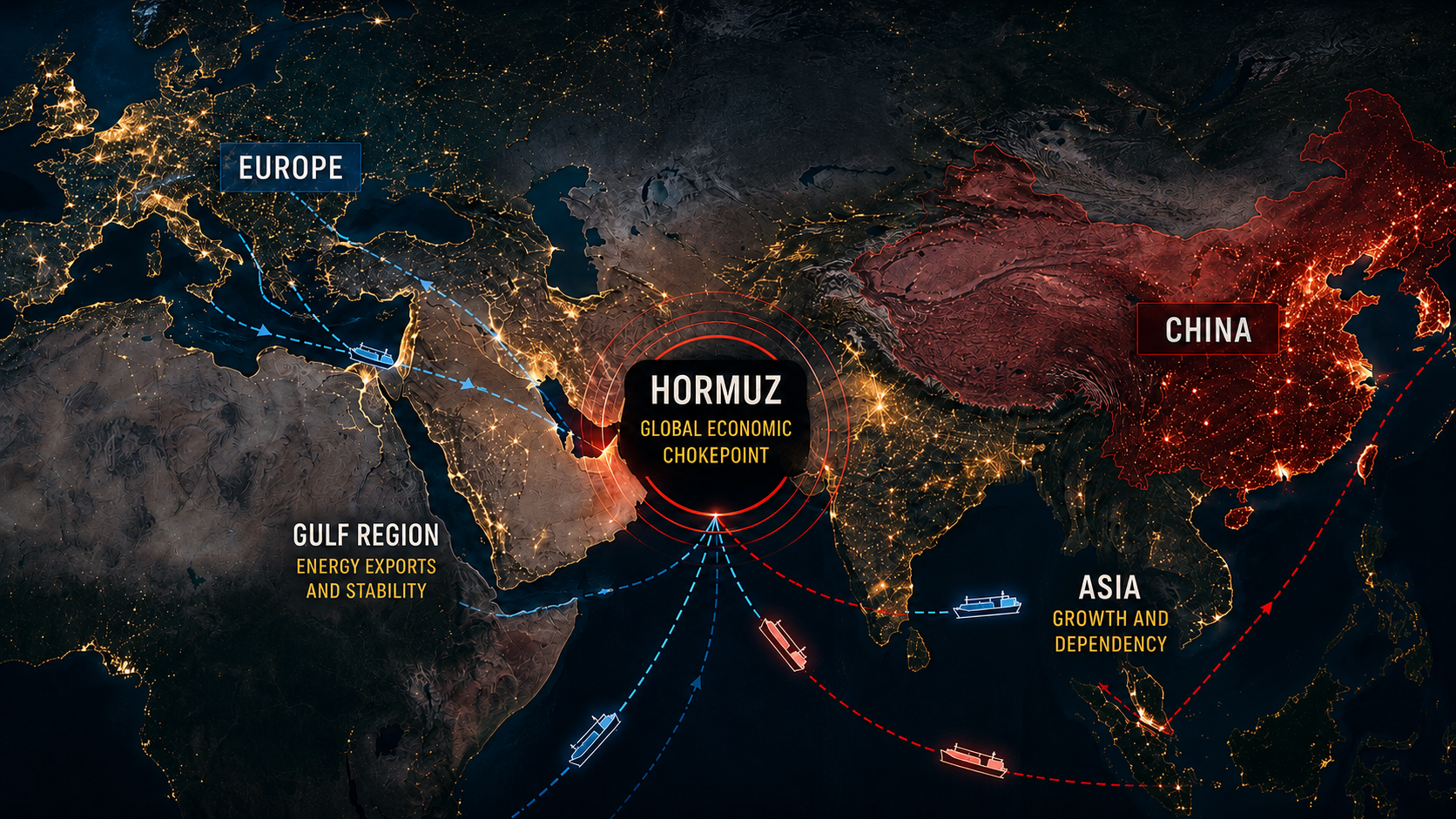
This Chokepoint Check assesses current pressure on the Strait of Hormuz, Bab al-Mandab and the Gulf region’s critical water, power, port and energy infrastructure. The key question is not only whether a route remains geographically open, but whether transport, insurance coverage, energy supply and site operations remain operationally viable.
Two new attacks on ADNOC vessels confirm that a geographically open strait still does not constitute a secure commercial route.
Nine merchant vessels transited Hormuz on Thursday, compared with an August average of twelve. At the same time, ADNOC reported attacks on two of its vessels. The UAE holds Iran responsible. Tehran, meanwhile, claims control over the strait, while Washington says it can maintain its port blockade indefinitely.
The Houthi attacks are now being met with a more permanent international security structure for the Red Sea and Bab al-Mandab.
Saudi Arabia’s Multinational Maritime Defense Coalition completed key preparations for its command structure on August 14. Thirteen states are already formal members, while representatives from 39 countries participated in the planning process. The first deputy commander is expected to come from Pakistan.
No sufficiently confirmed new daily signal has emerged for fixed Gulf infrastructure, but structural vulnerability remains high.
Kuwait in particular remains entirely dependent on Hormuz and has no export pipeline capable of bypassing the strait. KPC describes the current situation as the most severe oil-sector crisis since Iraq’s invasion in 1990. No sufficiently confirmed new physical damage to fixed Gulf facilities was identified for August 14.
ADNOC confirmed attacks on two of its vessels while they were transiting Hormuz on Thursday evening. No injuries were reported and the situation aboard the vessels was brought under control.
The UAE holds Iran responsible and describes the incidents as a renewed threat to commercial shipping. These are already repeated attacks on ADNOC-linked vessels within a short period.
Even vessels linked to a major Gulf exporter remain directly exposed. Insurability, crew risk, charter costs and the reliability of UAE exports therefore remain under significant pressure.
Verification Status: confirmed for the attacks and absence of injuries by ADNOC and UAE authorities. Attribution to Iran comes from the UAE government. WAM / Emirates News Agency, 14.08.2026 · SchaafMedia: Chokepoint Check – Hormuz, Trade Routes & Supply Chain Risks
US Defense Secretary Pete Hegseth said the Navy could sustain the blockade of Iranian ports practically indefinitely by rotating its vessels. Iran, meanwhile, claims control and management authority over Hormuz.
Both sides are signalling not withdrawal, but persistent claims of control. The maritime confrontation is evolving from a temporary crisis measure into a longer-term strategic pressure structure.
Companies can no longer assume a rapid return to pre-war operating conditions. Long-term procurement, freight and insurance alternatives are becoming increasingly important.
Verification Status: confirmed for the public positions of both sides. Nine visible merchant vessels transited Hormuz on Thursday, still below the August average. Reuters, 14.08.2026 · SchaafMedia: Hormuz Blockade 2026 – Strategy in the Chokepoint Shock
The Multinational Maritime Defense Coalition is beginning to integrate personnel into command, naval and intelligence structures. Thirteen states are formal members and Pakistan will provide the first deputy commander.
The alliance is focused on the Red Sea, Bab al-Mandab and the Gulf of Aden. The maritime response to the Houthi threat is therefore becoming more institutionalised and multinational.
Coordinated protection could improve predictability over the medium term. In the short term, however, the coalition demonstrates that governments themselves expect sustained attack pressure on critical trade routes.
Verification Status: confirmed by statements from the Saudi Ministry of Defense. The next phase is intended to establish operational readiness. Arab News, 14.08.2026 · SchaafMedia: Iran War – How the West Is Losing Its Dominance
The USS George Washington has taken a westward course from the Asia-Pacific region and was confirmed in the Strait of Malacca. It is expected to relieve the USS Abraham Lincoln, which has already been deployed for an unusually long period.
The deployment enables Washington to maintain its carrier presence in the Middle East despite prolonged deployment cycles. It is consistent with statements that the Iran blockade could be sustained for an extended period if necessary.
The US Navy is visibly preparing for a longer operational phase. This reduces the short-term risk of an abrupt US withdrawal, but increases the likelihood of prolonged military tension around key trade routes.
Verification Status: confirmed for the USS George Washington’s movement towards the Indian Ocean. A final operational plan to replace the Lincoln has not yet been officially confirmed. Associated Press via Arab News, 14.08.2026
Refiners in South Korea, Japan and Taiwan purchased additional US crude cargoes, while Indian state refiners are also seeking new volumes. US exports to Asia reached 2.35 million barrels per day in July.
The Hormuz disruption is already changing real procurement patterns. Asia is no longer simply waiting for a reopening, but is developing alternative supply chains outside the Gulf.
Longer transport routes increase tonne-miles, tanker demand and procurement costs. US crude is simultaneously gaining strategic importance, while dependence on short-notice Atlantic cargoes is rising.
Verification Status: confirmed for concrete US crude purchases by several Asian refiners. The development represents an operational procurement response to the continuing Hormuz disruption. Reuters, 14.08.2026 · SchaafMedia: Oil as a Weapon – Energy and Geopolitics in 2026
ADNOC vessels are hit while Hormuz remains militarily controlled and heavily constrained.
Shipping companies, refiners and governments build protection, rerouting and alternative procurement structures.
Asian buyers source more oil from the United States while Gulf exports remain difficult to plan reliably.
Tonne-miles, tanker demand, freight costs and strategic dependencies are changing structurally.
Two more ADNOC vessels are attacked, Hormuz remains heavily constrained and the United States is signalling a long-term blockade.
Repeated attacks plus persistent military controlNo sufficiently confirmed new attack on a fixed Gulf facility was identified for August 14. Earlier damage and the complete Hormuz dependence of individual states nevertheless continue to have an impact.
No new daily signal · structural disruption risk remains highThe United States and regional governments are building persistent maritime military structures, while Asian oil buyers are already geographically shifting procurement.
Security crisis is reshaping military architecture and global energy flowsEscalation continues to dominate clearly. Compared with August 12, the decisive development is less a single major attack than the structural consolidation of the conflict. Iran and the United States maintain competing claims of control over Hormuz, Washington is deploying additional carrier capacity and Saudi Arabia is building a multinational security structure for the Red Sea. At the same time, Asian buyers are already changing their actual oil supply chains. The crisis is therefore becoming more persistent both militarily and economically.
Note: This assessment was produced with support from our Geo-AI. AI can make mistakes. The analysis is intended as a source-based radar for potential escalation signals and does not replace fully verified intelligence, security, insurance or investment advice. In rapidly evolving situations, status, source availability and risk assessments may change at short notice.
Independent of the subject covered in this article, this separate Executive Briefing provides an in-depth analysis of another critical risk domain affecting European companies.
The 27-page Executive Briefing “Black Swan Risk Mapping for Europe’s Next Mobility and Infrastructure Shock” examines how geopolitical, infrastructural and administrative developments that are currently viewed in isolation could reinforce one another.
Based on the GFDD Framework™, the report shows how these dynamics could affect operational continuity, access to critical resources and the strategic resilience of companies.
The briefing includes a structured systemic-shock analysis and a directly applicable Business Exposure Checklist for CEOs, CFOs, COOs, investors and strategy teams.
You are currently viewing a placeholder content from X. To access the actual content, click the button below. Please note that doing so will share data with third-party providers.
More Information