Executive Intelligence. Industrial Risk. Geopolitics.
Strategic Sparring
for Decision-Makers
Risk intelligence across technology, law, markets and power dynamics.

Verdeckte Geschäftsrisiken, strategische Widersprüche und kritische Abhängigkeiten frühzeitig erkennen.
Kostenlose Analyse starten →
Verdeckte Machtstrukturen, Führungsrisiken und organisatorische Blockaden frühzeitig erkennen.
Kostenlose Analyse starten →
Geopolitische Risiken, globale Abhängigkeiten und kritische Lieferkettenrisiken frühzeitig erkennen.
Kostenlose Analyse starten →
Identify hidden business risks, strategic contradictions and critical dependencies at an early stage.
Start Free Analysis →
Identify hidden power structures, leadership risks and organizational blockers at an early stage.
Start Free Analysis →
Identify geopolitical risks, global dependencies and critical supply-chain vulnerabilities at an early stage.
Start Free Analysis →
Verdeckte Geschäftsrisiken, strategische Widersprüche und kritische Abhängigkeiten frühzeitig erkennen.
Kostenlose Analyse starten →
Verdeckte Machtstrukturen, Führungsrisiken und organisatorische Blockaden frühzeitig erkennen.
Kostenlose Analyse starten →
Geopolitische Risiken, globale Abhängigkeiten und kritische Lieferkettenrisiken frühzeitig erkennen.
Kostenlose Analyse starten →
Identify hidden business risks, strategic contradictions and critical dependencies at an early stage.
Start Free Analysis →
Identify hidden power structures, leadership risks and organizational blockers at an early stage.
Start Free Analysis →
Identify geopolitical risks, global dependencies and critical supply-chain vulnerabilities at an early stage.
Start Free Analysis →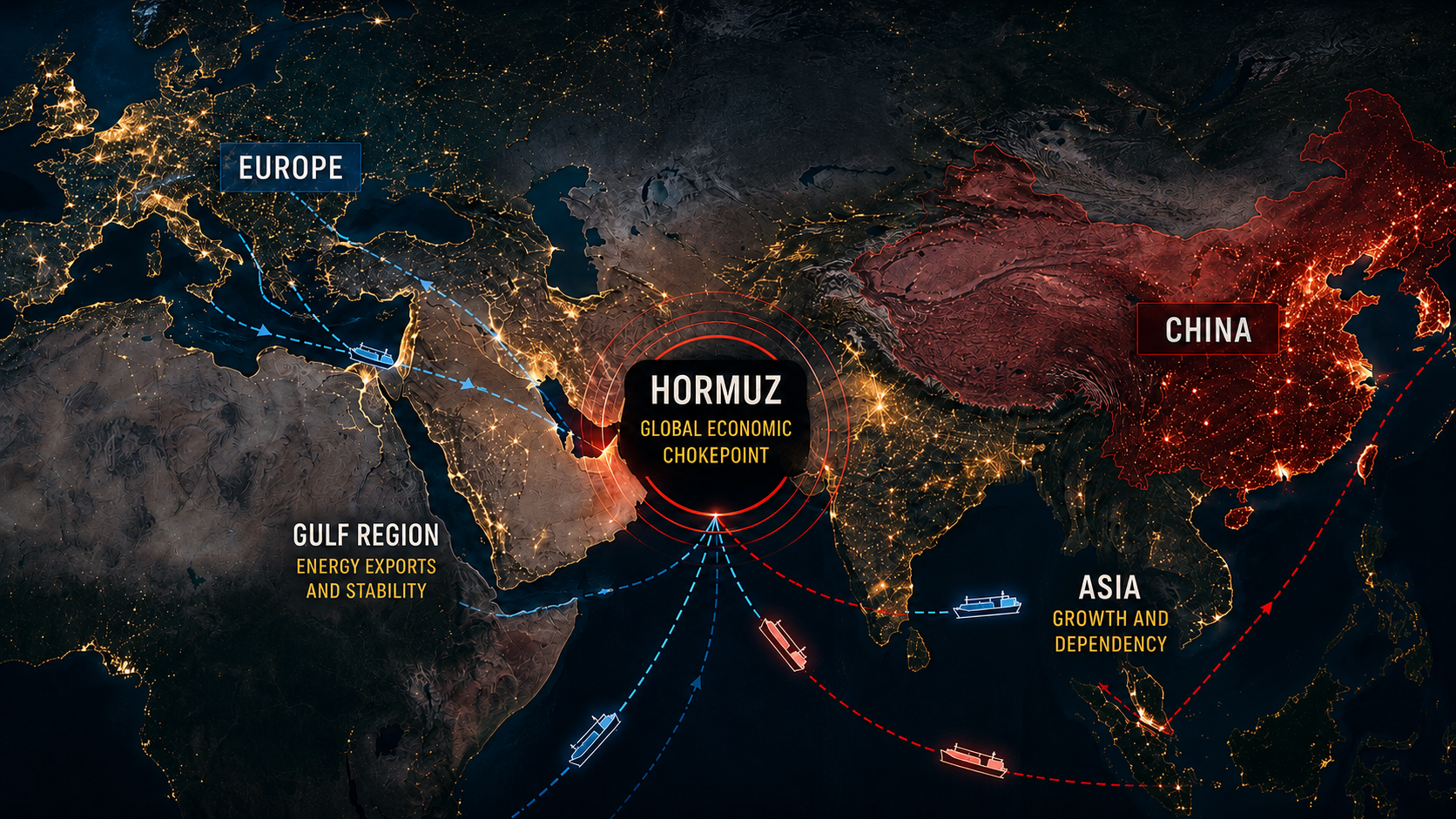
This Chokepoint Check assesses current pressure on the Strait of Hormuz, Bab al-Mandab and the Gulf region’s critical water, power, port and energy infrastructure. The key question is not only whether a route remains geographically open, but whether transport, insurance coverage, energy supply and site operations remain operationally viable.
A new attack confirms that despite individual transits, the strait remains operationally unreliable as a secure commercial route.
A vessel exiting Hormuz was struck by an unidentified projectile on August 18. UKMTO reported damage to the engine room and one affected crew member; Oman is assisting the vessel. At the same time, only six merchant-vessel transits were recorded on Monday, with no VLCC or LNG tanker passages.
Traffic remains below the recent average, while the Houthis have again claimed an attack on Saudi naval units near Mocha.
Nineteen merchant vessels transited Bab al-Mandab on Monday, compared with a ten-day average of 26. The Houthis also said on August 17 that they had attacked a Saudi military vessel and four escort ships off Mocha with missiles. Saudi Arabia has not confirmed the claim.
No sufficiently confirmed new daily signal has emerged for fixed Gulf infrastructure, but export logistics remain under significant pressure.
Saudi Aramco is currently offering Arab Medium and Arab Heavy through ship-to-ship transfers off Fujairah. This makes crude available outside conventional port-loading operations in order to partially bypass continuing disruptions in Hormuz and the Red Sea. No new physical damage to fixed Gulf facilities has been confirmed.
A merchant vessel was struck by an unidentified projectile while exiting Hormuz on August 18. The engine room was damaged. The Omani coast guard is assisting the vessel.
UKMTO reported one affected crew member. The precise casualty status was initially unclear. Responsibility for and the motive behind the attack have not yet been confirmed.
The incident immediately increases crew, insurance and charter risks. Even a nominally passable corridor therefore remains operationally difficult for shipping companies to assess reliably.
Verification Status: confirmed for the projectile strike, engine-room damage and assistance from Oman. Responsibility remains unclear. Associated Press, 18.08.2026 · SchaafMedia: Chokepoint Check – Hormuz, Trade Routes & Supply Chain Risks
The Houthis said on August 17 that they had attacked a Saudi military vessel and four escort ships with missiles off Yemen’s coast near Mocha.
Saudi Arabia had not initially confirmed the attack. The signal therefore remains unclear and is not assessed as a confirmed military strike.
A confirmed expansion of attacks to militarily protected formations would increase risk for merchant vessels operating nearby and further deteriorate security conditions around Mocha.
Verification Status: unclear. The Houthi attack claim itself is confirmed; independent or Saudi confirmation of a strike is absent. Reuters, 17.08.2026 · directly relevant on 18.08.
Kpler recorded only six merchant-vessel transits through Hormuz on Monday, compared with a ten-day average of eleven. At Bab al-Mandab, the figure was 19 compared with 26.
Hormuz remains particularly critical: no VLCC or LNG tanker transits were recorded. Some vessels operating without AIS signals may, however, be absent from the data.
Low transit volumes restrict predictable transport capacity. Oil, LNG and freight flows continue to require alternative routes, higher costs and longer lead times.
Verification Status: confirmed by current Kpler tracking data for August 17, published on August 18. Reuters / Kpler, 18.08.2026 · SchaafMedia: Hormuz Blockade 2026 – Strategies for the Chokepoint Shock
Saudi Aramco is currently offering Arab Medium and Arab Heavy to buyers through ship-to-ship transfers off Fujairah. This creates additional supply options outside conventional port loading.
The measure demonstrates operational adaptation, not normalisation. It is necessary precisely because Hormuz and Saudi Arabia’s Red Sea route remain difficult to plan reliably.
Additional STS loading can reduce individual supply bottlenecks. At the same time, complexity, vessel requirements, security demands and dependence on alternative loading points increase.
Verification Status: confirmed for current Aramco offers using ship-to-ship transfers off Fujairah. Oil & Gas Middle East, 18.08.2026 · SchaafMedia: Oil as a Weapon – Why Energy Dominates Geopolitics and Markets in 2026
Iran is signalling a more offensive military posture following the expiry of the previous negotiating deadline. Washington rejects an extension of the existing arrangement.
These remain political and military signals, rather than evidence of a confirmed new Iranian offensive. At the same time, Oman’s mediation role is coming under growing US pressure.
A declining prospect of a rapid agreement prolongs uncertainty around Hormuz, sanctions, insurance, energy prices and long-term supply contracts.
Verification Status: confirmed for the public positions and threats; no new large-scale military operation has yet been confirmed. Reuters, 18.08.2026 · Daily Sabah, 18.08.2026 · Türkiye offers further mediation support · SchaafMedia: Iran Check – 5 Escalation Signals from August 17, 2026
A vessel is struck in Hormuz while military attack pressure persists in the Red Sea.
Shipping companies reduce transit while energy suppliers use STS loading and alternative export routes.
Hormuz and Bab al-Mandab remain below their recent transit averages.
Freight, insurance, energy and procurement costs remain elevated and difficult to plan.
A merchant vessel is struck directly in Hormuz, while transit remains in single digits and Bab al-Mandab also stays below its recent average.
New physical attack plus continuing restrictions on shippingNo sufficiently confirmed new physical attack on fixed Gulf facilities was identified on August 18. Export infrastructure nevertheless remains under pressure, requiring alternative STS and rerouting models.
No new facility attack · operational bypass structures remain necessaryPhysical attacks, low transit volumes, Red Sea risk and alternative oil-loading operations are simultaneously affecting shipping and energy supply.
Multiple maritime and energy risk channels remain active simultaneouslyThe escalation trajectory has deteriorated again compared with August 16. The decisive development is the new physical attack directly in Hormuz while transit volumes remain very low. Bab al-Mandab also remains under pressure. The economic response increasingly consists of bypassing and adapting rather than genuine normalisation: alternative loading, reduced transit and new procurement routes. Politically, Washington and Tehran are also moving further apart again.
Note: This assessment was produced with support from our Geo-AI. AI can make mistakes. The analysis is intended as a source-based radar for potential escalation signals and does not replace fully verified intelligence, security, insurance or investment advice. In rapidly evolving situations, status, source availability and risk assessments may change at short notice.
Independent of the subject covered in this article, this separate Executive Briefing provides an in-depth analysis of another critical risk domain affecting European companies.
The 27-page Executive Briefing “Black Swan Risk Mapping for Europe’s Next Mobility and Infrastructure Shock” examines how geopolitical, infrastructural and administrative developments that are currently viewed in isolation could reinforce one another.
Based on the GFDD Framework™, the report shows how these dynamics could affect operational continuity, access to critical resources and the strategic resilience of companies.
The briefing includes a structured systemic-shock analysis and a directly applicable Business Exposure Checklist for CEOs, CFOs, COOs, investors and strategy teams.
You are currently viewing a placeholder content from X. To access the actual content, click the button below. Please note that doing so will share data with third-party providers.
More Information