Executive Intelligence. Industrial Risk. Geopolitics.
Strategic Sparring
for Decision-Makers
Risk intelligence across technology, law, markets and power dynamics.


Verdeckte Geschäftsrisiken, strategische Widersprüche und kritische Abhängigkeiten frühzeitig erkennen.
Kostenlose Analyse starten →
Verdeckte Machtstrukturen, Führungsrisiken und organisatorische Blockaden frühzeitig erkennen.
Kostenlose Analyse starten →
Geopolitische Risiken, globale Abhängigkeiten und kritische Lieferkettenrisiken frühzeitig erkennen.
Kostenlose Analyse starten →
Identify hidden business risks, strategic contradictions and critical dependencies at an early stage.
Start Free Analysis →
Identify hidden power structures, leadership risks and organizational blockers at an early stage.
Start Free Analysis →
Identify geopolitical risks, global dependencies and critical supply-chain vulnerabilities at an early stage.
Start Free Analysis →
Verdeckte Geschäftsrisiken, strategische Widersprüche und kritische Abhängigkeiten frühzeitig erkennen.
Kostenlose Analyse starten →
Verdeckte Machtstrukturen, Führungsrisiken und organisatorische Blockaden frühzeitig erkennen.
Kostenlose Analyse starten →
Geopolitische Risiken, globale Abhängigkeiten und kritische Lieferkettenrisiken frühzeitig erkennen.
Kostenlose Analyse starten →
Identify hidden business risks, strategic contradictions and critical dependencies at an early stage.
Start Free Analysis →
Identify hidden power structures, leadership risks and organizational blockers at an early stage.
Start Free Analysis →
Identify geopolitical risks, global dependencies and critical supply-chain vulnerabilities at an early stage.
Start Free Analysis →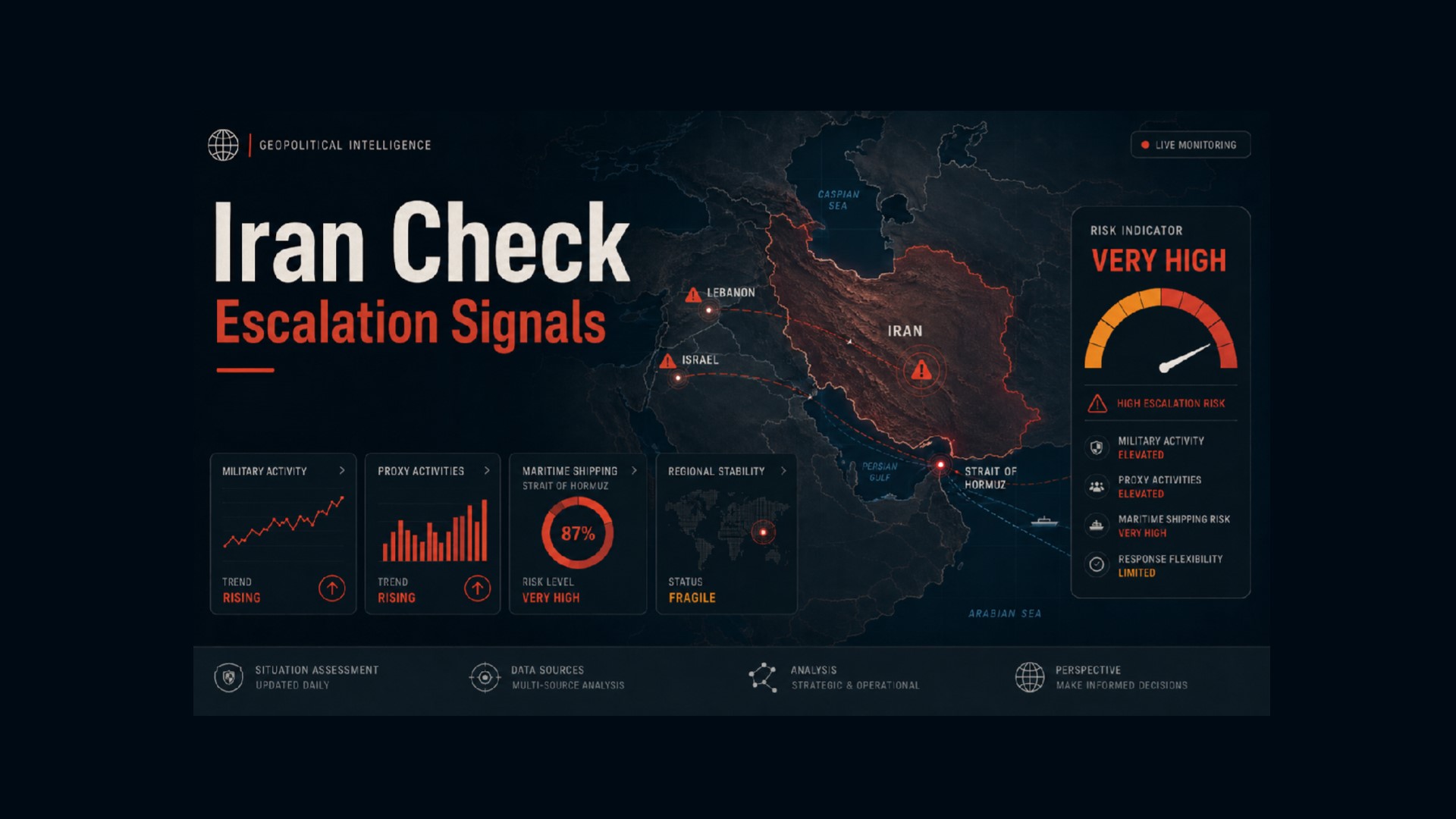
This escalation radar summarises five relevant signals as of August 19, 2026. It focuses on substantiated statements by official bodies, verified events and monitoring sources with potential implications for energy prices, supply chains, markets, maritime security, aviation and regional stability.
The UAE has suspended all trade and financial transactions with Iran after two ballistic missiles were reportedly launched from Iranian territory. Iran denies responsibility. The conflict is therefore escalating directly again between Tehran and a key Gulf state.
Iran’s Chief of Staff Ali Abdollahi stated on August 19 that any support for US military operations would be regarded as participation in American attacks. US bases and their host states are therefore moving more directly into Iran’s deterrence logic.
Only six merchant vessels transited Hormuz on Tuesday. More than 80 percent of observed transits over the past two weeks used the Omani route. Shipowners are therefore increasingly bypassing the traffic corridor preferred by Iran.
| Actor | Type | Severity | Status | Source / Verification Status | Business Impact |
|---|---|---|---|---|---|
| UAE / Iran / Gulf region / ballistic missiles | UAE suspends trade and financial transactions with Iran after new missile alert | Critical · Level 5/5 | The United Arab Emirates suspended all trade, commercial and financial transactions with Iran on August 19. The move followed a new missile alert: according to the UAE, two ballistic missiles were launched from Iran towards maritime targets. Emirati authorities said neither missile reached a target on land. Iran rejects responsibility and describes the allegation as false. Power dynamics: The Iran conflict is therefore spreading directly again to one of the Gulf’s most important economic and logistics hubs. Military uncertainty is translating immediately into economic decoupling. | Confirmed by AP News, August 19, 2026 . Verification status: confirmed regarding the trade and financial suspension and the missile alert reported by the UAE. Iranian responsibility for the missiles remains disputed and is denied by Tehran. Background: Schaaf Media · Middle East Escalation Check from August 18, 2026 . | Critical business impact on Dubai and UAE hubs, Iran trade, payment flows, re-exports, banks, logistics, compliance and insurance. The UAE has been a key economic channel for Iran; a prolonged suspension would significantly increase Tehran’s economic isolation. |
| Iran / United States / Gulf states / US bases / Iranian armed forces | Iran says support for US military operations could constitute participation in the war | Critical · Level 5/5 | Iran’s Chief of Staff Ali Abdollahi issued an explicit warning to Gulf states on August 19. Any support or facilitation for US military operations would be regarded as participation in American attacks. Abdollahi referred specifically to the presence of US military aircraft and refuelling aircraft at regional bases. Power dynamics: Tehran is once again broadening its logic of targeting and responsibility. From Iran’s perspective, not only the United States, but also states providing infrastructure or support could become part of the conflict. | Confirmed by Arab News / AFP, August 19, 2026 . Verification status: confirmed regarding Abdollahi’s warning. No specific new attack decision against an individual Gulf state was announced. Further analysis: Schaaf Media · Ukraine and Iran: Trump’s Two-Front War of Attrition? . | Critical business impact on the UAE, Qatar, Bahrain, Kuwait and other states hosting US military facilities, aviation, business travel, critical infrastructure, personnel security and evacuation planning. The distinction between a military host state and an active participant in the war is becoming politically less clear. |
| Iran / Oman / international shipowners / Strait of Hormuz | More than 80 percent of recent Hormuz transits use the Omani route | Critical · Level 5/5 | The operational structure of Hormuz traffic is changing significantly. Only six merchant vessels transited the strait on Tuesday, down from nine the previous day and compared with a ten-day average of eleven. At the same time, according to Kpler, more than 80 percent of transits over the past two weeks used the internationally recognised Omani corridor. The route preferred by Iran is therefore increasingly being bypassed. Power dynamics: While Tehran politically claims control over Hormuz, actual shipping traffic is increasingly shifting towards the Omani side. Political claims and operational control are therefore beginning to diverge. | Confirmed by Arab News, August 19, 2026 . Verification status: confirmed regarding six visible transits and the strong use of the Omani corridor. AIS shutdowns may mean that not all vessel movements are visible. Further reading: Schaaf Media · Hormuz Blockade 2026: Strategies for the Chokepoint Shock . | Critical business impact on oil, LNG, tanker charters, insurability, transit costs, freight rates and delivery times. The Omani route creates limited operational alternatives, but does not replace a return to pre-war volumes. |
| United States / UAE / Iran / Rubio / Hormuz | Washington and Abu Dhabi coordinate security while US-Iran talks remain stalled | High to critical · Level 4/5 | US Secretary of State Marco Rubio spoke on August 19 with UAE National Security Adviser Sheikh Tahnoon bin Zayed about regional security and Hormuz. At the same time, Trump stated that there were neither ongoing nor planned talks with Iran. Tehran presents the situation differently and says Washington is continuing to seek renewed negotiations. Power dynamics: Instead of a direct US-Iran negotiating architecture, security coordination between Washington and the Gulf states is again moving to the foreground. This increases pressure on Iran, but simultaneously raises escalation risks for US partners. | Confirmed by Al Jazeera, August 19, 2026 . Verification status: confirmed regarding the Rubio-Tahnoon call and the contradictory public US-Iranian statements. No new direct negotiating date has been confirmed. Background: Schaaf Media · Iran Check: 5 Escalation Signals from August 17, 2026 . | High to critical business impact on Gulf states, US-Iran exposure, sanctions, financial markets, energy prices, site planning and security costs. The absence of direct talks prolongs uncertainty around Hormuz and regional investment. |
| Iraq / Iran / Qalibaf / Hormuz / Iraqi oil industry | Iraq seeks special status for its oil exports through Hormuz | High to critical · Level 4/5 | Iraqi Parliament Speaker Haibat Al-Halbousi called on August 19, during talks with his Iranian counterpart Mohammad Baqer Qalibaf, for special status for Iraqi oil exports through Hormuz. Qalibaf is on a three-day visit to Baghdad. In parallel, Iraq is seeking to structurally reduce its dependence on Hormuz and develop additional export routes. Power dynamics: Iraq’s request demonstrates the extent to which Iran can now influence the export capacity of another major OPEC producer. At the same time, Baghdad is increasing pressure to build alternative oil routes through other states and ports. | Confirmed by Arab News, August 19, 2026 . Verification status: confirmed regarding Iraq’s request for special status. No Iranian commitment or specific new transit quota has been announced. Further reading: Schaaf Media · Oil as a Weapon: Why Energy Dominates Geopolitics and Markets in 2026 . | High to critical business impact on Iraqi oil exports, OPEC supply capacity, tankers, refineries, oil prices and energy security. Iraq has also approved a three-month mechanism to diversify its export routes, scheduled to take effect on September 1. |
The most important new escalation on August 19, 2026 lies in the relationship between Iran and the Gulf states. The UAE has suspended trade and financial transactions with Iran after ballistic missiles were again reported heading towards the Emirates. At the same time, Iran’s military says that support for US operations could be treated as participation in the war. The US-Iran conflict is therefore once again becoming an immediate security problem for the entire Gulf region.
A new operational reality is emerging in Hormuz at the same time. Overall traffic remains extremely low, while more than 80 percent of recent transits are using the Omani corridor. At least operationally, this weakens Iran’s previous claim that it alone can control and monetise the traffic.
Diplomacy also remains blocked. Washington says there are no ongoing or planned talks with Iran. Instead, the United States is intensifying security coordination with the UAE. Iraq, meanwhile, is attempting to negotiate special conditions directly with Tehran for its oil exports.
For companies, regional bypass structures are therefore becoming increasingly important. Oil has returned to a three-week high amid continuing uncertainty around Hormuz, while states and companies are building alternative export, financing and transport routes. EASA CZIBs for Iran, Iraq, Jordan, Lebanon, the Persian Gulf and the Gulf of Oman remain active until August 31, 2026; no new tightening was issued on August 19.
The five most important signals for a European and German risk assessment are: the UAE’s full suspension of trade and financial transactions with Iran following the new missile alert, Iran’s warning to Gulf states against any support for US military operations, the increasing shift of Hormuz traffic towards the Omani route, closer US-UAE security coordination while direct US-Iran talks remain blocked, and Iraq’s request for special status for its oil exports through the Strait of Hormuz.
Note: This assessment was prepared with the support of our Geo AI. AI can make mistakes. The analysis is intended as a radar for potential escalation signals and does not replace a fully verified intelligence assessment.
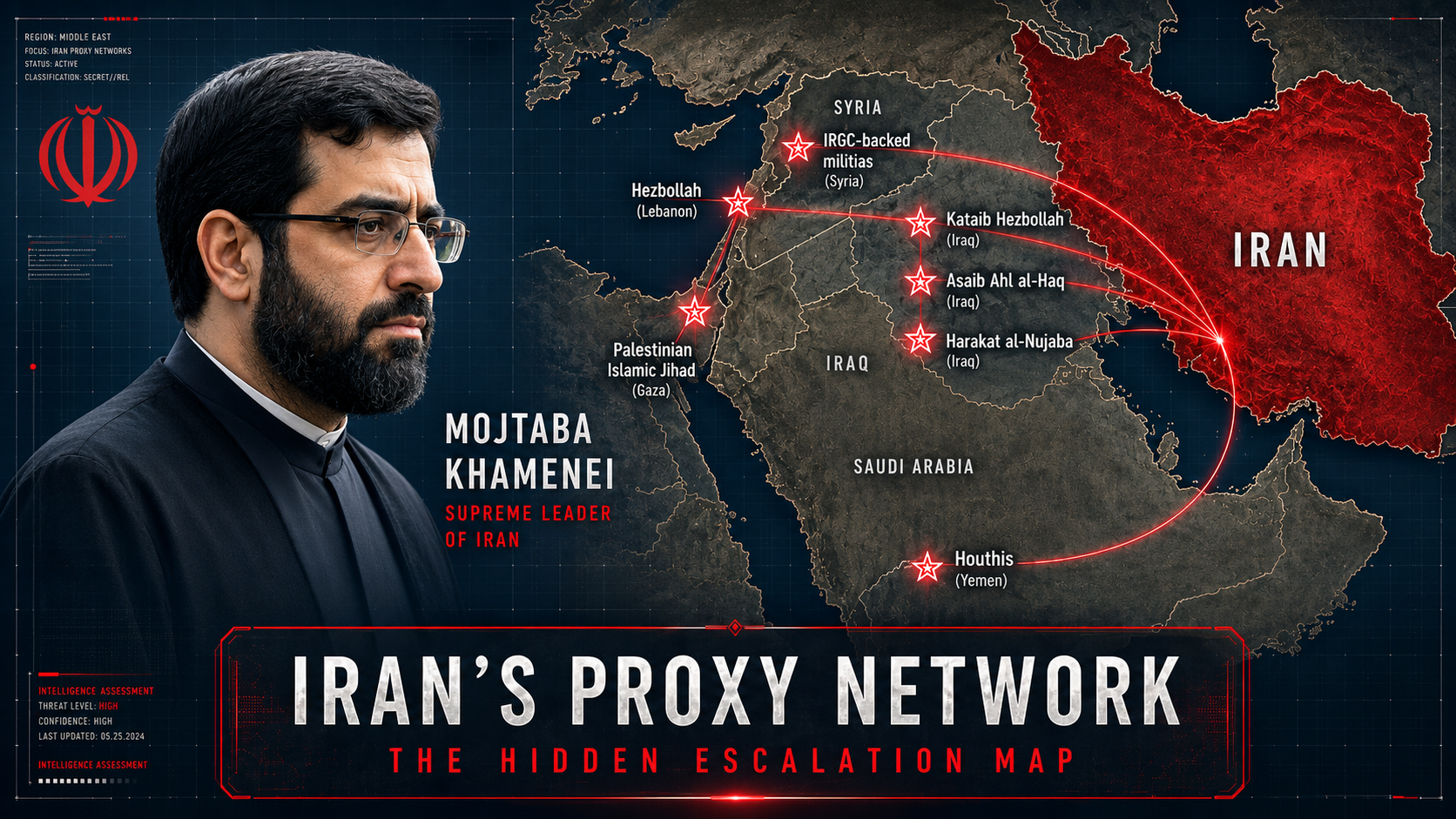
What decision-makers should watch now — before proxy escalation becomes a cost, compliance or supply-chain shock.
This 17-page executive briefing translates Iran’s proxy network into concrete business risks: energy price exposure, maritime chokepoints, war-risk premiums, sanctions, shadow fleets, supply-chain disruption and early-warning indicators for board-level decisions.
You are currently viewing a placeholder content from X. To access the actual content, click the button below. Please note that doing so will share data with third-party providers.
More Information