Executive Intelligence. Industrial Risk. Geopolitics.
Strategic Sparring
for Decision-Makers
Risk intelligence across technology, law, markets and power dynamics.

Verdeckte Geschäftsrisiken, strategische Widersprüche und kritische Abhängigkeiten frühzeitig erkennen.
Kostenlose Analyse starten →
Verdeckte Machtstrukturen, Führungsrisiken und organisatorische Blockaden frühzeitig erkennen.
Kostenlose Analyse starten →
Geopolitische Risiken, globale Abhängigkeiten und kritische Lieferkettenrisiken frühzeitig erkennen.
Kostenlose Analyse starten →
Identify hidden business risks, strategic contradictions and critical dependencies at an early stage.
Start Free Analysis →
Identify hidden power structures, leadership risks and organizational blockers at an early stage.
Start Free Analysis →
Identify geopolitical risks, global dependencies and critical supply-chain vulnerabilities at an early stage.
Start Free Analysis →
Verdeckte Geschäftsrisiken, strategische Widersprüche und kritische Abhängigkeiten frühzeitig erkennen.
Kostenlose Analyse starten →
Verdeckte Machtstrukturen, Führungsrisiken und organisatorische Blockaden frühzeitig erkennen.
Kostenlose Analyse starten →
Geopolitische Risiken, globale Abhängigkeiten und kritische Lieferkettenrisiken frühzeitig erkennen.
Kostenlose Analyse starten →
Identify hidden business risks, strategic contradictions and critical dependencies at an early stage.
Start Free Analysis →
Identify hidden power structures, leadership risks and organizational blockers at an early stage.
Start Free Analysis →
Identify geopolitical risks, global dependencies and critical supply-chain vulnerabilities at an early stage.
Start Free Analysis →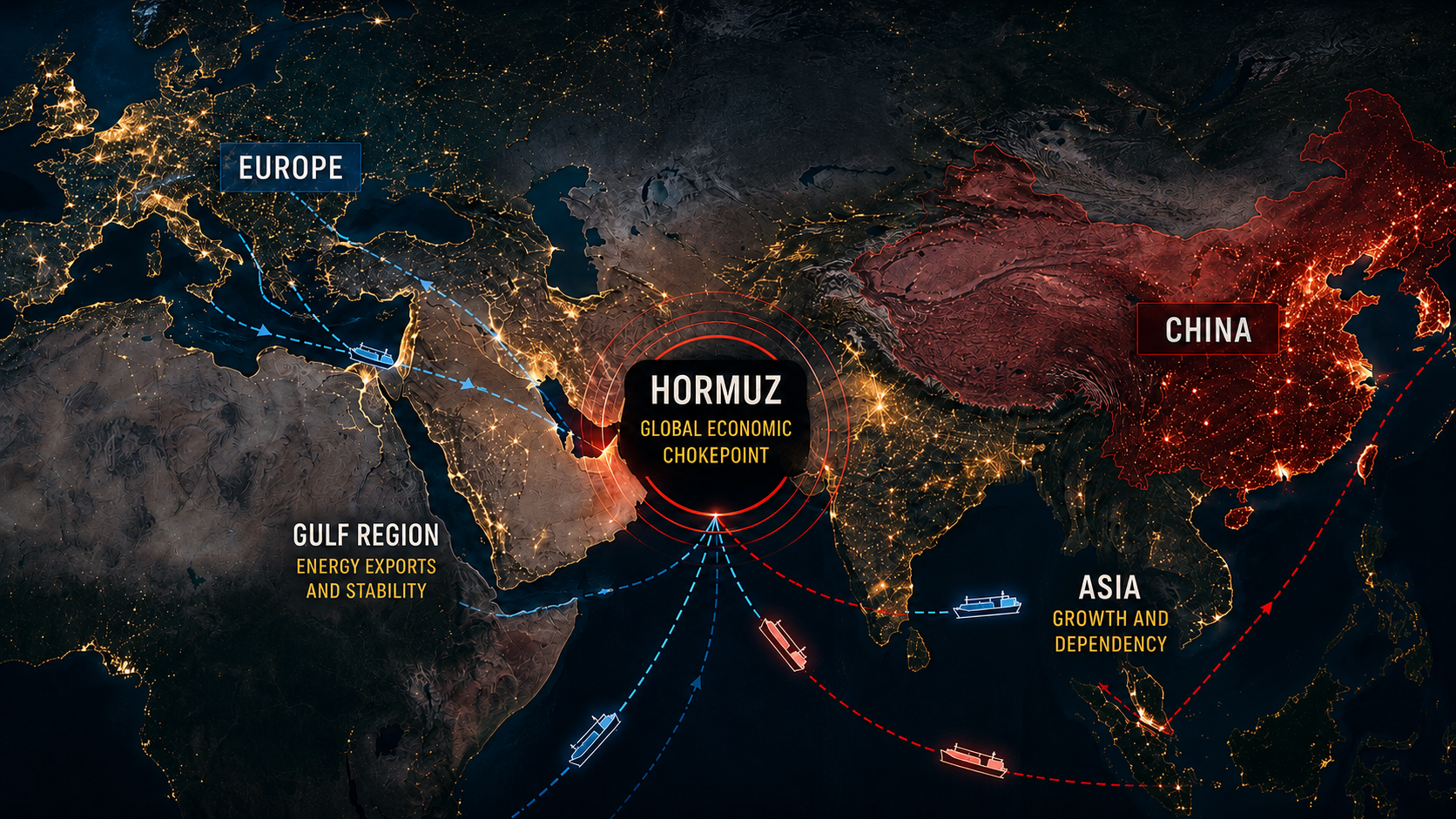
This Chokepoint Check assesses current pressure on the Strait of Hormuz, Bab al-Mandab and the Gulf region’s critical water, power, port and energy infrastructure. The key question is not only whether a route remains geographically open, but whether transport, insurance coverage, energy supply and site operations remain operationally viable.
The route remains geographically open, but a new direct attack on a vessel keeps operational risk at an extreme level.
UKMTO confirmed on Sunday that a vessel was struck by a projectile while transiting the Strait. The vessel caught fire and the crew was evacuated.
The risk has expanded from coastal control to a strategic island in the middle of the chokepoint.
Houthi forces have reached and reportedly taken control of Perim, regionally also known as Mayun, inside Bab al-Mandab. This increases their direct influence over the strait.
Saudi Arabia’s primary alternative to the Strait of Hormuz is offline following a drone attack.
Saudi Arabia shut the roughly 1,200-kilometre East-West Pipeline as a precaution following an aerial attack. The pipeline had recently been carrying around four to five million barrels of oil per day.
UKMTO reported on Sunday that a vessel was struck by a projectile while transiting Hormuz and subsequently caught fire.
The crew was evacuated. Iranian media reported one fatality and injuries. Responsibility for the attack has not yet been confirmed.
The incident immediately increases crew-safety, war-risk, insurance and transit exposure for vessels continuing to use Hormuz.
Verification Status: partially confirmed. UKMTO confirms the strike, fire and evacuation; casualty figures originate from Iranian sources, while responsibility remains unclear. Reuters / UKMTO, 13.09.2026 · SchaafMedia: Chokepoint Risk Analysis – Hormuz & Supply Chain Risks
Saudi Arabia shut its East-West Pipeline following drone attacks on facilities in the Riyadh and Medina regions as a precaution.
Riyadh and Baghdad confirmed that the drones were launched from Iraqi territory. Baghdad subsequently dismissed a commander.
The pipeline had been transporting four to five million barrels per day and was Saudi Arabia’s main export alternative to the disrupted Hormuz route.
Verification Status: confirmed. The pipeline shutdown and Iraqi origin of the drones were confirmed by Saudi Arabia and the Iraqi government respectively. Reuters, 12.09.2026 · directly operationally relevant on 13.09. · SchaafMedia: Oil as a Geopolitical Weapon – Why Energy Dominates Geopolitics and Markets in 2026
Following their advance through Mocha and Dhubab, Houthi forces reached Perim/Mayun directly inside the strait between Yemen and Africa.
The position gives the Houthis significantly greater influence over vessel movements and military operations in Bab al-Mandab.
Red Sea and Suez routes face additional war-risk, crew-safety and rerouting exposure. Saudi exports are particularly vulnerable.
Verification Status: confirmed for the Houthi advance onto the island. Permanent military control and concrete restrictions on transit remain unclear. Al Jazeera, 12.09.2026 · directly relevant on 13.09. · SchaafMedia: Middle East Escalation Check from September 11, 2026
Houthi forces reported on Sunday new missile and drone attacks against Saudi Arabia, including a military base in Sharurah.
Saudi Arabia simultaneously reported that a projectile in Jazan injured two people and damaged a mosque, among other property.
Continuing attacks increase risks to personnel, infrastructure, aviation and industrial continuity across the south of the Kingdom.
Verification Status: partially confirmed. Saudi Arabia confirms damage and injuries; individual Houthi target claims remain statements by a conflict party. Al Jazeera, 13.09.2026 · SchaafMedia: Iran Check – 5 Escalation Signals from September 12, 2026
Iran and Gulf states are due to meet in Oman on Monday to discuss Hormuz and regional security. Bahrain has declined to participate.
According to the Iranian side, no signed agreement is expected. Tehran continues to seek transit-fee rights, while Oman rejects that position.
Diplomacy is therefore unlikely to deliver a rapid normalisation of transit conditions or insurance requirements in the short term.
Verification Status: confirmed for the planned talks and Bahrain’s refusal to attend. No agreement or operational reopening has yet been achieved. Reuters, 12.09.2026 · directly relevant on 13.09. · SchaafMedia: Strait of Hormuz Blockade 2026 – Protecting Margins and Supply Chains in the Chokepoint Shock
Vessel struck in Hormuz, Saudi pipeline shut and Houthis control Perim/Mayun.
Shipowners, energy companies and insurers are simultaneously losing safe alternative routes.
Hormuz remains disrupted, the Saudi bypass pipeline is offline and Bab al-Mandab becomes riskier.
Oil, freight, war-risk premiums, lead times and procurement costs come under simultaneous pressure.
A vessel was directly struck in Hormuz, while the Houthis are strengthening their position in Bab al-Mandab.
Both chokepoints open · direct attack and control risks prevent reliable normal operationsSaudi Arabia’s most important Hormuz-bypass pipeline was shut following a drone attack.
Critical energy infrastructure directly hit · key export capacity impairedHormuz, Bab al-Mandab and Saudi Arabia’s primary alternative export route are simultaneously under military or operational pressure.
Maritime, energy and regional security risks are fully interconnectedOverall risk remains critical. Compared with September 11, the situation has become markedly more systemic: Hormuz has seen a new vessel attack, Bab al-Mandab now carries an additional territorial risk dimension and Saudi Arabia’s key alternative export route is temporarily offline.
Note: This assessment was produced with support from our Geo-AI. AI can make mistakes. The analysis is intended as a source-based radar for potential escalation signals and does not replace fully verified intelligence, security, insurance or investment advice. In rapidly evolving situations, status, source availability and risk assessments may change at short notice.
Independent of the subject covered in this article, this separate Executive Briefing provides an in-depth analysis of another critical risk domain affecting European companies.
The 27-page Executive Briefing “Black Swan Risk Mapping for Europe’s Next Mobility and Infrastructure Shock” examines how geopolitical, infrastructural and administrative developments that are currently viewed in isolation could reinforce one another.
Based on the GFDD Framework™, the report shows how these dynamics could affect operational continuity, access to critical resources and the strategic resilience of companies.
The briefing includes a structured systemic-shock analysis and a directly applicable Business Exposure Checklist for CEOs, CFOs, COOs, investors and strategy teams.
You are currently viewing a placeholder content from X. To access the actual content, click the button below. Please note that doing so will share data with third-party providers.
More Information