Executive Intelligence. Industrial Risk. Geopolitics.
Strategic Sparring
for Decision-Makers
Risk intelligence across technology, law, markets and power dynamics.


Verdeckte Geschäftsrisiken, strategische Widersprüche und kritische Abhängigkeiten frühzeitig erkennen.
Kostenlose Analyse starten →
Verdeckte Machtstrukturen, Führungsrisiken und organisatorische Blockaden frühzeitig erkennen.
Kostenlose Analyse starten →
Geopolitische Risiken, globale Abhängigkeiten und kritische Lieferkettenrisiken frühzeitig erkennen.
Kostenlose Analyse starten →
Identify hidden business risks, strategic contradictions and critical dependencies at an early stage.
Start Free Analysis →
Identify hidden power structures, leadership risks and organizational blockers at an early stage.
Start Free Analysis →
Identify geopolitical risks, global dependencies and critical supply-chain vulnerabilities at an early stage.
Start Free Analysis →
Verdeckte Geschäftsrisiken, strategische Widersprüche und kritische Abhängigkeiten frühzeitig erkennen.
Kostenlose Analyse starten →
Verdeckte Machtstrukturen, Führungsrisiken und organisatorische Blockaden frühzeitig erkennen.
Kostenlose Analyse starten →
Geopolitische Risiken, globale Abhängigkeiten und kritische Lieferkettenrisiken frühzeitig erkennen.
Kostenlose Analyse starten →
Identify hidden business risks, strategic contradictions and critical dependencies at an early stage.
Start Free Analysis →
Identify hidden power structures, leadership risks and organizational blockers at an early stage.
Start Free Analysis →
Identify geopolitical risks, global dependencies and critical supply-chain vulnerabilities at an early stage.
Start Free Analysis →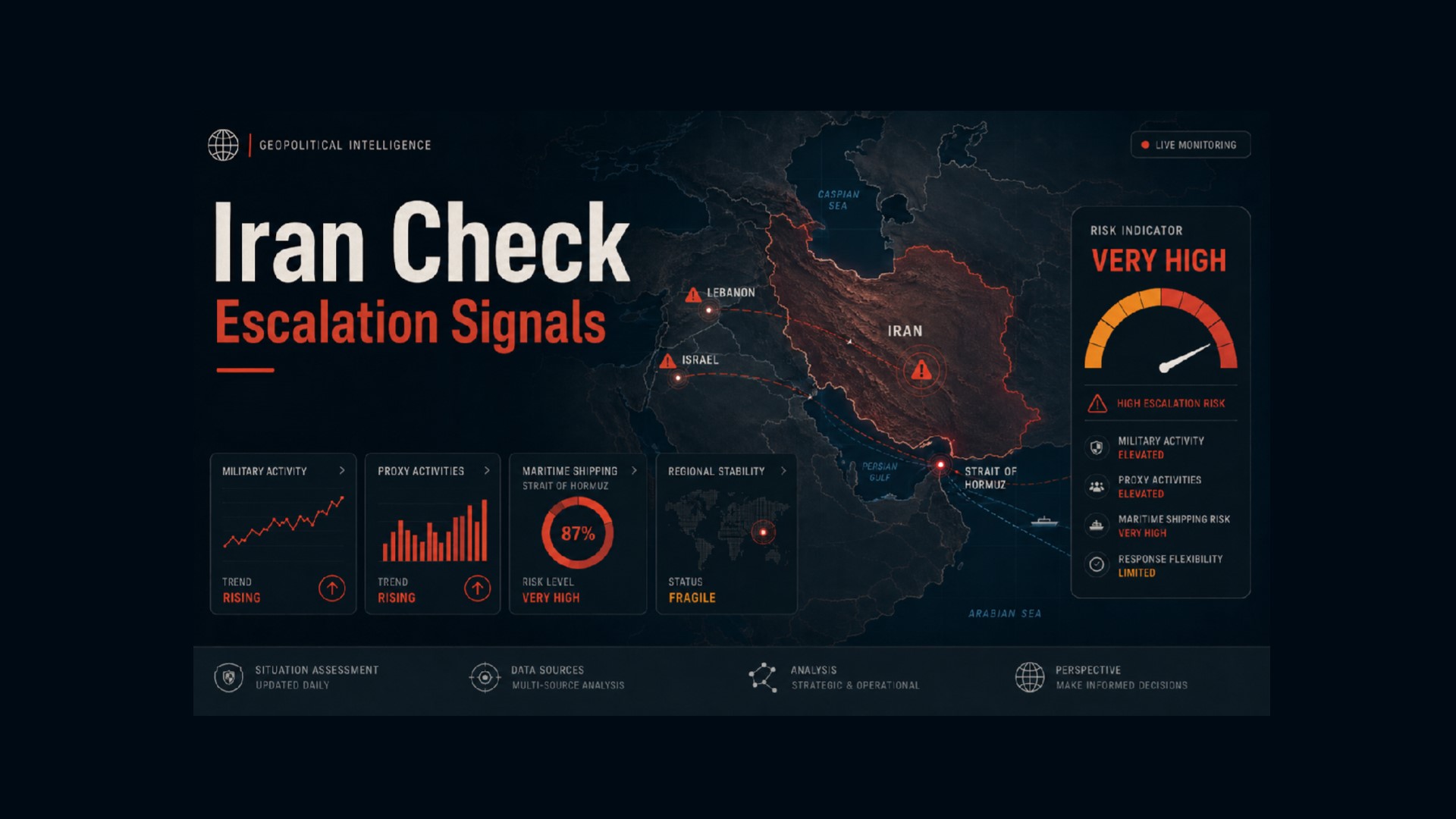
This escalation radar summarizes five relevant signals as of September 16, 2026. The focus is on verifiable statements by official sources, confirmed events and monitoring data with potential implications for energy prices, supply chains, markets, maritime security, aviation and regional stability.
The IRGC says it shot down a U.S. MQ-9 over Qeshm. The claim has not yet been independently confirmed. However, the potential direct U.S.-Iran incident occurred immediately adjacent to the strategic Hormuz corridor.
Only four tracked vessels passed through the Strait of Hormuz on Tuesday. The 10-day average stands at 18. No VLCCs or LNG carriers were among the recorded transits.
Saudi Arabia reports intercepting a Houthi drone south of Mecca. The Houthis deny targeting the holy city. Riyadh nevertheless announces deterrence measures.
| Actor | Type | Severity | Status | Source / Verification | Business Impact |
|---|---|---|---|---|---|
| Iran / IRGC / United States / Qeshm / Hormuz | Iran reports downing of U.S. MQ-9 immediately adjacent to the Strait of Hormuz | Critical · Level 5/5 | A new direct U.S.-Iran flashpoint emerged on September 16. The IRGC states that its air defence forces shot down a U.S. MQ-9 over Qeshm at 02:29 local time. Several explosions had previously been reported in the area from the direction of the sea. No independent U.S. confirmation of the drone loss has yet been issued. Power dynamics: Qeshm lies directly adjacent to the Strait of Hormuz. Any direct confrontation between Iranian air defences and U.S. reconnaissance assets raises the risk of further military miscalculation inside the chokepoint. | Official Iranian account: Tasnim / IRGC, September 16, 2026 . Reuters also reported explosions on Qeshm: Reuters, September 16, 2026 . Verification status: partially confirmed. The explosions are confirmed; the MQ-9 shootdown remains an IRGC claim that has not yet been independently verified. Further analysis: Schaaf Media · Iran War: How the West Is Fighting While Losing Its Dominance . | Critical business impact on Hormuz, marine insurance, oil and LNG, U.S. military operations, as well as maritime and civil aviation. Direct U.S.-Iran incidents inside the chokepoint environment increase war-risk premiums and short-term rerouting risks. |
| Iran / United States / international shipping companies / Hormuz | Hormuz traffic falls to four visible transits – no VLCCs or LNG carriers | Critical · Level 5/5 | The operational situation is deteriorating again. Only four vessel transits were recorded on Tuesday, down from seven the previous day. Two vessels entered the Gulf, while two departed. The 10-day average stands at 18 transits. No VLCC and no LNG carrier was among the tracked vessels. AIS shutdowns mean that actual vessel movements may be higher. Power dynamics: A commercial normalization of the Gulf’s most important chokepoint remains out of sight. | Confirmed by Reuters, September 16, 2026 . Verification status: confirmed for four visible transits, the 10-day average and the absence of VLCC and LNG carrier transits. Dark shipping movements may not appear in tracking data. Further analysis: Schaaf Media · Hormuz Blockade 2026: Protecting Margins and Supply Chains in the Chokepoint Shock . | Critical business impact on crude oil, LNG, petrochemicals, freight rates, insurance and Europe-Asia supply chains. The absence of LNG and VLCC traffic demonstrates that major energy flows remain difficult to plan reliably. |
| Saudi Arabia / Houthis / Iran / Yemen / Mecca | Houthi drone intercepted south of Mecca – Saudi Arabia sets new red line | Critical · Level 5/5 | The Houthi-Saudi escalation has acquired a new political dimension. Saudi Arabia states that its air defences destroyed a Houthi drone south of Mecca on Tuesday evening, before it reached restricted airspace. Riyadh explicitly defines the security of Mecca as a red line and announces deterrence measures. The Houthis deny targeting Mecca or other religious sites. Power dynamics: The confrontation is shifting from energy and military targets to a highly symbolic level, significantly increasing pressure on Saudi Arabia to respond. | Confirmed by Reuters, September 16, 2026 . Verification status: partially confirmed. Confirmed are the Saudi interception report, the declaration of a red line and the Houthi denial. The drone’s actual target has not been independently verified. Background: Schaaf Media · Iran’s Proxies: The Hidden Escalation Map of the Middle East . | Critical business impact on Saudi Arabia, aviation, tourism, energy infrastructure and Red Sea shipping. A Saudi military response could intensify fighting in Yemen and increase pressure on Bab el-Mandeb. |
| Saudi Arabia / Oman / Iran / Asian and European buyers | Pipeline damage forces additional Saudi oil loadings via Oman | Critical · Level 5/5 | The chokepoint crisis has reached physical export logistics. Saudi Aramco is offering Asian customers additional Arab Light, Arab Medium and Arab Heavy cargoes via ship-to-ship transfers off Sohar in Oman. Sohar lies outside the Strait of Hormuz. The move follows damage to Saudi Arabia’s East-West Pipeline caused by drone attacks. Loadings from Yanbu are suspended; individual September deliveries to Europe are being cancelled or delayed. Power dynamics: Saudi Arabia now has to compensate for disruption to what was previously its own Hormuz bypass route through an additional emergency solution. | Confirmed by Reuters, September 16, 2026 . Verification status: confirmed for additional Sohar loadings, suspended Yanbu cargoes and delivery delays. Saudi Aramco did not comment on the reports. Further analysis: Schaaf Media · Oil as a Power Instrument: Why Energy Is Dominating Geopolitics and Markets in 2026 . | Critical business impact on oil supply, refineries, tanker logistics, freight rates, European buyers and industrial energy costs. The crisis therefore affects not only Hormuz, but also alternative Saudi export corridors. |
| United States / CENTCOM / Israel / Saudi Arabia / UAE / Qatar / Gulf States | CENTCOM confirms regional military coordination over the Iran war | High to Critical · Level 4/5 | Politically and militarily, the regional counter-architecture to Iran is becoming more closely integrated. CENTCOM confirms a meeting of senior military leaders from eight countries in Germany. Participants included Israel, Saudi Arabia, the UAE, Bahrain, Kuwait, Qatar, Jordan and Egypt. CENTCOM Commander Brad Cooper reaffirmed the continued U.S. military presence in the region and outlined plans to increase shipping traffic through Hormuz. In parallel, Israeli-Saudi discussions on intelligence support against the Houthis are being reported. Power dynamics: The Iran war is accelerating practical military integration between Israel and Arab states under the CENTCOM framework. | Reported and confirmed by CENTCOM: Axios, September 15, 2026 . Verification status: confirmed for the meeting and CENTCOM’s statement on expanded security cooperation. Details regarding bilateral Israeli-Saudi support are based on unnamed sources. The mandatory alliance review simultaneously shows no new Iranian membership, partner or observer status. Background: Schaaf Media · Middle East Escalation Check – September 15, 2026 . | High to critical business impact on regional security architecture, Hormuz, air and missile defence, military logistics, insurability and investment risk. Greater operational integration strengthens deterrence, but also raises the risk of drawing additional states directly into the Iran conflict. |
The most important military development on September 16, 2026 is occurring directly adjacent to the Strait of Hormuz. Iran reports the downing of a U.S. MQ-9 over Qeshm. The drone loss has not yet been independently confirmed, but the simultaneously reported explosions on Qeshm underline the continued active military situation directly at the chokepoint.
At the same time, the operational shipping situation is deteriorating. Only four visible vessels passed through Hormuz, with no VLCC or LNG carrier transits. Saudi Arabia is also being forced, following damage to its East-West Pipeline, to reroute additional crude volumes via Sohar in Oman. This means both the main route and an important alternative corridor are under pressure at the same time.
The Houthi-Saudi confrontation has also reached a new escalation level. Saudi Arabia has explicitly declared Mecca a red line following the interception of a drone. This increases political pressure on Riyadh to respond more forcefully to the Houthis, while Bab el-Mandeb is already under significant security pressure.
In parallel, the regional security architecture is changing. CENTCOM is coordinating Israel and several Arab states more closely, while Iranian Foreign Minister Araghchi is meeting Wang Yi in Beijing on September 16. No new Iranian alliance, partner or observer status has been confirmed. EASA CZIBs for Iran, Iraq, Jordan, Lebanon, the Persian Gulf and the Gulf of Oman remain active until September 30, 2026; no new revision was published on September 16.
The five most important signals for a European risk assessment are: Iran’s as yet independently unconfirmed downing of a U.S. MQ-9 over Qeshm, the fall in visible Hormuz traffic to just four vessels without VLCC or LNG carrier transits, the intercepted Houthi drone near Mecca and Saudi Arabia’s newly declared red line, the additional rerouting of Saudi oil exports via Oman following damage to the East-West Pipeline, and the confirmed closer military coordination between CENTCOM, Israel and Arab states.
Note: This assessment was prepared with support from our Geo-AI. AI can make mistakes. The analysis is intended as a radar for potential escalation signals and does not replace a fully verified intelligence assessment.
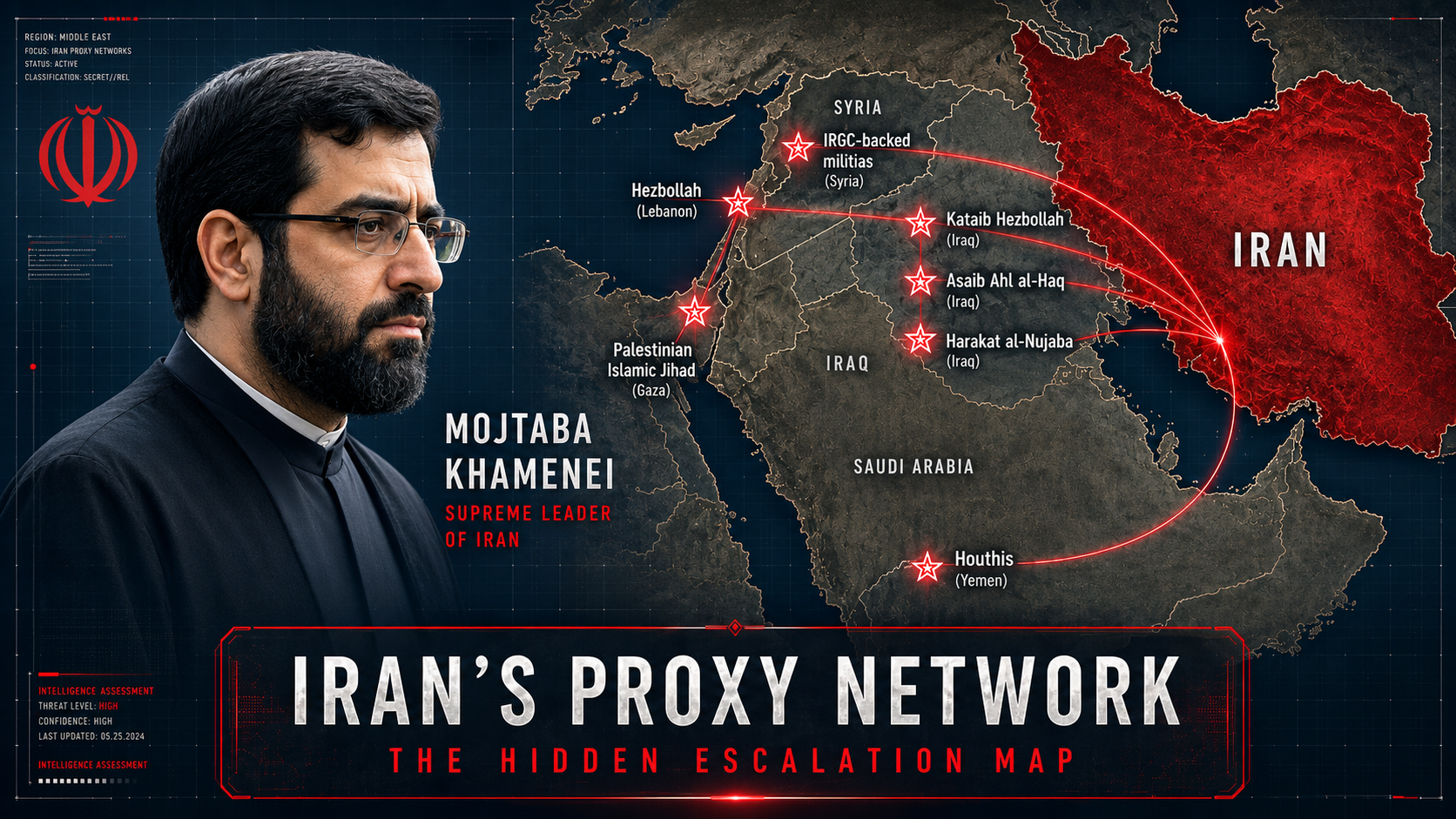
What decision-makers should watch now — before proxy escalation becomes a cost, compliance or supply-chain shock.
This 17-page executive briefing translates Iran’s proxy network into concrete business risks: energy price exposure, maritime chokepoints, war-risk premiums, sanctions, shadow fleets, supply-chain disruption and early-warning indicators for board-level decisions.
You are currently viewing a placeholder content from X. To access the actual content, click the button below. Please note that doing so will share data with third-party providers.
More Information