Executive Intelligence. Industrial Risk. Geopolitics.
Strategic Sparring
for Decision-Makers
Risk intelligence across technology, law, markets and power dynamics.


Verdeckte Geschäftsrisiken, strategische Widersprüche und kritische Abhängigkeiten frühzeitig erkennen.
Kostenlose Analyse starten →
Verdeckte Machtstrukturen, Führungsrisiken und organisatorische Blockaden frühzeitig erkennen.
Kostenlose Analyse starten →
Geopolitische Risiken, globale Abhängigkeiten und kritische Lieferkettenrisiken frühzeitig erkennen.
Kostenlose Analyse starten →
Identify hidden business risks, strategic contradictions and critical dependencies at an early stage.
Start Free Analysis →
Identify hidden power structures, leadership risks and organizational blockers at an early stage.
Start Free Analysis →
Identify geopolitical risks, global dependencies and critical supply-chain vulnerabilities at an early stage.
Start Free Analysis →
Verdeckte Geschäftsrisiken, strategische Widersprüche und kritische Abhängigkeiten frühzeitig erkennen.
Kostenlose Analyse starten →
Verdeckte Machtstrukturen, Führungsrisiken und organisatorische Blockaden frühzeitig erkennen.
Kostenlose Analyse starten →
Geopolitische Risiken, globale Abhängigkeiten und kritische Lieferkettenrisiken frühzeitig erkennen.
Kostenlose Analyse starten →
Identify hidden business risks, strategic contradictions and critical dependencies at an early stage.
Start Free Analysis →
Identify hidden power structures, leadership risks and organizational blockers at an early stage.
Start Free Analysis →
Identify geopolitical risks, global dependencies and critical supply-chain vulnerabilities at an early stage.
Start Free Analysis →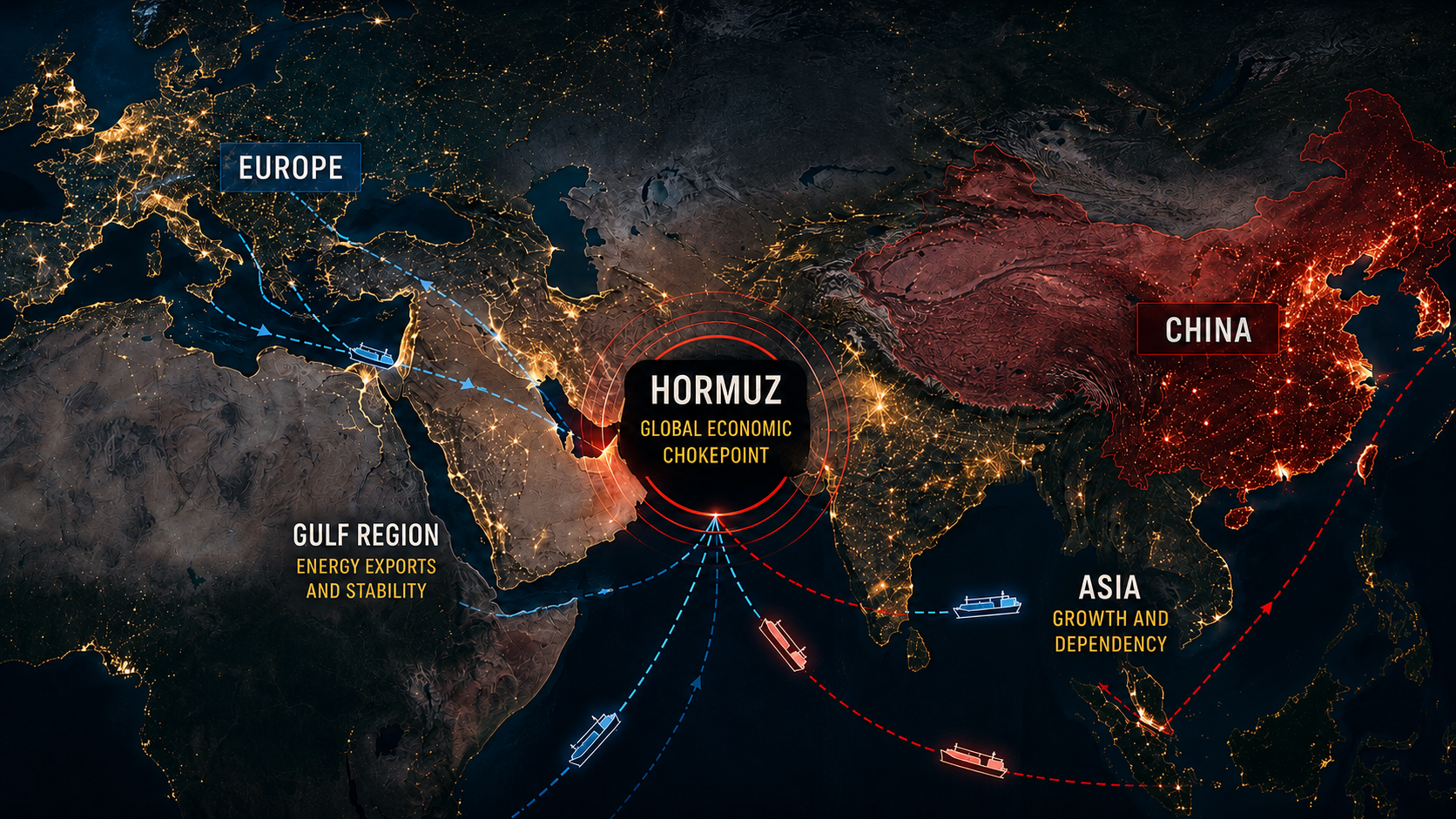
This Chokepoint Check assesses the current pressure on the Strait of Hormuz, Bab al-Mandab and critical water, power, port and energy infrastructure across the Gulf region. The key question is not merely whether a route remains geographically open, but whether transport, insurance, energy supply and site operations remain operationally viable.
The route remains geographically open, but visible traffic is still far below normal levels.
Kpler recorded nine commodity transits on Thursday, down from 14 the previous day. Eight of the nine visible vessels exited the strait.
The corridor remains navigable, while the military conflict in Yemen and attacks on Saudi Arabia continue.
Kpler recorded 26 commodity transits on Thursday, almost unchanged from the previous day. The operational environment remains tense because of the Houthi escalation.
Saudi Arabia’s Red Sea energy corridor remains under direct military threat despite the pipeline restart.
Saudi Air Defense reported the interception of six Houthi missiles targeting Taif and Yanbu on September 24.
Kpler recorded nine commodity vessels on Thursday, down from 14 on Wednesday and below the 10-day average of 18.
Eight of the nine vessels exited Hormuz. AIS-dark transits are not included in the data.
Transport capacity remains tight. Charter, insurance and delivery-time risks remain exceptionally high.
Verification status: confirmed by current Kpler data dated September 25; dark transits prevent a complete picture of vessel traffic. Reuters / Business Recorder, September 25, 2026 · SchaafMedia: Strait of Hormuz Blockade 2026 – Chokepoint Shock
Market participants report that STS capacity off Oman has been fully utilised by additional Saudi exports.
More VLCCs must transport crude oil through Hormuz and transfer it to other tankers outside the strait.
Vessel availability is declining, freight costs are rising, and cargoes remain on the water for longer.
Verification status: confirmed by Reuters based on trading sources, analysts and current export data. Reuters / Times of Israel, September 25, 2026 · SchaafMedia: Oil as a Power Instrument – Why Energy Dominates Geopolitics and Markets in 2026
Saudi Arabia’s air defence reported on September 24 the interception of six Houthi missiles targeting Yanbu and Taif.
Yanbu therefore remains, despite the restart of the East-West Pipeline, a directly threatened energy and export hub.
Further successful strikes could again disrupt pipeline, refinery or port operations and increase dependence on Hormuz.
Verification status: confirmed by the spokesperson for the Saudi-led coalition. According to Saudi Arabia, all six missiles were intercepted. Saudi Gazette, September 24, 2026 · SchaafMedia: Iran Check – 5 Escalation Signals from September 24, 2026
President Macron announced the deployment of French troops, radar and defence systems to Yanbu.
Paris describes the mission as defensive and limited to protecting energy infrastructure.
Protection of the Red Sea export corridor is becoming internationalised. At the same time, dependence on military protection is increasing.
Verification status: confirmed by President Macron. No offensive French operation against the Houthis has been announced. Tagesschau / Reuters, September 25, 2026 · SchaafMedia: Middle East Escalation Check – September 23, 2026
The three states are planning an urgent meeting of their chiefs of staff on support for Saudi Arabia.
In parallel, the secretariat, committees and working groups of the Makkah Joint Defence Agreement are being further institutionalised.
Operational activation could further expand the Yemen conflict toward Türkiye and Pakistan and create new regional security axes.
Verification status: confirmed for the planned military talks and institutional implementation. No concrete troop deployments have yet been decided. Saudi Gazette, September 25, 2026 · SchaafMedia: Middle East Escalation Check – September 23, 2026
Hormuz remains constrained while Yanbu is again under military attack.
Saudi Arabia uses more tankers and STS transfers, while France reinforces the protection of Yanbu.
STS zones and VLCC availability become constrained, while Red Sea export capacity continues to require military protection.
Freight costs, voyage times and security costs rise even as oil supply remains available.
With nine transits, Hormuz is operating at only half its 10-day average, while STS capacity is fully utilised.
Route remains open · commercial capacity and alternative logistics remain severely constrainedYanbu and Taif have again been targeted by ballistic missiles.
Critical Saudi export infrastructure remains under direct threat despite defensive measuresMaritime bottlenecks, attacks on energy infrastructure, French military assistance and alliance activation are occurring simultaneously.
Energy, transport, military and alliance risks are systemically interconnectedOverall risk remains critical. Compared with September 23, the bottleneck is shifting from pipeline capacity alone toward tanker availability, STS transfers and military protection. At the same time, external states are becoming more institutionally integrated into Saudi Arabia’s defence. Diplomatic talks on Hormuz are creating a more concrete path toward de-escalation, but without operational implementation so far.
Disclaimer: This assessment was prepared with support from our Geo AI. AI can make mistakes. This analysis is intended as a source-based radar for potential escalation signals and does not constitute fully verified intelligence, security, insurance or investment advice. In fast-moving situations, status, source availability and risk assessments may change at short notice.
Independent of the subject covered in this article, this separate Executive Briefing provides an in-depth analysis of another critical risk domain affecting European companies.
The 27-page Executive Briefing “Black Swan Risk Mapping for Europe’s Next Mobility and Infrastructure Shock” examines how geopolitical, infrastructural and administrative developments that are currently viewed in isolation could reinforce one another.
Based on the GFDD Framework™, the report shows how these dynamics could affect operational continuity, access to critical resources and the strategic resilience of companies.
The briefing includes a structured systemic-shock analysis and a directly applicable Business Exposure Checklist for CEOs, CFOs, COOs, investors and strategy teams.
You are currently viewing a placeholder content from X. To access the actual content, click the button below. Please note that doing so will share data with third-party providers.
More Information