Executive Intelligence. Industrial Risk. Geopolitics.
Strategic Sparring
for Decision-Makers
Risk intelligence across technology, law, markets and power dynamics.


Verdeckte Geschäftsrisiken, strategische Widersprüche und kritische Abhängigkeiten frühzeitig erkennen.
Kostenlose Analyse starten →
Verdeckte Machtstrukturen, Führungsrisiken und organisatorische Blockaden frühzeitig erkennen.
Kostenlose Analyse starten →
Geopolitische Risiken, globale Abhängigkeiten und kritische Lieferkettenrisiken frühzeitig erkennen.
Kostenlose Analyse starten →
Identify hidden business risks, strategic contradictions and critical dependencies at an early stage.
Start Free Analysis →
Identify hidden power structures, leadership risks and organizational blockers at an early stage.
Start Free Analysis →
Identify geopolitical risks, global dependencies and critical supply-chain vulnerabilities at an early stage.
Start Free Analysis →
Verdeckte Geschäftsrisiken, strategische Widersprüche und kritische Abhängigkeiten frühzeitig erkennen.
Kostenlose Analyse starten →
Verdeckte Machtstrukturen, Führungsrisiken und organisatorische Blockaden frühzeitig erkennen.
Kostenlose Analyse starten →
Geopolitische Risiken, globale Abhängigkeiten und kritische Lieferkettenrisiken frühzeitig erkennen.
Kostenlose Analyse starten →
Identify hidden business risks, strategic contradictions and critical dependencies at an early stage.
Start Free Analysis →
Identify hidden power structures, leadership risks and organizational blockers at an early stage.
Start Free Analysis →
Identify geopolitical risks, global dependencies and critical supply-chain vulnerabilities at an early stage.
Start Free Analysis →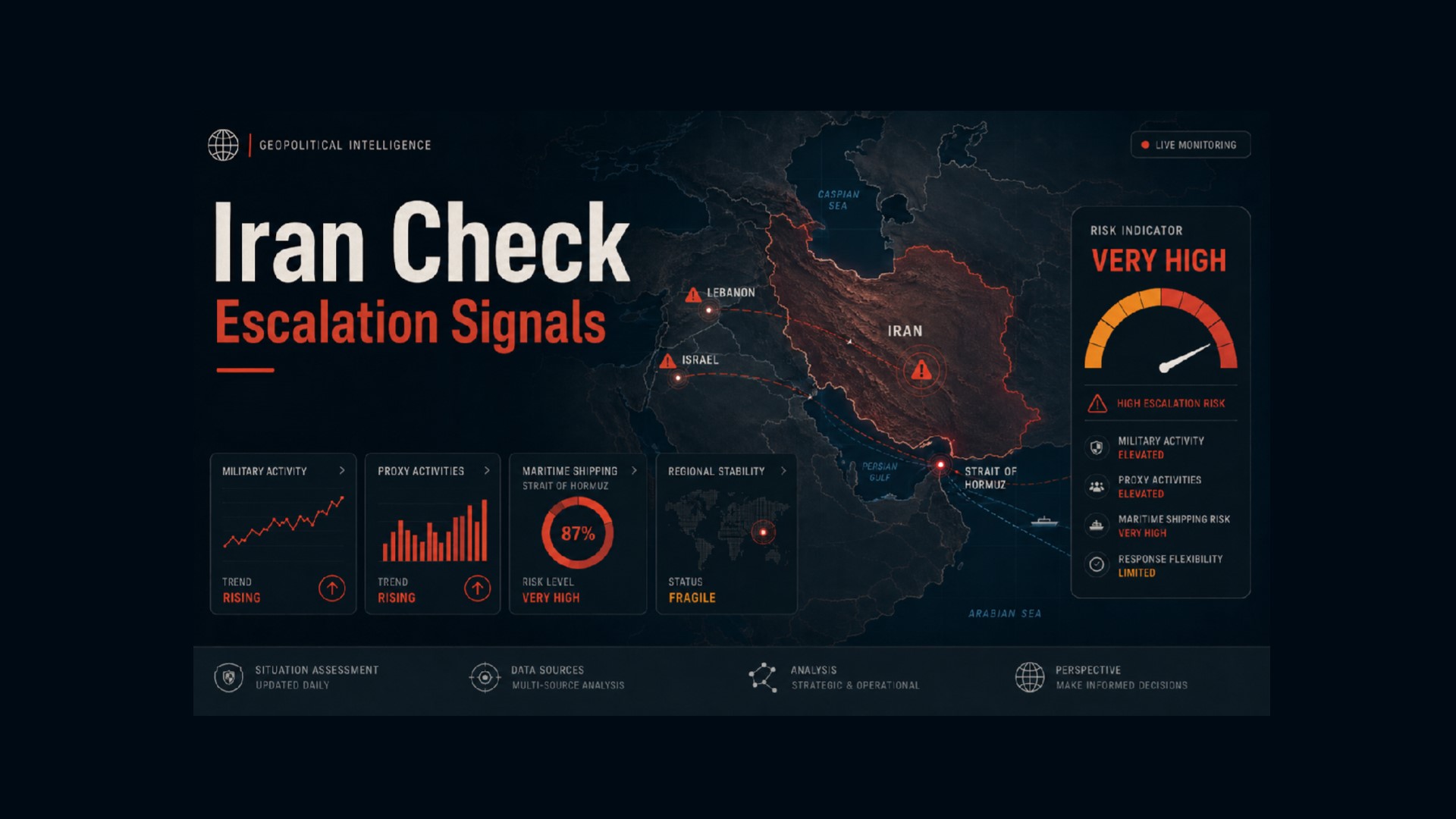
This escalation radar summarizes five relevant signals as of September 24, 2026. The focus is on verifiable statements by official sources, confirmed events and monitoring data with potential implications for energy prices, supply chains, markets, maritime security, aviation and regional stability.
Iran is reviewing the U.S. response to its peace proposals, but there is no sign of substantive convergence. Brent rises back above $103 per barrel on September 24.
Tehran warns neighbouring states that their airports could be rendered inoperable if they stop Iranian flights under U.S. sanctions pressure. The first international connections are already being cancelled.
A Greek-operated Patriot system has shot down a ballistic missile and a drone over Saudi Arabia’s Yanbu energy region. Their origin was not initially disclosed.
| Actor | Type | Severity | Status | Source / Verification | Business Impact |
|---|---|---|---|---|---|
| Iran / United States / Qatar / UN General Assembly / Hormuz | U.S.-Iran negotiations remain far apart – oil reacts immediately | Critical · Level 5/5 | The diplomatic opening has so far failed to produce credible convergence. Following the indirect talks on September 23, Iran is reviewing the U.S. response to its peace proposals. An Iranian official says the two sides remain far apart. President Pezeshkian simultaneously rejects political capitulation under U.S. pressure. Brent rises again above $103 per barrel on September 24. Power dynamics: Diplomacy has resumed, but it has not yet broken the military and economic escalation logic. | Current market and negotiation situation: Reuters, September 24, 2026 . Background on the talks: Reuters, September 23, 2026 . Verification status: confirmed for the continuing disagreements, Iran’s review of the U.S. response and the oil market reaction. No breakthrough or ceasefire agreement has been confirmed. Further analysis: Schaaf Media · Strait of Hormuz Blockade 2026: Protecting Margins and Supply Chains in the Chokepoint Shock . | Critical business impact on oil, LNG, inflation, freight rates, markets and investment decisions. As long as diplomacy fails to generate operational de-escalation, high risk premiums in energy and transport will persist. |
| Iran / United States / Iraq / Oman / Gulf States / civil aviation | Iran threatens neighbouring states with disabling their airports | Critical · Level 5/5 | The conflict is expanding into civilian aviation infrastructure. Supreme National Security Council Secretary Mohsen Rezaei says on September 23 that Iran would ensure that airports in neighbouring states could no longer operate if those countries halted Iranian flights under U.S. pressure. The threat follows new U.S. secondary-sanctions risks for service providers supporting Iranian airlines. Flights to Baghdad, Muscat and other destinations are already being restricted. At the same time, some Iranian airlines continue to fly to China, Türkiye and other countries. Power dynamics: Economic sanctions are now generating a direct threat logic against regional civilian infrastructure. | Iranian threat: Reuters, September 23, 2026 . Current operational impact: AFP / Free Malaysia Today, September 24, 2026 . Verification status: confirmed for Rezaei’s public threat and several flight cancellations. No actual Iranian operation against an airport has been confirmed. Background: Schaaf Media · Iran War: How the West Is Fighting While Losing Its Dominance . | Critical business impact on civil aviation, airports, cargo, business travel, insurance and regional logistics. The threat expands the potential risk zone from Iranian airlines to foreign airports. Existing EASA CZIBs for Iran and several neighbouring regions remain active until September 30. |
| Saudi Arabia / Greece / Iran-aligned actors / Yanbu | Greek Patriot system intercepts ballistic missile and drone over Yanbu | Critical · Level 5/5 | The international air-defence role in Saudi Arabia is becoming increasingly operational. A Patriot system operated by Greek military personnel intercepts on September 24 a ballistic missile and a drone in the wider Yanbu area. Yanbu hosts critical oil-refining and export infrastructure. Saudi Civil Defence simultaneously warns of risks in Mecca, Tabuk, Jeddah, Yanbu and Taif. The origin of the missile and drone was not initially disclosed. Power dynamics: European forces are increasingly taking on concrete defensive roles for Saudi energy infrastructure. | Confirmed by Reuters, September 24, 2026 . Verification status: confirmed for the interception of a ballistic missile and a drone by the Greek-operated Patriot system. The origin of both projectiles has not been confirmed. Further analysis: Schaaf Media · Middle East Escalation Check – September 23, 2026 . | Critical business impact on Yanbu, Saudi refineries, oil exports, aviation, insurance and military logistics. Repeated activation of foreign air-defence systems highlights the continuing threat to critical energy infrastructure. |
| Houthis / Iran / Yemen / Saudi Arabia / Taiz / Aden | Houthis attempt to break through strategic Taiz-Aden supply route | High to Critical · Level 4/5 | The Houthi offensive is shifting further toward southern Yemen. Saudi-backed government forces say on September 24 that they repelled coordinated Houthi attacks overnight on the Hejat al-Abd route. The road connects Taiz with Lahj and Aden and is a critical supply corridor for government forces and civilians. The offensive follows Houthi territorial gains along the Red Sea coast and around Bab el-Mandeb. Power dynamics: The Houthis are attempting to connect their coastal gains with pressure on southern supply logistics. | Confirmed as a government account by Reuters, September 24, 2026 . Regional reporting: Al Jazeera, September 24, 2026 . Verification status: partially confirmed. Intense fighting around the strategic route is confirmed. Casualty figures come primarily from government forces; no Houthi statement has been issued. Background: Schaaf Media · Iran’s Proxies: The Hidden Escalation Map of the Middle East . | High to critical business impact on Aden, Taiz, Bab el-Mandeb, land logistics, humanitarian supply and Red Sea shipping. Disruption of the route would significantly increase pressure on southern Yemen and regional supply corridors. |
| China / United States / Iran / Taiwan | Iran war becomes part of Trump-Xi great-power bargaining | High to Critical · Level 4/5 | The Iran conflict is becoming directly linked on September 24 to the China-U.S.-Taiwan axis. President Trump welcomes Xi Jinping in Washington. According to Reuters sources, China is offering support in applying pressure on Iran, while Beijing is simultaneously seeking restrictions on U.S. arms deliveries to Taiwan. No corresponding agreement has been confirmed. China also continues to maintain important economic and transport links with Iran. Power dynamics: The Iran war is therefore becoming part of a broader U.S.-China negotiating framework extending as far as Taiwan. | Current summit assessment: Reuters, September 24, 2026 . Verification status: partially confirmed. The Trump-Xi meeting and the Iran war as a discussion topic are confirmed. The potential linkage between pressure on Iran and Taiwan concessions is based on Reuters sources; no deal has been confirmed. Background: Schaaf Media · Iran Check: 5 Escalation Signals – September 22, 2026 . | High to critical business impact on U.S.-China relations, sanctions, energy trade, Taiwan risk and global supply chains. Linking Iran and Taiwan would connect two previously separate geopolitical risk clusters. |
The most important political development on September 24, 2026 is the still-open but deadlocked U.S.-Iran diplomatic window. Tehran is reviewing the U.S. response to its proposals, but the two sides remain far apart. At the same time, Brent has risen back above $103. Markets therefore see no credible de-escalation yet.
Operationally, the risk zone is expanding into aviation. Iran is threatening neighbouring states with disabling their airports if they halt Iranian flights under U.S. sanctions pressure. International flight connections are already being cancelled. Sanctions, civil aviation and military deterrence are therefore becoming directly interconnected.
Saudi Arabia’s energy infrastructure also remains under threat. A Greek-operated Patriot system has intercepted a ballistic missile and a drone over Yanbu. In parallel, the Houthis are attempting to pressure the strategic Taiz-Aden supply corridor. Energy and logistics routes therefore remain exposed at the same time.
A stronger global conflict linkage is also emerging. At the Trump-Xi summit, the Iran war has become part of U.S.-China negotiations and therefore indirectly touches the Taiwan issue as well. No new Iranian alliance, partner or observer status has been confirmed as of September 24. EASA CZIBs for Iran, Iraq, Jordan, Lebanon, the Persian Gulf and Gulf of Oman remain active until September 30, 2026; no new revision was published on September 24.
The five most important signals for a European risk assessment are: the still-deadlocked U.S.-Iran negotiating window amid renewed oil-price increases, Iran’s direct threat against airports in states that halt Iranian flights under U.S. pressure, the interception of a ballistic missile and a drone over Saudi Arabia’s Yanbu energy region by a Greek-operated Patriot system, the new Houthi offensive against the strategic Taiz-Aden supply corridor, and the linkage of the Iran war with the China-U.S.-Taiwan axis at today’s Trump-Xi summit.
Note: This assessment was prepared with support from our Geo-AI. AI can make mistakes. The analysis is intended as a radar for potential escalation signals and does not replace a fully verified intelligence assessment.
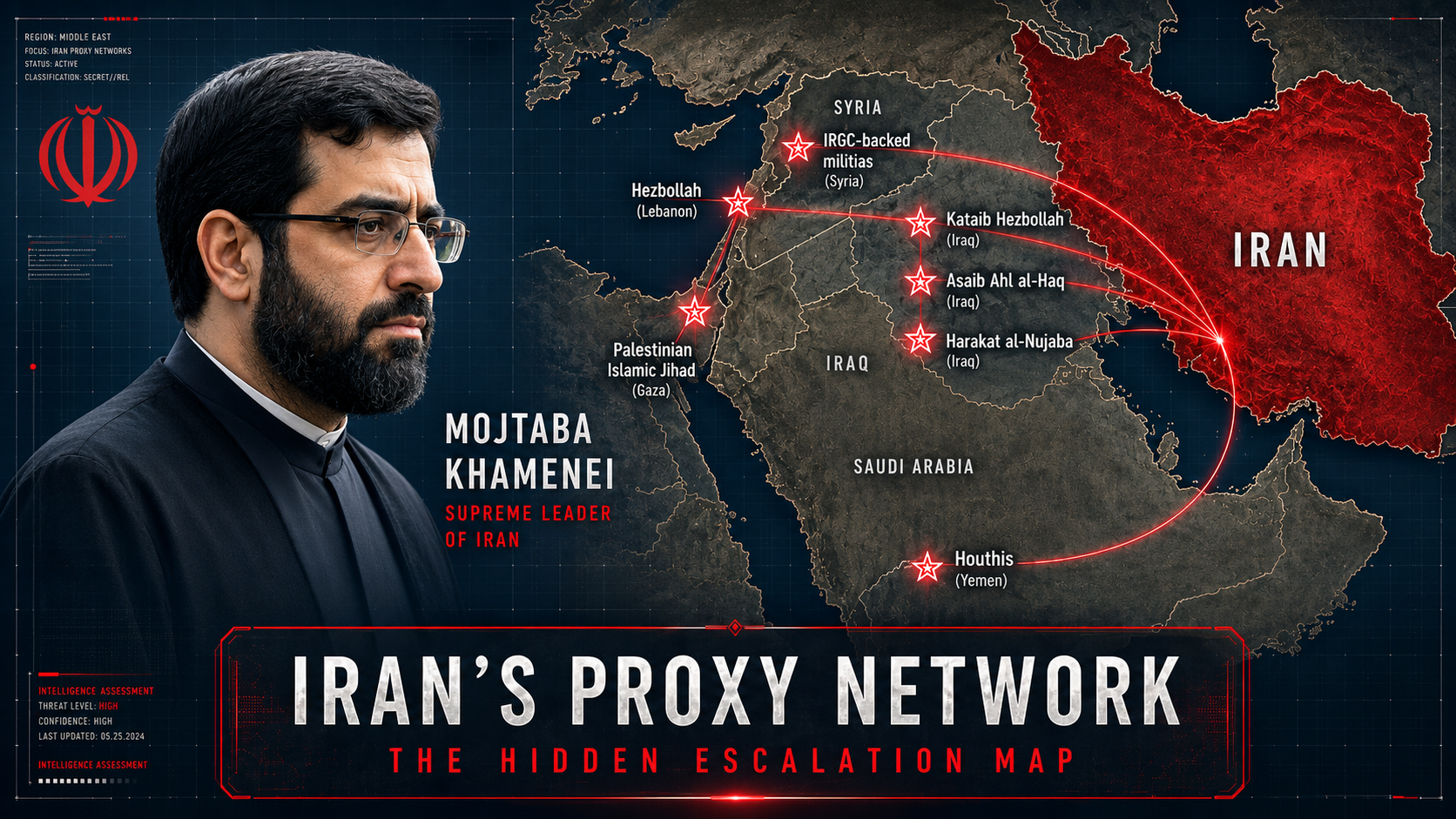
What decision-makers should watch now — before proxy escalation becomes a cost, compliance or supply-chain shock.
This 17-page executive briefing translates Iran’s proxy network into concrete business risks: energy price exposure, maritime chokepoints, war-risk premiums, sanctions, shadow fleets, supply-chain disruption and early-warning indicators for board-level decisions.
You are currently viewing a placeholder content from X. To access the actual content, click the button below. Please note that doing so will share data with third-party providers.
More Information