Executive Intelligence. Industrial Risk. Geopolitics.
Strategic Sparring
for Decision-Makers
Risk intelligence across technology, law, markets and power dynamics.


Verdeckte Geschäftsrisiken, strategische Widersprüche und kritische Abhängigkeiten frühzeitig erkennen.
Kostenlose Analyse starten →
Verdeckte Machtstrukturen, Führungsrisiken und organisatorische Blockaden frühzeitig erkennen.
Kostenlose Analyse starten →
Geopolitische Risiken, globale Abhängigkeiten und kritische Lieferkettenrisiken frühzeitig erkennen.
Kostenlose Analyse starten →
Identify hidden business risks, strategic contradictions and critical dependencies at an early stage.
Start Free Analysis →
Identify hidden power structures, leadership risks and organizational blockers at an early stage.
Start Free Analysis →
Identify geopolitical risks, global dependencies and critical supply-chain vulnerabilities at an early stage.
Start Free Analysis →
Verdeckte Geschäftsrisiken, strategische Widersprüche und kritische Abhängigkeiten frühzeitig erkennen.
Kostenlose Analyse starten →
Verdeckte Machtstrukturen, Führungsrisiken und organisatorische Blockaden frühzeitig erkennen.
Kostenlose Analyse starten →
Geopolitische Risiken, globale Abhängigkeiten und kritische Lieferkettenrisiken frühzeitig erkennen.
Kostenlose Analyse starten →
Identify hidden business risks, strategic contradictions and critical dependencies at an early stage.
Start Free Analysis →
Identify hidden power structures, leadership risks and organizational blockers at an early stage.
Start Free Analysis →
Identify geopolitical risks, global dependencies and critical supply-chain vulnerabilities at an early stage.
Start Free Analysis →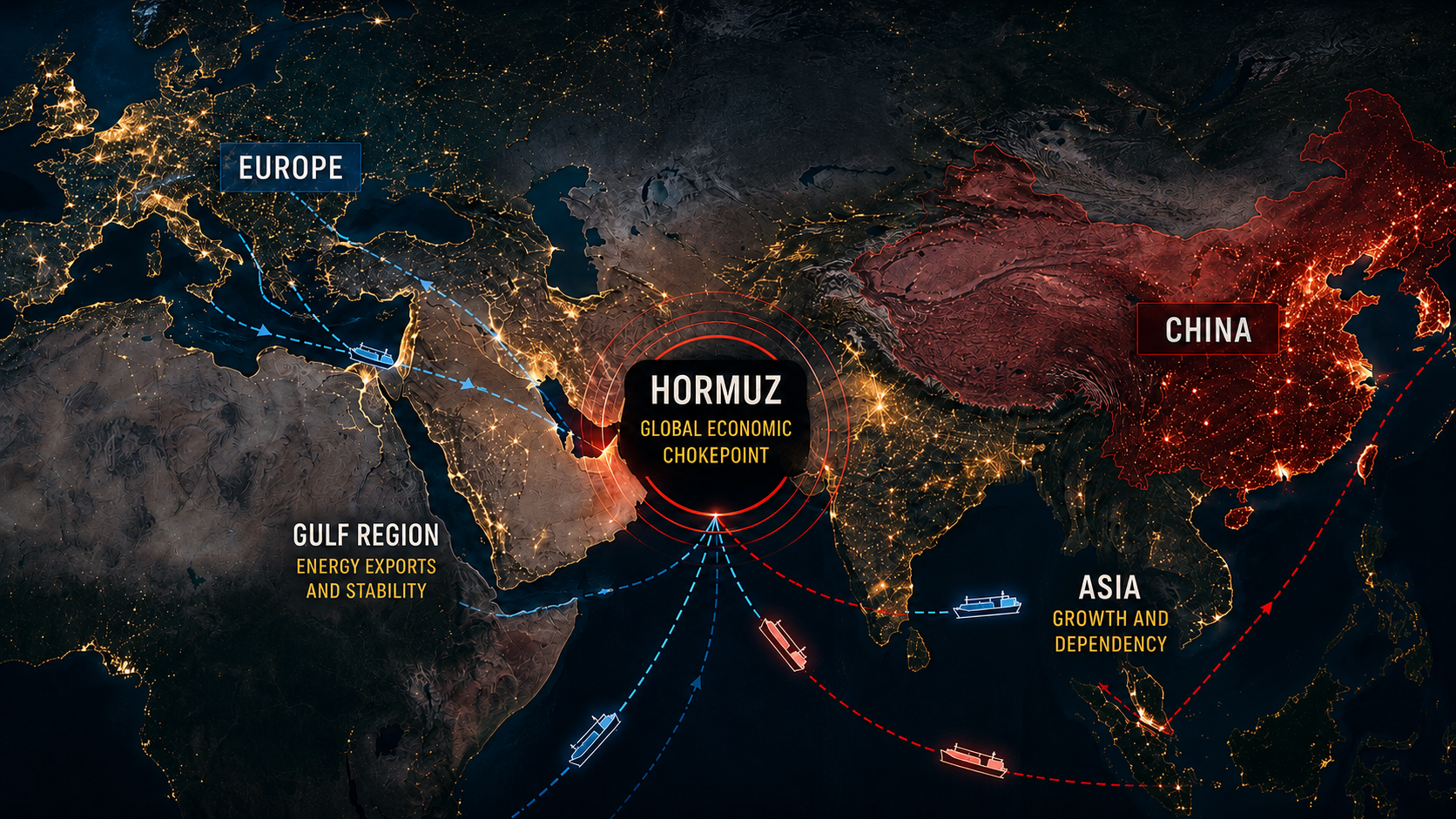
This Chokepoint Check assesses the current pressure on the Strait of Hormuz, Bab al-Mandab and critical water, power, port and energy infrastructure across the Gulf region. The key question is not merely whether a route remains geographically open, but whether transport, insurance, energy supply and site operations remain operationally viable.
The route remains geographically open, but visible commercial traffic remains at an extreme low.
Kpler recorded only three commodity transits on Tuesday, down from four the previous day. At the same time, the LNG tanker Al Mafyar reappeared inside the strait.
The corridor remains navigable, while transit stays below average and fighting along the Red Sea coast continues.
On Tuesday, 22 commodity vessels passed through the strait, compared with a 10-day average of around 26 vessels.
Saudi Arabia’s most important bypass around Hormuz is operational again, initially at significantly reduced capacity.
The East-West Pipeline restarted on 22 September. Full capacity could still take six to eight weeks, according to sources.
Kpler recorded three commodity vessels on Tuesday, compared with four on Monday and around 15 on the 10-day average.
All three visible vessels exited the strait. AIS-dark transits remain outside the dataset.
Predictable Gulf logistics remain severely constrained. Charter, insurance and capacity risks remain exceptionally high.
Verification status: confirmed by current Kpler data dated 23 September; dark transits prevent a complete picture of vessel traffic. Reuters, 23 September 2026 · SchaafMedia: Chokepoint Check – Hormuz, Trade Routes & Supply Chain Risks
Saudi Arabia restarted the East-West Pipeline on 22 September following the attack, initially at a low flow rate.
Around 40 percent of capacity could be restored within several days. Full restoration is expected to take six to eight weeks.
The Red Sea route is regaining real export capacity. This reduces supply pressure, but does not eliminate infrastructure risk.
Verification status: confirmed by several sources familiar with operations; Aramco initially declined to comment. Reuters, 22 September 2026 · SchaafMedia: Middle East Escalation Check – 21 September 2026
The Houthis reported new Saudi strikes on Mokha, while fighting continues along the strategic Red Sea coast.
Specific casualty claims originate from Houthi-linked sources. The continued military confrontation, however, is broadly documented.
The Bab al-Mandab corridor remains exposed to a direct military conflict environment, even though shipping remains possible.
Verification status: partially confirmed. Saudi airstrikes and fighting are documented; individual Houthi claims regarding damage and casualties remain unverified. AFP / The Manila Times, 23 September 2026 · SchaafMedia: Middle East Escalation Check – 21 September 2026
At Saudi Arabia’s request, London is providing an RAF Voyager for defensive air-to-air refuelling of Saudi aircraft.
According to London, the mission is defensive and time-limited. It nevertheless directly extends the endurance of Saudi air operations.
Saudi air defence gains additional operational reach. At the same time, a NATO member becomes more directly involved in the regional security architecture.
Verification status: confirmed by the UK Ministry of Defence. British combat operations against the Houthis have not been announced. UK Ministry of Defence, 22 September 2026 · SchaafMedia: Iran Check – 5 Escalation Signals, 22 September 2026
On 22 September, France began working with the United States on a new UN Security Council draft aimed at safeguarding freedom of navigation through Hormuz.
The proposal envisages an international mission to protect commercial shipping, explicitly without an offensive mandate against Iran.
A UN mandate could institutionalise maritime security and facilitate transit. No resolution has yet been adopted.
Verification status: confirmed for the drafting process. Security Council approval or operational implementation has not yet occurred. Reuters, 22 September 2026 · SchaafMedia: Chokepoint Check – Hormuz, Trade Routes & Supply Chain Risks
Hormuz remains severely constrained, while Bab al-Mandab remains embedded in an active military conflict zone.
Saudi Arabia restarts the East-West Pipeline while external states prepare additional security support.
Red Sea exports can gradually resume, while visible Hormuz capacity remains extremely low.
Oil supply pressure eases partially, while insurance, security and routing costs remain structurally elevated.
Hormuz records only three visible transits, while Bab al-Mandab remains below its 10-day average.
Both chokepoints remain open · commercial capacity and security remain severely constrainedThe East-West Pipeline is operating again, but initially only at reduced throughput.
Critical export infrastructure partially restored · full capacity remains weeks awayMaritime restrictions, Saudi-Houthi fighting, British military support and UN security initiatives are operating simultaneously.
Energy, transport, military and international security architecture remain systemically interconnectedOverall risk remains critical, but there is now the first tangible operational relief. The East-West Pipeline is restoring additional export capacity, while Hormuz and Bab al-Mandab remain significantly constrained. At the same time, the security architecture is becoming increasingly international: the United Kingdom is providing direct support, while France and the United States are seeking a multilateral solution for Hormuz.
Disclaimer: This assessment was prepared with support from our Geo AI. AI can make mistakes. This analysis is intended as a source-based radar for potential escalation signals and does not constitute fully verified intelligence, security, insurance or investment advice. In fast-moving situations, status, source availability and risk assessments may change at short notice.
Independent of the subject covered in this article, this separate Executive Briefing provides an in-depth analysis of another critical risk domain affecting European companies.
The 27-page Executive Briefing “Black Swan Risk Mapping for Europe’s Next Mobility and Infrastructure Shock” examines how geopolitical, infrastructural and administrative developments that are currently viewed in isolation could reinforce one another.
Based on the GFDD Framework™, the report shows how these dynamics could affect operational continuity, access to critical resources and the strategic resilience of companies.
The briefing includes a structured systemic-shock analysis and a directly applicable Business Exposure Checklist for CEOs, CFOs, COOs, investors and strategy teams.
You are currently viewing a placeholder content from X. To access the actual content, click the button below. Please note that doing so will share data with third-party providers.
More Information