Executive Intelligence. Industrial Risk. Geopolitics.
Strategic Sparring
for Decision-Makers
Risk intelligence across technology, law, markets and power dynamics.

Verdeckte Geschäftsrisiken, strategische Widersprüche und kritische Abhängigkeiten frühzeitig erkennen.
Kostenlose Analyse starten →
Verdeckte Machtstrukturen, Führungsrisiken und organisatorische Blockaden frühzeitig erkennen.
Kostenlose Analyse starten →
Geopolitische Risiken, globale Abhängigkeiten und kritische Lieferkettenrisiken frühzeitig erkennen.
Kostenlose Analyse starten →
Identify hidden business risks, strategic contradictions and critical dependencies at an early stage.
Start Free Analysis →
Identify hidden power structures, leadership risks and organizational blockers at an early stage.
Start Free Analysis →
Identify geopolitical risks, global dependencies and critical supply-chain vulnerabilities at an early stage.
Start Free Analysis →
Verdeckte Geschäftsrisiken, strategische Widersprüche und kritische Abhängigkeiten frühzeitig erkennen.
Kostenlose Analyse starten →
Verdeckte Machtstrukturen, Führungsrisiken und organisatorische Blockaden frühzeitig erkennen.
Kostenlose Analyse starten →
Geopolitische Risiken, globale Abhängigkeiten und kritische Lieferkettenrisiken frühzeitig erkennen.
Kostenlose Analyse starten →
Identify hidden business risks, strategic contradictions and critical dependencies at an early stage.
Start Free Analysis →
Identify hidden power structures, leadership risks and organizational blockers at an early stage.
Start Free Analysis →
Identify geopolitical risks, global dependencies and critical supply-chain vulnerabilities at an early stage.
Start Free Analysis →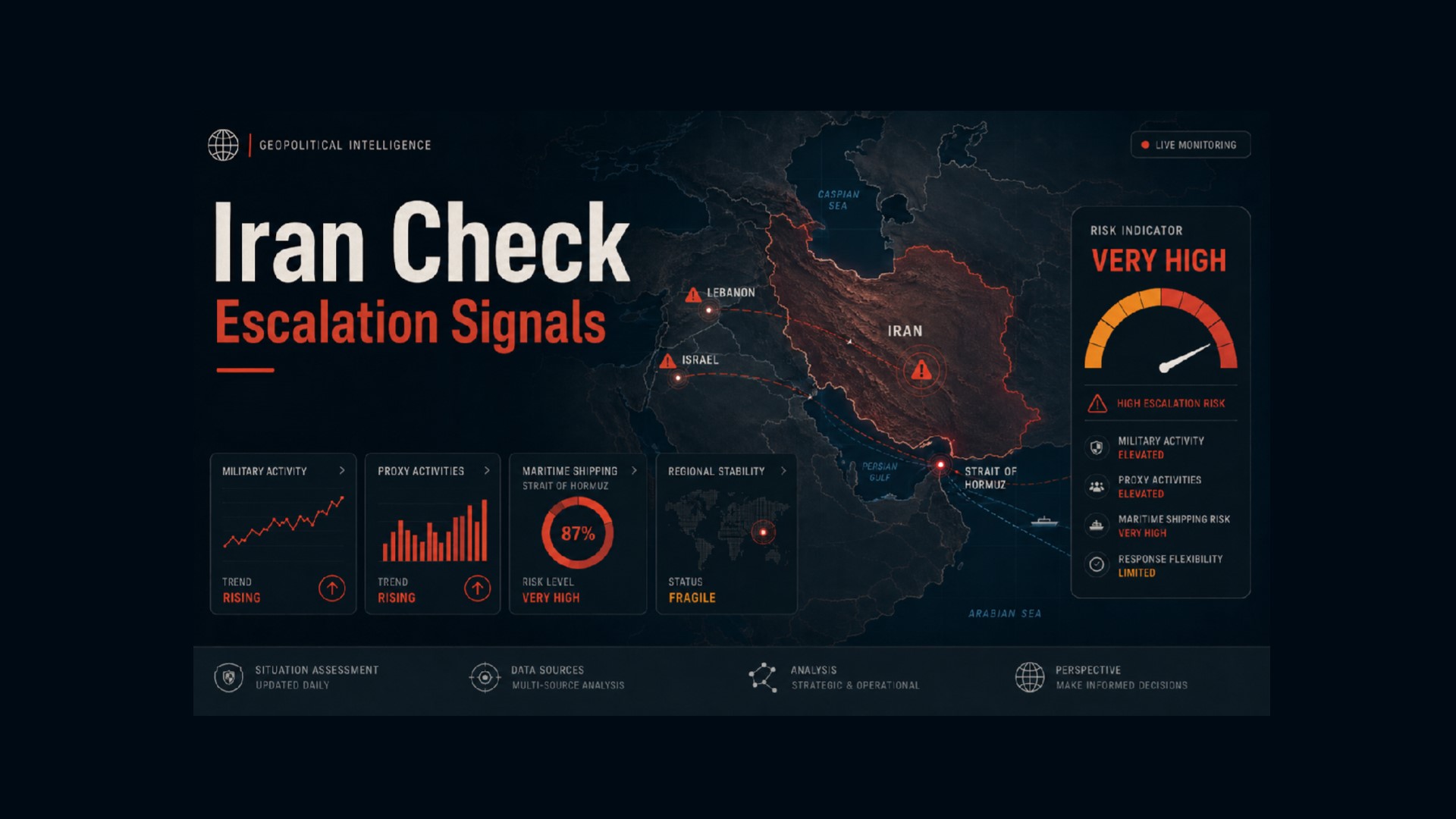
This escalation radar summarizes five relevant signals from June 20, 2026. The focus is on verifiable official statements, confirmed events, and monitoring sources with potential impact on energy prices, supply chains, markets, and regional security.
The diplomatic track remains possible, but renewed violence in Lebanon and Israel’s security concerns continue to strain implementation.
Israeli strikes after a renewed ceasefire show that the Lebanon front can still disrupt the broader US-Iran process.
The Strait of Hormuz is politically reopening, but maritime security guarantees, insurance costs, and energy-market risks remain key stress factors.
| Actor | Type | Severity | Status | Source / Verification status | Business impact |
|---|---|---|---|---|---|
| Iran / USA / US-Iran negotiation process | Diplomacy under pressure from Lebanon escalation | High to critical · Level 4/5 | The continuation of US-Iran talks remains uncertain on June 20, 2026. Reuters reports that new Israeli strikes in Lebanon are weighing on the outlook for further US-Iran talks. The central risk has therefore shifted: the question is no longer only whether a US-Iran framework exists, but whether it can be implemented while Israel, Hezbollah, Lebanon and the Hormuz issue remain active pressure points. | Confirmed by Reuters, June 20, 2026. Verification status: confirmed for new Israeli strikes, the strain on the ceasefire and the uncertain outlook for further US-Iran talks; open when and under what conditions the next negotiation round can actually take place. | High relevance for oil prices, sanctions, Iran exposure, political risk premiums, energy planning, supply chains, insurance, and companies with Middle East or Gulf exposure. |
| Israel / Benjamin Netanyahu / Israeli public and security debate | Domestic backlash and security doubts after the Iran deal | High to critical · Level 4/5 | In Israel, the US-Iran agreement is triggering anger and a sense of betrayal among parts of the public and political environment. According to The Guardian, many Israelis view the deal as a security failure because it does not eliminate the perceived threat from Iran and Hezbollah and may limit Israel’s freedom of military response, especially in Lebanon. This strengthens the risk that Israel continues to interpret the Lebanon front through its own security doctrine rather than through the US-Iran de-escalation framework. | Confirmed by The Guardian, June 20, 2026. Verification status: confirmed for Israeli anger, security concerns and the political backlash after the Iran deal; open whether this domestic pressure will translate into further military action in Lebanon. | Increased risk for Israel, Lebanon, air traffic, infrastructure, evacuations, insurance, banks, regional supply chains, investment decisions, and companies with Israel or Levant exposure. |
| USA / Qatar / Israel / Hezbollah | US- and Qatar-mediated ceasefire as precondition for further Iran diplomacy | High · Level 3/5 | US officials said a renewed ceasefire between Israel and Hezbollah was back in force. According to Axios, the agreement was mediated by the United States and Qatar, with Iranian support. At the same time, clashes reportedly continued even after the ceasefire was supposed to take effect. This makes the ceasefire an operational precondition for renewed US-Iran diplomacy, but not yet a reliable stabilizer. | Confirmed by Axios, June 19, 2026. Verification status: confirmed for the US account of a renewed ceasefire, Qatar’s role and the link to US-Iran talks; open whether the ceasefire is militarily sustainable. | Short-term calming signal for markets, but high relapse risk for oil, freight rates, insurance, Middle East exposure, supply chains, and political planning certainty. |
| Hormuz / IMO / maritime security | Monitoring background: seafarer protection, freedom of navigation and security guarantees | Critical · Level 5/5 | The International Maritime Organization assesses the US-Iran agreement as an important step back toward peace, diplomacy and freedom of navigation. At the same time, the IMO points to at least 46 verified attacks against international shipping in and around the Strait of Hormuz since the beginning of the conflict. For June 20, 2026, this source is therefore relevant as a maritime monitoring and security baseline, even though it is not a daily source from June 20. | Confirmed by International Maritime Organization, June 15, 2026. Verification status: confirmed for IMO’s assessment, documented attacks, seafarer protection and maritime security concerns; not a daily source from June 20, 2026, but still a credible official monitoring source for Hormuz. | Direct business impact on tanker routing, crew safety, marine insurance, LNG, oil, shipping companies, port planning, supply-chain costs, and risk models. |
| Hormuz / EIA / energy and supply-chain markets | Monitoring background: oil price, demand and chokepoint risk | High to critical · Level 4/5 | The EIA expects lower global oil demand to limit price increases from short-term disruptions in the Middle East. At the same time, Hormuz remains a central chokepoint: even with political de-escalation, shipping risks, insurance premiums, delayed normalization and possible setbacks can directly affect energy prices and supply chains. For June 20, 2026, this source is therefore relevant as energy and market background, not as a daily news update. | Confirmed by U.S. Energy Information Administration, June 9, 2026. Verification status: confirmed for the EIA assessment on demand, price effects and Hormuz disruptions; not a daily source from June 20, 2026, but still a relevant official energy monitoring source. | High relevance for oil, LNG, inflation, procurement prices, transport costs, inventories, energy-intensive sectors, logistics, chemicals, industrial production, and European companies. |
You are currently viewing a placeholder content from X. To access the actual content, click the button below. Please note that doing so will share data with third-party providers.
More Information