Executive Intelligence. Industrial Risk. Geopolitics.
Strategic Sparring
for Decision-Makers
Risk intelligence across technology, law, markets and power dynamics.


Verdeckte Geschäftsrisiken, strategische Widersprüche und kritische Abhängigkeiten frühzeitig erkennen.
Kostenlose Analyse starten →
Verdeckte Machtstrukturen, Führungsrisiken und organisatorische Blockaden frühzeitig erkennen.
Kostenlose Analyse starten →
Geopolitische Risiken, globale Abhängigkeiten und kritische Lieferkettenrisiken frühzeitig erkennen.
Kostenlose Analyse starten →
Identify hidden business risks, strategic contradictions and critical dependencies at an early stage.
Start Free Analysis →
Identify hidden power structures, leadership risks and organizational blockers at an early stage.
Start Free Analysis →
Identify geopolitical risks, global dependencies and critical supply-chain vulnerabilities at an early stage.
Start Free Analysis →
Verdeckte Geschäftsrisiken, strategische Widersprüche und kritische Abhängigkeiten frühzeitig erkennen.
Kostenlose Analyse starten →
Verdeckte Machtstrukturen, Führungsrisiken und organisatorische Blockaden frühzeitig erkennen.
Kostenlose Analyse starten →
Geopolitische Risiken, globale Abhängigkeiten und kritische Lieferkettenrisiken frühzeitig erkennen.
Kostenlose Analyse starten →
Identify hidden business risks, strategic contradictions and critical dependencies at an early stage.
Start Free Analysis →
Identify hidden power structures, leadership risks and organizational blockers at an early stage.
Start Free Analysis →
Identify geopolitical risks, global dependencies and critical supply-chain vulnerabilities at an early stage.
Start Free Analysis →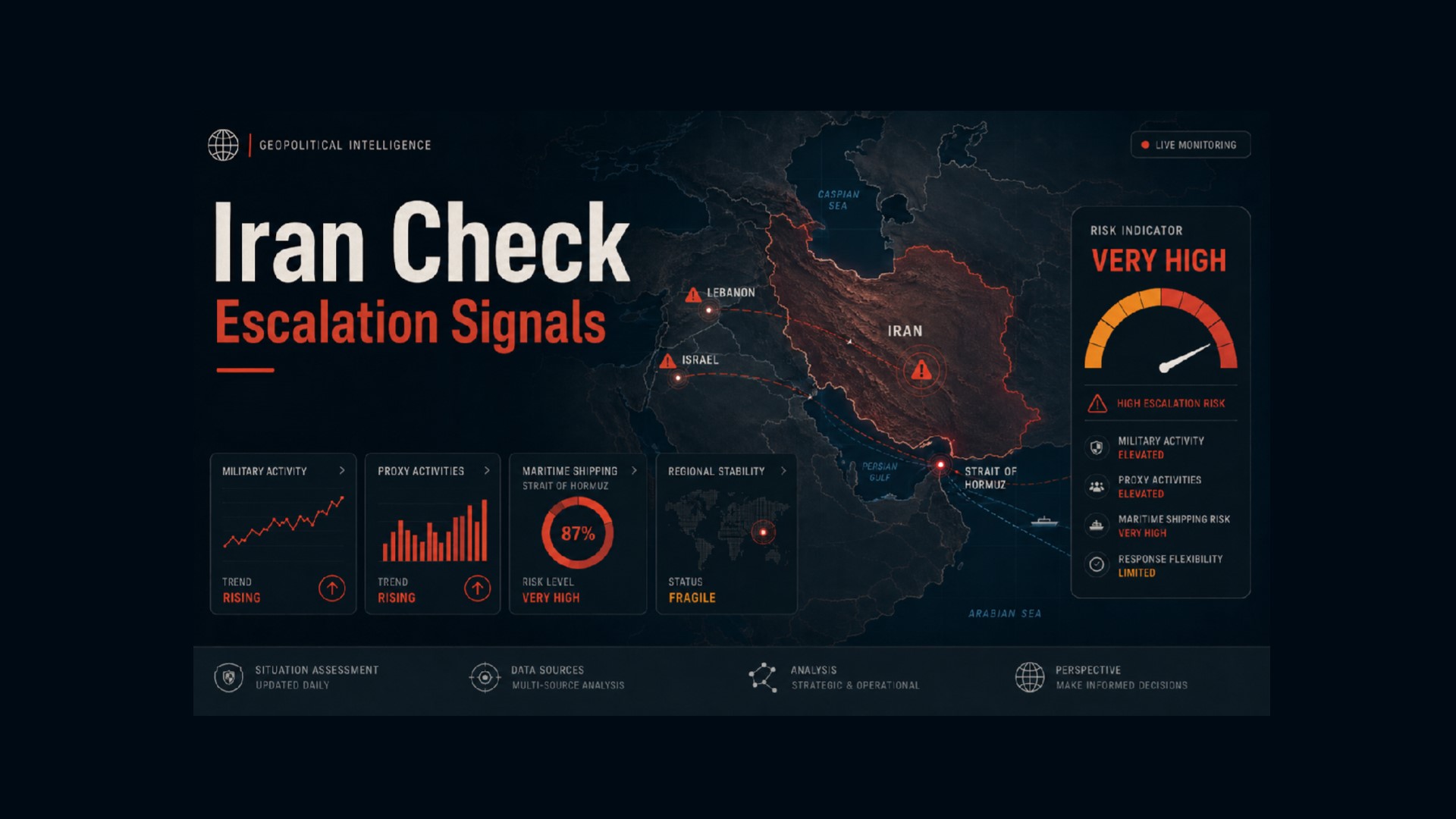
This escalation radar summarizes five relevant signals from June 22, 2026. The focus is on verifiable official statements, confirmed events, and monitoring sources with potential impact on energy prices, supply chains, markets, maritime security, and regional stability.
Mediators report a 60-day roadmap, technical talks, and a communication line for Hormuz. Implementation remains politically fragile.
Iranian closure threats, safe passage for commercial vessels, and insurance questions show that the route has not yet normalized.
Threats, loss of face, mistrust, and domestic political pressure can override operational progress at any time.
| Actor | Type | Severity | Status | Source / Verification status | Business impact |
|---|---|---|---|---|---|
| Iran / USA / Qatar / Pakistan | 60-day roadmap, technical talks, and Hormuz communication line | High to critical · Level 4/5 | Reuters reports that the first high-level round of talks between the United States and Iran in Switzerland has been completed. Mediators from Qatar and Pakistan reported a roadmap toward a final agreement within 60 days. In addition, technical talks, a mechanism to contain the fighting in Lebanon, and a communication line for safe commercial shipping through the Strait of Hormuz were agreed. | Confirmed by Reuters, June 22, 2026. Verification status: confirmed for the completion of the talks, the 60-day roadmap, technical follow-up talks, the Lebanon mechanism, and the Hormuz communication line; open whether the arrangements can be implemented in an operationally resilient way. | High relevance for oil prices, sanctions, Iran exposure, political risk premiums, energy planning, supply chains, insurance, and companies with Middle East or Gulf exposure. |
| Iran / Hezbollah / Israel / Lebanon | Lebanon as emotional and military stress test | High to critical · Level 4/5 | Al Jazeera reports that the Lebanon ceasefire appears to be holding, but continues to act as a neuralgic point in the US-Iran negotiations. Iranian actors emphasize progress, while at the same time warning Israel against further presence in southern Lebanon. From a human-dynamics perspective, the situation remains dangerous because several actors are under pressure to avoid loss of face, maintain deterrence, and respond to revenge expectations: each side must show strength without visibly breaking the deal. | Confirmed by Al Jazeera, June 22, 2026. Verification status: confirmed for the roadmap, technical follow-up talks, Lebanon connection, and Iranian warning rhetoric; the human-dynamics assessment is an analytical interpretation based on the reported statements. | Increased risk for Lebanon, northern Israel, evacuations, political predictability, investment decisions, regional supply chains, and companies with Levant or Middle East exposure. |
| USA / Iran / negotiation level | Human dynamics: difficult start, threat posture, and loss of face | High · Level 3/5 | The Guardian describes the first day of the renewed talks as progress after a difficult start. Strong Trump statements initially created tensions; Iranian negotiators reacted sensitively, but the talks continued through mediators. This dynamic matters for the escalation radar: not only formal content matters, but also status, humiliation, loss of face, and whether actors must show strength domestically while still trying to negotiate externally. | Confirmed by The Guardian, June 22, 2026. Verification status: confirmed for the difficult start, progress signal, and role of threat rhetoric; the human-dynamics layer is an analytical inference from the described negotiation situation. | High relevance for political risk premiums, market volatility, supply-chain timing decisions, oil-price hedging, management communication, and scenario planning. |
| Hormuz / UKMTO-JMIC / maritime operating picture | Transit risk, security level, and operational caution | Critical · Level 5/5 | The JMIC advisory note via UKMTO describes updated risks for transits through the Strait of Hormuz. The threat level was reduced after reopening signals, but remains relevant for shipowners, insurers, crews, and charterers. For June 22, 2026, this source is important because it addresses not only political intentions, but concrete maritime transit and security logic. | Confirmed by JMIC / UKMTO Advisory Note 009-26, June 18, 2026. Verification status: not from June 22, 2026, but still relevant as an operational maritime security source for Hormuz transits; the daily situation should be supplemented with current AIS and shipping-company data. | Direct business impact on tanker routing, crew safety, marine insurance, LNG, oil, port planning, freight rates, supply-chain costs, and risk models. |
| Hormuz / Windward / AIS and shipping risk | Current transit data, AIS risk indicators, and chokepoint situation | High to critical · Level 4/5 | Windward Daily Intelligence reports current transit movements through the Strait of Hormuz on June 22, 2026 and points to elevated risk indicators in the Gulf region. Particularly relevant are AIS behavior, dark activity, high-risk indicators, and regional movement patterns between Iran, the UAE, and other Gulf ports. The signal: Hormuz is not only a political chokepoint, but remains an operational area where shipowners, insurers, and charterers must continuously weigh risk against delivery pressure. | Confirmed by Windward Daily Intelligence, June 22, 2026. Verification status: current maritime OSINT/AIS monitoring source; confirmed for transit movements, risk indicators, and the operational shipping picture. Detailed data may change throughout the day. | High relevance for oil, LNG, freight rates, marine insurance, transport costs, inventories, energy-intensive industries, logistics, chemicals, industrial production, and European companies. |
You are currently viewing a placeholder content from X. To access the actual content, click the button below. Please note that doing so will share data with third-party providers.
More Information