Executive Intelligence. Industrial Risk. Geopolitics.
Strategic Sparring
for Decision-Makers
Risk intelligence across technology, law, markets and power dynamics.

Verdeckte Geschäftsrisiken, strategische Widersprüche und kritische Abhängigkeiten frühzeitig erkennen.
Kostenlose Analyse starten →
Verdeckte Machtstrukturen, Führungsrisiken und organisatorische Blockaden frühzeitig erkennen.
Kostenlose Analyse starten →
Geopolitische Risiken, globale Abhängigkeiten und kritische Lieferkettenrisiken frühzeitig erkennen.
Kostenlose Analyse starten →
Identify hidden business risks, strategic contradictions and critical dependencies at an early stage.
Start Free Analysis →
Identify hidden power structures, leadership risks and organizational blockers at an early stage.
Start Free Analysis →
Identify geopolitical risks, global dependencies and critical supply-chain vulnerabilities at an early stage.
Start Free Analysis →
Verdeckte Geschäftsrisiken, strategische Widersprüche und kritische Abhängigkeiten frühzeitig erkennen.
Kostenlose Analyse starten →
Verdeckte Machtstrukturen, Führungsrisiken und organisatorische Blockaden frühzeitig erkennen.
Kostenlose Analyse starten →
Geopolitische Risiken, globale Abhängigkeiten und kritische Lieferkettenrisiken frühzeitig erkennen.
Kostenlose Analyse starten →
Identify hidden business risks, strategic contradictions and critical dependencies at an early stage.
Start Free Analysis →
Identify hidden power structures, leadership risks and organizational blockers at an early stage.
Start Free Analysis →
Identify geopolitical risks, global dependencies and critical supply-chain vulnerabilities at an early stage.
Start Free Analysis →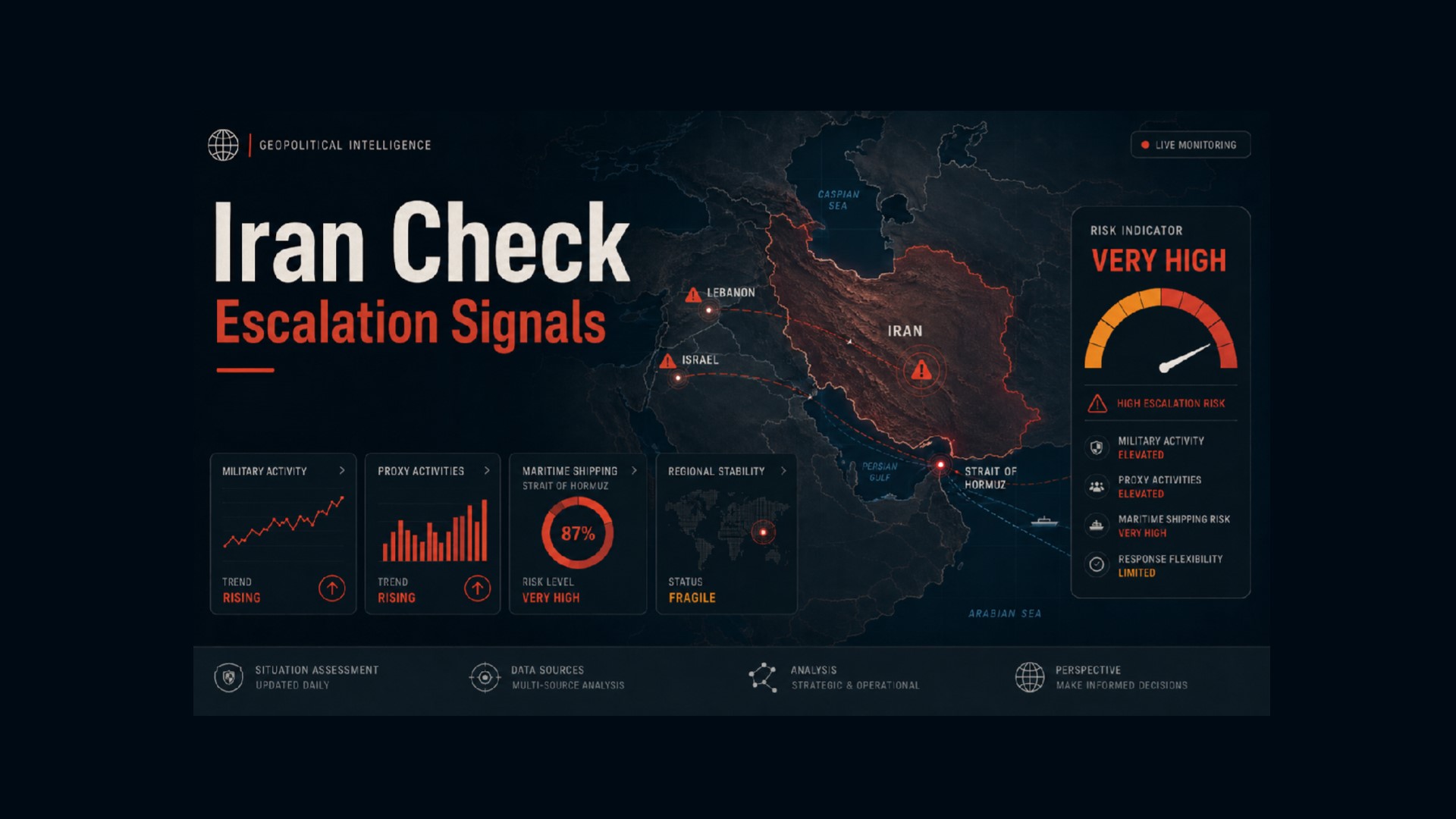
This escalation radar summarizes five relevant signals as of September 30, 2026. The focus is on verifiable statements by official sources, confirmed events and monitoring data with potential implications for energy prices, supply chains, markets, maritime security, aviation and regional stability.
Foreign Minister Araghchi has received concrete U.S. feedback via Qatar. According to Reuters, the main dispute now concerns the sequencing of the agreed steps. The negotiating channel is therefore more active than it was two days ago.
Defence Minister Asif says Pakistan will defend Saudi Arabia under the Makkah pact with all available means. He does not, however, confirm participation in airstrikes.
The complete U.S. withdrawal changes the regional balance of power. Iran and allied groups portray it as a strategic success, while security risks from militias and Islamic State could increase.
| Actor | Type | Severity | Status | Source / Verification | Business Impact |
|---|---|---|---|---|---|
| Iran / United States / Qatar / Hormuz | U.S. delivers concrete feedback on Iran’s seven-day plan | High to Critical · Level 4/5 | The negotiations are entering a new phase. Foreign Minister Abbas Araghchi receives concrete U.S. feedback through Qatari mediators on Iran’s seven-day plan. The plan is intended to build confidence, reopen Hormuz and move the parties toward a broader agreement. According to Reuters, the dispute now appears to concern less the components of the plan than the sequencing of the individual steps. Araghchi is expected to review the U.S. response in Tehran on September 30. Power dynamics: The conflict remains unresolved, but negotiations are moving for the first time from broad positions toward concrete implementation. | Confirmed by Reuters, September 30, 2026 . Verification status: confirmed for the U.S. feedback, Qatari mediation and the dispute over the sequencing of steps. No agreement or reopening of Hormuz has yet been confirmed. Further analysis: Schaaf Media · Strait of Hormuz Blockade 2026: Protecting Margins and Supply Chains in the Chokepoint Shock . | High to critical business impact on oil, LNG, tanker logistics, freight rates, marine insurance and inflation. Progress on sequencing concrete steps could reduce risk premiums. Failure would leave Hormuz in place as a pressure instrument. |
| Saudi Arabia / Iran conflict / Yanbu / oil market | Saudi Arabia resumes oil loadings via Yanbu | High · Level 3/5 | Physical energy supply is easing. Saudi Arabia has resumed tanker loadings at the Red Sea port of Yanbu following the restart of the East-West Pipeline. The pipeline had been shut down after a drone attack in September. Aramco is now again informing customers about October loadings. Saudi Arabia therefore once more has access to an important export alternative to Hormuz. Power dynamics: Restoring the east-west route reduces Iran’s leverage over Saudi export flows. | Confirmed by Dawn / Reuters, September 30, 2026 . Verification status: confirmed for the pipeline restart, resumed loadings and the new October schedule. Full pre-war capacity has not yet been restored. Background: Schaaf Media · Oil as a Power Instrument: Why Energy Dominates Geopolitics and Markets in 2026 . | High business impact on crude supply, refineries, tankers, freight rates and energy prices. Additional export capacity via the Red Sea reduces immediate dependence on Hormuz and improves supply security. |
| Pakistan / Saudi Arabia / Türkiye / Houthis / Iran | Pakistan pledges to defend Saudi Arabia with all available means | Critical · Level 5/5 | The Makkah pact is becoming militarily more concrete. Defence Minister Khawaja Muhammad Asif says Pakistan will defend Saudi Arabia with all available means against Houthi attacks. In principle, all Pakistani military capabilities would be available under the pact. Asif does not confirm, however, whether Pakistani forces have already participated in airstrikes. A concrete Saudi operational request also remains unconfirmed. Power dynamics: The mutual-defence pledge is moving from political support toward possible direct military involvement. | Confirmed by AP News, September 30, 2026 . Verification status: confirmed for Asif’s defence pledge and the general availability of Pakistani capabilities. Direct Pakistani participation in strikes has not been confirmed. Background: Schaaf Media · Middle East Escalation Check – September 29, 2026 . | Critical business impact on regional security architecture, Saudi Arabia, military logistics, energy infrastructure and investment risk. Actual Pakistani combat involvement would significantly internationalize the conflict. |
| United States / Iraq / Iran / Iran-aligned militias | U.S. forces leave final bases in Iraq – strategic space for Iran increases | High to Critical · Level 4/5 | The U.S. military withdrawal from Iraq is completed on September 30. Washington leaves its remaining bases after more than two decades of military presence. Iran and allied groups describe the withdrawal as a success of their resistance strategy. At the same time, Iraqi security officials warn of a potential security vacuum. Intelligence, aerial surveillance and containment of Islamic State are particularly affected. Power dynamics: The U.S. military footprint is shrinking, while Iran-aligned militias could gain greater political and institutional space. | Confirmed by Reuters, September 30, 2026 . Verification status: confirmed for the full U.S. withdrawal and the loss of key American intelligence and surveillance capabilities. The actual extent of any additional increase in Iranian influence remains to be seen. Further analysis: Schaaf Media · Iran’s Proxies: The Hidden Escalation Map of the Middle East . | High to critical business impact on Iraq, energy facilities, land logistics, security costs and investment risk. A weaker Western security framework increases uncertainty for companies and critical infrastructure. |
| UAE / Saudi Arabia / Houthis / Yemen | Saudi Arabia and UAE begin rapprochement after major rift | High to Critical · Level 4/5 | The Gulf security architecture is beginning to shift again. UAE Vice President Sheikh Mansour bin Zayed visits Riyadh and meets Crown Prince Mohammed bin Salman as well as Defence Minister Khalid bin Salman. It is the first high-level UAE visit since the severe rift between the two states. The meeting takes place as Saudi Arabia seeks international support against Houthi attacks. Both sides discuss regional developments as well as stronger cooperation and coordination. Power dynamics: The Houthi threat could push two previously divided Gulf powers back toward closer security cooperation. | Confirmed by Reuters, September 29, 2026 . Verification status: confirmed for the visit, the high-level meetings and discussions on stronger cooperation. Renewed direct UAE military involvement in Yemen has not been confirmed. Background: Schaaf Media · Middle East Escalation Check – September 29, 2026 . | High to critical business impact on Gulf cooperation, Yemen, Bab el-Mandeb, energy, ports and investment risk. A Saudi-Emirati security rapprochement could strengthen the regional counter-position to the Houthis. |
The most important political development on September 30, 2026 is the concrete U.S. response to Iran’s seven-day plan. The central dispute now concerns the sequencing of the planned steps. Diplomacy is therefore moving more clearly toward practical implementation for the first time. However, no agreement on reopening Hormuz has yet been reached.
Operationally, energy supply is improving at the same time. Saudi Arabia has resumed oil loadings via Yanbu. The East-West Pipeline therefore once again provides an important export alternative to the Strait of Hormuz. This reduces physical supply risk without resolving the political crisis.
At the same time, the Makkah pact is becoming militarily more concrete. Pakistan explicitly places all available defence capabilities at Saudi Arabia’s disposal. Direct Pakistani combat involvement has not yet been confirmed. However, the threshold between a mutual-defence pledge and operational support is narrowing.
The regional balance of power is also changing strategically. The United States is leaving its final bases in Iraq, while Iran and its allies portray the withdrawal as a success. At the same time, Saudi Arabia and the UAE are moving cautiously toward closer cooperation again under pressure from the Houthi escalation. EASA CZIBs for Iran, Iraq, Jordan, Lebanon, the Persian Gulf and Gulf of Oman remain active on September 30; no new extension or revision had been published at the time of review.
The five most important signals for a European risk assessment are: the concrete U.S. response to Iran’s seven-day plan for Hormuz, the resumption of Saudi oil loadings via Yanbu and the East-West Pipeline, Pakistan’s pledge to defend Saudi Arabia under the Makkah pact with all available means, the complete U.S. troop withdrawal from Iraq and the potential additional space for Iran-aligned forces, and the cautious security rapprochement between Saudi Arabia and the UAE.
Note: This assessment was prepared with support from our Geo-AI. AI can make mistakes. The analysis is intended as a radar for potential escalation signals and does not replace a fully verified intelligence assessment.
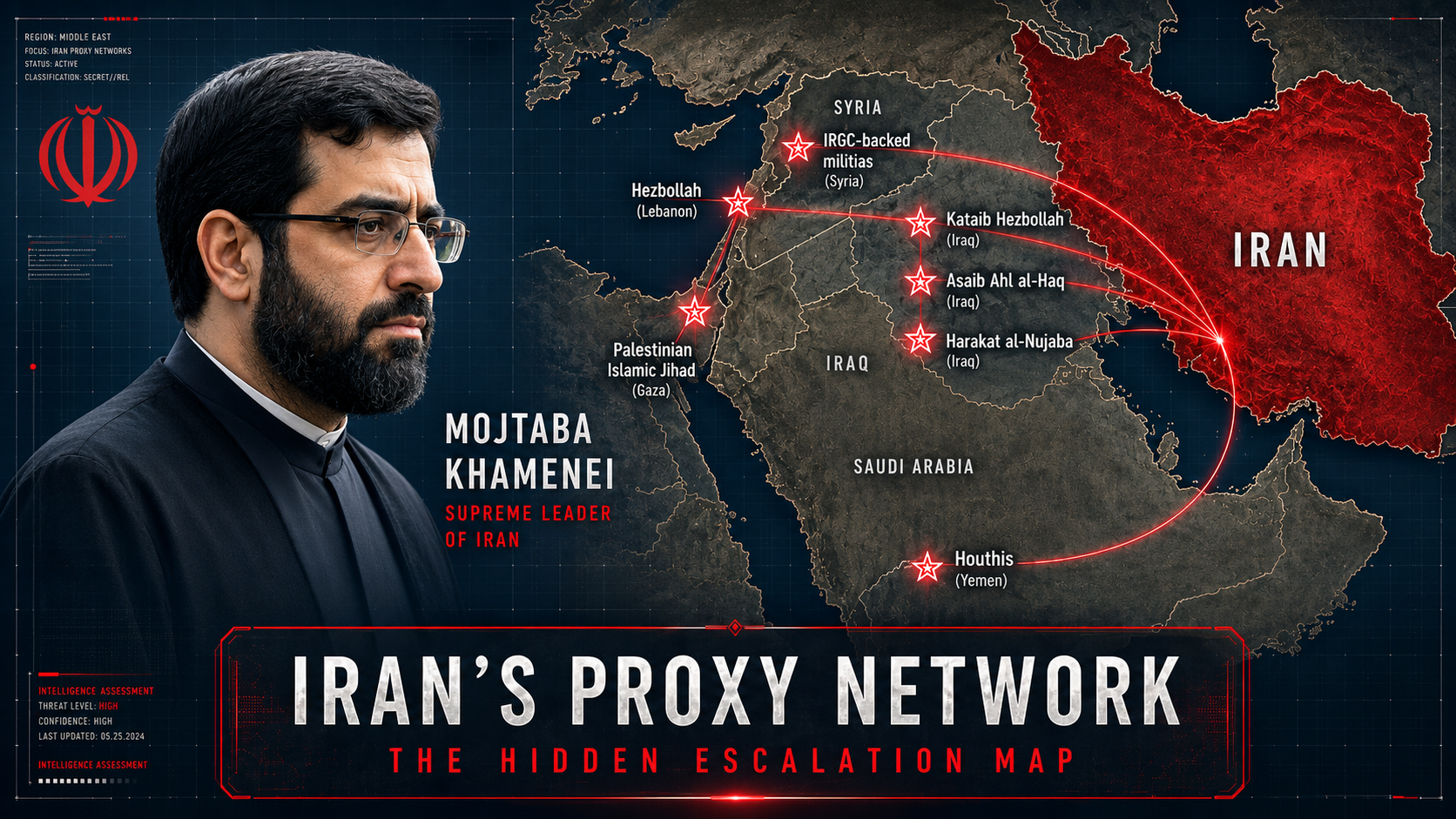
What decision-makers should watch now — before proxy escalation becomes a cost, compliance or supply-chain shock.
This 17-page executive briefing translates Iran’s proxy network into concrete business risks: energy price exposure, maritime chokepoints, war-risk premiums, sanctions, shadow fleets, supply-chain disruption and early-warning indicators for board-level decisions.
You are currently viewing a placeholder content from X. To access the actual content, click the button below. Please note that doing so will share data with third-party providers.
More Information