Executive Intelligence. Industrial Risk. Geopolitics.
Strategic Sparring
for Decision-Makers
Risk intelligence across technology, law, markets and power dynamics.


Verdeckte Geschäftsrisiken, strategische Widersprüche und kritische Abhängigkeiten frühzeitig erkennen.
Kostenlose Analyse starten →
Verdeckte Machtstrukturen, Führungsrisiken und organisatorische Blockaden frühzeitig erkennen.
Kostenlose Analyse starten →
Geopolitische Risiken, globale Abhängigkeiten und kritische Lieferkettenrisiken frühzeitig erkennen.
Kostenlose Analyse starten →
Identify hidden business risks, strategic contradictions and critical dependencies at an early stage.
Start Free Analysis →
Identify hidden power structures, leadership risks and organizational blockers at an early stage.
Start Free Analysis →
Identify geopolitical risks, global dependencies and critical supply-chain vulnerabilities at an early stage.
Start Free Analysis →
Verdeckte Geschäftsrisiken, strategische Widersprüche und kritische Abhängigkeiten frühzeitig erkennen.
Kostenlose Analyse starten →
Verdeckte Machtstrukturen, Führungsrisiken und organisatorische Blockaden frühzeitig erkennen.
Kostenlose Analyse starten →
Geopolitische Risiken, globale Abhängigkeiten und kritische Lieferkettenrisiken frühzeitig erkennen.
Kostenlose Analyse starten →
Identify hidden business risks, strategic contradictions and critical dependencies at an early stage.
Start Free Analysis →
Identify hidden power structures, leadership risks and organizational blockers at an early stage.
Start Free Analysis →
Identify geopolitical risks, global dependencies and critical supply-chain vulnerabilities at an early stage.
Start Free Analysis →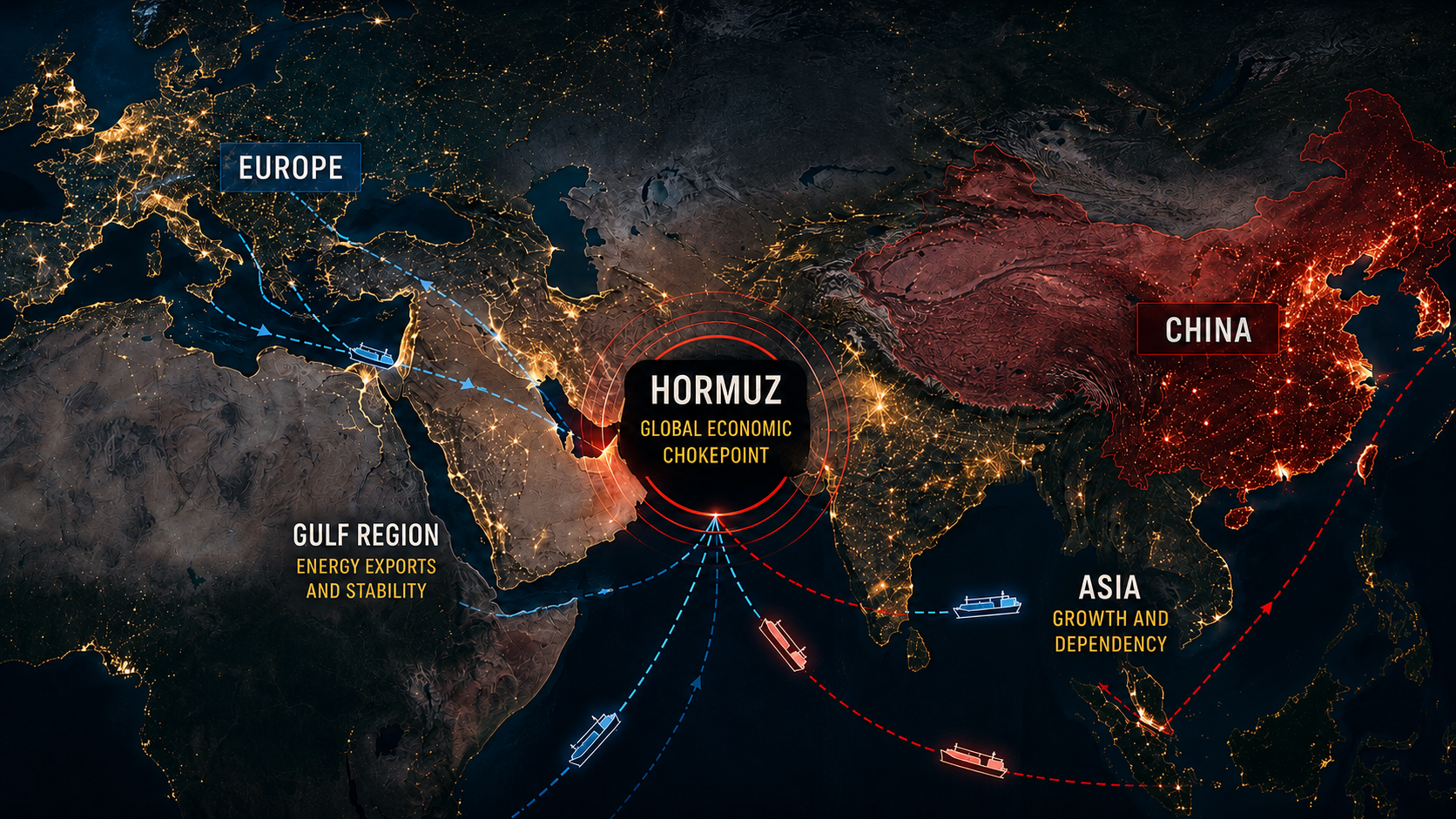
This Chokepoint Check assesses the current pressure on the Strait of Hormuz, Bab al-Mandab and critical water, power, port and energy infrastructure across the Gulf region. The key question is not merely whether a route remains geographically open, but whether transport, insurance, energy supply and site operations remain operationally viable.
The corridor remains exposed to significant risk, but is showing limited operational recovery in LNG transport.
Several QatarEnergy-linked LNG tankers have again been observed inside or outside the strait. This does not yet represent a return to normal shipping conditions.
Maritime security risk is expanding from the Yemen/Red Sea theatre into the Gulf of Aden and the Horn of Africa.
US officials are warning of growing weapons, drone, training and logistics cooperation between the Houthis and al-Shabaab.
Saudi Arabia’s Red Sea export corridor is regaining operational capacity.
Crude oil loading in Yanbu has resumed at around two million barrels per day; pipeline throughput continues to increase.
Saudi Arabia has resumed crude oil loading from Yanbu following the restart of the East-West Pipeline. This restores a substantial operational export alternative to the Strait of Hormuz.
Around two million barrels per day are already being loaded; pipeline throughput is approximately 2.65 million bpd. Capacity remains below normal levels, but the trend clearly shows recovery of Saudi Arabia’s Red Sea export corridor.
Saudi Arabia is regaining real bypass capacity around Hormuz. Export and procurement risks are partially easing.
Verification status: confirmed by trading sources, shipping and satellite data. Full pipeline capacity has not yet been restored. Reuters, September 29, 2026 · SchaafMedia: Middle East Escalation Check from September 27, 2026
Several QatarEnergy-linked LNG tankers have recently been visibly transiting Hormuz or have reappeared outside the strait. This marks the first clearer visible increase in LNG movements from Qatar through the chokepoint.
In August, there were no visible Qatar LNG transits. The current development therefore indicates limited normalisation. It does not yet represent a return to regular shipping traffic, as many tankers continue to switch off AIS.
LNG supply to Asia is regaining operational predictability. Dark transits and security risks, however, remain in place.
Verification status: confirmed by Kpler and LSEG data. AIS shutdowns continue to limit the completeness of vessel tracking. Arab News / Reuters, September 28, 2026 · SchaafMedia: Chokepoint Check – Hormuz, Trade Routes & Supply Chain Risks
US officials are warning of growing cooperation involving weapons, drones, training and logistics. The cooperation appears to involve not only material transfers, but also know-how and potential joint support structures.
This creates a concrete cross-theatre linkage between Yemen, Somalia and the Gulf of Aden. A primarily regional Houthi risk could therefore develop into a broader maritime security problem.
Shipping risks could expand south of Bab al-Mandab and generate additional protection and insurance costs.
Verification status: partially confirmed. Cooperation and earlier weapons/training structures are documented; no concrete new attacks resulting from them have been confirmed. Arab Times / Financial Times, September 29, 2026 · SchaafMedia: Iran Check – 5 Escalation Signals from September 28, 2026
US Secretary of State Rubio and Saudi Arabia’s foreign minister held talks in Washington on Yemen and regional security. The discussions focused in particular on growing Houthi risks and the security of key maritime routes.
Freedom of navigation through Hormuz and Bab al-Mandab as well as Houthi escalation were explicitly discussed. Both chokepoints are therefore increasingly being treated together as part of a wider regional security architecture.
Maritime security is becoming a more important component of bilateral US-Saudi security planning for trade and energy exports.
Verification status: confirmed. The talks took place on September 28 and were further detailed on September 29 by US and Saudi statements. Al Jazeera, September 29, 2026 · SchaafMedia: Middle East Escalation Check from September 27, 2026
Saudi Arabia’s defence minister invited UAE Vice President Mansour bin Zayed to Saudi Arabia on September 29. The meeting follows a period of clearly strained relations between Riyadh and Abu Dhabi over Yemen.
It is the first publicly announced direct meeting since the open dispute over Yemen. No new security agreement has yet been confirmed, but politically the move points to a cautious rapprochement.
A Saudi-Emirati rapprochement could facilitate future Red Sea, Yemen and Gulf security coordination.
Verification status: confirmed for the invitation and travel announcement. No new military cooperation has yet been confirmed. Arab News / SPA / WAM, September 29, 2026 · SchaafMedia: Middle East Escalation Check from September 27, 2026
Hormuz and the Red Sea remain under security pressure, while Yemen-related risks are spreading into the Gulf of Aden.
Yanbu is loading crude oil again, Qatar LNG is using Hormuz more frequently and security cooperation is expanding.
Middle East crude exports have returned to nearly 80 percent of pre-war levels, but still depend on workarounds.
Supply risks are partially declining, while security, insurance and route-protection costs remain high.
Hormuz is seeing more LNG traffic, but continues to depend on restricted and partly dark transit.
Partial operational recovery · normal and reliably insurable shipping has not yet been restoredYanbu and the East-West Pipeline are operating again, but still below previous capacity levels.
Export capacity has improved significantly · infrastructure remains militarily and operationally vulnerableRed Sea risks, Horn of Africa linkages and international security coordination are operating simultaneously.
Energy, shipping, terrorism and alliance risks remain systemically interconnectedOverall risk has declined to high to critical. Compared with September 27, energy exports through Yanbu and, to some extent, Hormuz are stabilising. At the same time, maritime security risk is expanding through the Houthi–al-Shabaab connection into the Gulf of Aden and the Horn of Africa. The overall environment therefore remains systemically tense, but currently no longer meets the criteria for a sustained critical Level 5/5.
Disclaimer: This assessment was prepared with support from our Geo AI. AI can make mistakes. This analysis is intended as a source-based radar for potential escalation signals and does not constitute fully verified intelligence, security, insurance or investment advice. In fast-moving situations, status, source availability and risk assessments may change at short notice.
Independent of the subject covered in this article, this separate Executive Briefing provides an in-depth analysis of another critical risk domain affecting European companies.
The 27-page Executive Briefing “Black Swan Risk Mapping for Europe’s Next Mobility and Infrastructure Shock” examines how geopolitical, infrastructural and administrative developments that are currently viewed in isolation could reinforce one another.
Based on the GFDD Framework™, the report shows how these dynamics could affect operational continuity, access to critical resources and the strategic resilience of companies.
The briefing includes a structured systemic-shock analysis and a directly applicable Business Exposure Checklist for CEOs, CFOs, COOs, investors and strategy teams.
You are currently viewing a placeholder content from X. To access the actual content, click the button below. Please note that doing so will share data with third-party providers.
More Information