Executive Intelligence. Industrial Risk. Geopolitics.
Strategic Sparring
for Decision-Makers
Risk intelligence across technology, law, markets and power dynamics.

Verdeckte Geschäftsrisiken, strategische Widersprüche und kritische Abhängigkeiten frühzeitig erkennen.
Kostenlose Analyse starten →
Verdeckte Machtstrukturen, Führungsrisiken und organisatorische Blockaden frühzeitig erkennen.
Kostenlose Analyse starten →
Geopolitische Risiken, globale Abhängigkeiten und kritische Lieferkettenrisiken frühzeitig erkennen.
Kostenlose Analyse starten →
Identify hidden business risks, strategic contradictions and critical dependencies at an early stage.
Start Free Analysis →
Identify hidden power structures, leadership risks and organizational blockers at an early stage.
Start Free Analysis →
Identify geopolitical risks, global dependencies and critical supply-chain vulnerabilities at an early stage.
Start Free Analysis →
Verdeckte Geschäftsrisiken, strategische Widersprüche und kritische Abhängigkeiten frühzeitig erkennen.
Kostenlose Analyse starten →
Verdeckte Machtstrukturen, Führungsrisiken und organisatorische Blockaden frühzeitig erkennen.
Kostenlose Analyse starten →
Geopolitische Risiken, globale Abhängigkeiten und kritische Lieferkettenrisiken frühzeitig erkennen.
Kostenlose Analyse starten →
Identify hidden business risks, strategic contradictions and critical dependencies at an early stage.
Start Free Analysis →
Identify hidden power structures, leadership risks and organizational blockers at an early stage.
Start Free Analysis →
Identify geopolitical risks, global dependencies and critical supply-chain vulnerabilities at an early stage.
Start Free Analysis →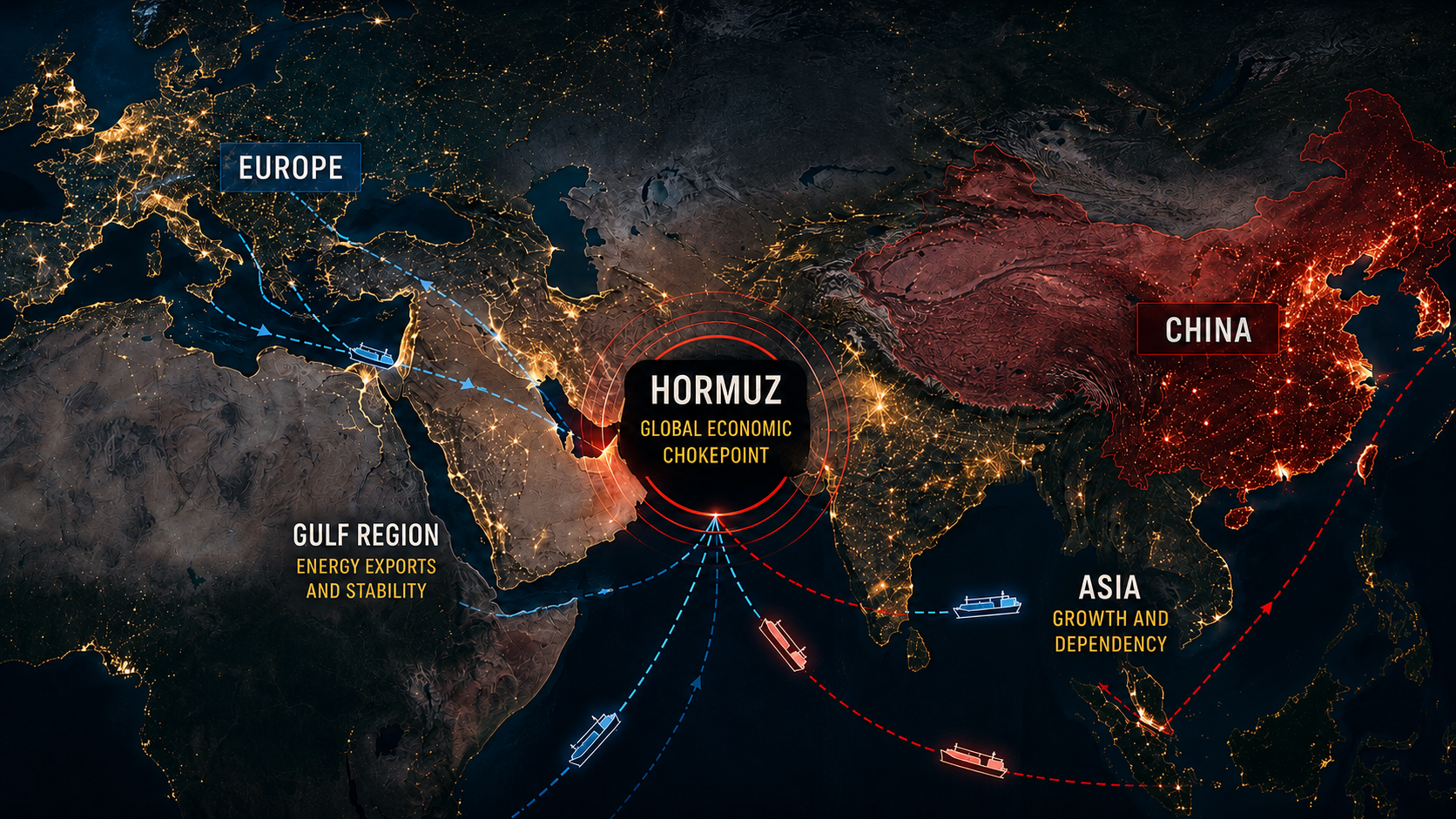
This Chokepoint Check assesses current pressure on the Strait of Hormuz, Bab al-Mandab and the Gulf region’s critical water, power, port and energy infrastructure. The key question is not only whether a route remains geographically open, but whether transport, insurance coverage, energy supply and site operations remain operationally viable.
Traffic is stabilising at a very low level, but there is still no sign of operational normalisation.
Kpler recorded nine merchant-vessel transits through Hormuz on Wednesday, unchanged from Tuesday. Washington describes the strait as open, while Iran continues to describe it as closed. The political definition therefore remains at odds with actual, heavily reduced usage.
Risk is shifting today from the immediate chokepoint further into the Gulf of Aden and therefore onto the approach to Bab al-Mandab.
UKMTO reported a tanker around 136 nautical miles east of Al Mukalla on August 20. Six armed men boarded the vessel, took control and redirected it towards Somalia. At the same time, visible Bab al-Mandab traffic fell from 32 to 27 vessels.
No sufficiently confirmed new attack signal has emerged for fixed Gulf facilities, but a potential expansion towards subsea cables is new.
According to current reports, Iranian planners are also considering attacks on subsea fibre-optic cables around Hormuz in the event of renewed US escalation. No operational implementation has been confirmed. The risk therefore potentially expands from energy and shipping into digital infrastructure.
Nine merchant vessels transited Hormuz on Wednesday, unchanged from Tuesday. At Bab al-Mandab, the figure simultaneously fell from 32 to 27.
The data show no recovery to normal levels. Hormuz in particular remains operationally heavily constrained despite US political statements that the strait is open.
Low and volatile transit volumes complicate capacity planning, charter decisions and reliable delivery schedules for energy and freight.
Verification Status: confirmed through current Kpler tracking data for August 19, published on August 20. Reuters / Kpler, 20.08.2026 · SchaafMedia: Chokepoint Check – Hormuz, Trade Routes & Supply Chain Risks
A westbound tanker reported a suspicious craft around 136 nautical miles east of Al Mukalla on August 20. Six armed men subsequently boarded.
UKMTO confirmed that the attackers took control of the vessel and changed its course towards Somalia. The perpetrators and motive remain unclear.
The approach to Bab al-Mandab now faces an additional security channel alongside missile and drone threats: hijacking, crew security and loss of vessel control.
Verification Status: confirmed for boarding, seizure of control and course change by UKMTO. No connection to the Houthis has been confirmed. UKMTO Warning 118-26, 20.08.2026
Israeli Defence Minister Katz warned Türkiye on August 20 against “dangerous adventures” in Syria. The warning follows a dispute over possible Turkish use of Abu al-Duhur airbase.
Syria and Türkiye deny plans for a permanent deployment. Washington is mediating to prevent a direct Israel-Türkiye confrontation between two US partners.
Further escalation would turn Syria, Turkish logistics areas and the eastern Mediterranean into an additional regional risk corridor.
Verification Status: confirmed for the Israeli warning and Syrian-Turkish denial. A permanent Turkish deployment has not been confirmed. Reuters, 20.08.2026 · SchaafMedia: Iran War – How the West Is Losing Its Dominance
According to current reports, Iranian forces have assessed potential retaliation options against US military facilities in south-eastern Europe. Bulgaria and Cyprus are among the locations mentioned.
This is contingency planning for a renewed US escalation, not a confirmed attack order. Nevertheless, it creates a concrete Europe linkage for the first time.
An actual expansion would affect NATO risks, military logistics and potentially subsea cables as well as digital links between Europe and Asia.
Verification Status: partially confirmed. The report on Iranian planning is confirmed; no operational decision or attack has taken place. Anadolu Agency, 19.08.2026 · directly relevant on 20.08.
The US administration announced a new comprehensive economic campaign against Iran on August 20. Third countries and companies that economically support Tehran are also expected to face pressure.
The focus includes financial flows, oil trade, ship registries, companies and other international access channels used by Iran. Concrete implementation of individual measures is still to follow.
This increases sanctions, payment, compliance and secondary-sanctions risks for international banks, shipping companies, traders and businesses with exposure to Iran.
Verification Status: confirmed for the announced US economic campaign. The actual scope of individual sanctions must be assessed based on subsequent implementation measures. Financial Times, 20.08.2026 · SchaafMedia: Iran Check – 5 Escalation Signals from August 19, 2026
Hormuz remains constrained while a tanker is forcibly seized in the Gulf of Aden.
Shipping companies reduce risk exposure while security and compliance create additional operational burdens.
Transit volumes remain weak while additional political risks spread to third countries.
Freight, insurance, sanctions and procurement risks increasingly operate at the same time.
Hormuz remains heavily constrained with nine visible transits. At the same time, a tanker is forcibly seized on the approach to Bab al-Mandab.
Two maritime risk zones remain operationally stressed at the same timeNo new confirmed physical attack on fixed Gulf facilities was identified on August 20. What is new, however, is the possible inclusion of subsea communications cables in Iranian contingency planning.
No new facility attack · communications infrastructure enters the risk pictureMaritime disruptions coincide with Israel-Türkiye tensions, possible Iran-Europe scenarios and a new US economic campaign against Iran’s international connections.
Regional crisis extends into the NATO area, communications and global tradeThe situation remains critical even though Hormuz has not recorded a new physical attack today. The central change lies in the geographic and functional expansion: the Gulf of Aden now has an additional operational risk channel through the tanker hijacking, Israel and Türkiye are moving into more direct confrontation over Syria, and Iran is considering retaliation increasingly beyond the Middle East. At the same time, Washington is increasing economic pressure on Iran’s international connections.
Note: This assessment was produced with support from our Geo-AI. AI can make mistakes. The analysis is intended as a source-based radar for potential escalation signals and does not replace fully verified intelligence, security, insurance or investment advice. In rapidly evolving situations, status, source availability and risk assessments may change at short notice.
Independent of the subject covered in this article, this separate Executive Briefing provides an in-depth analysis of another critical risk domain affecting European companies.
The 27-page Executive Briefing “Black Swan Risk Mapping for Europe’s Next Mobility and Infrastructure Shock” examines how geopolitical, infrastructural and administrative developments that are currently viewed in isolation could reinforce one another.
Based on the GFDD Framework™, the report shows how these dynamics could affect operational continuity, access to critical resources and the strategic resilience of companies.
The briefing includes a structured systemic-shock analysis and a directly applicable Business Exposure Checklist for CEOs, CFOs, COOs, investors and strategy teams.
You are currently viewing a placeholder content from X. To access the actual content, click the button below. Please note that doing so will share data with third-party providers.
More Information