Executive Intelligence. Industrial Risk. Geopolitics.
Strategic Sparring
for Decision-Makers
Risk intelligence across technology, law, markets and power dynamics.


Verdeckte Geschäftsrisiken, strategische Widersprüche und kritische Abhängigkeiten frühzeitig erkennen.
Kostenlose Analyse starten →
Verdeckte Machtstrukturen, Führungsrisiken und organisatorische Blockaden frühzeitig erkennen.
Kostenlose Analyse starten →
Geopolitische Risiken, globale Abhängigkeiten und kritische Lieferkettenrisiken frühzeitig erkennen.
Kostenlose Analyse starten →
Identify hidden business risks, strategic contradictions and critical dependencies at an early stage.
Start Free Analysis →
Identify hidden power structures, leadership risks and organizational blockers at an early stage.
Start Free Analysis →
Identify geopolitical risks, global dependencies and critical supply-chain vulnerabilities at an early stage.
Start Free Analysis →
Verdeckte Geschäftsrisiken, strategische Widersprüche und kritische Abhängigkeiten frühzeitig erkennen.
Kostenlose Analyse starten →
Verdeckte Machtstrukturen, Führungsrisiken und organisatorische Blockaden frühzeitig erkennen.
Kostenlose Analyse starten →
Geopolitische Risiken, globale Abhängigkeiten und kritische Lieferkettenrisiken frühzeitig erkennen.
Kostenlose Analyse starten →
Identify hidden business risks, strategic contradictions and critical dependencies at an early stage.
Start Free Analysis →
Identify hidden power structures, leadership risks and organizational blockers at an early stage.
Start Free Analysis →
Identify geopolitical risks, global dependencies and critical supply-chain vulnerabilities at an early stage.
Start Free Analysis →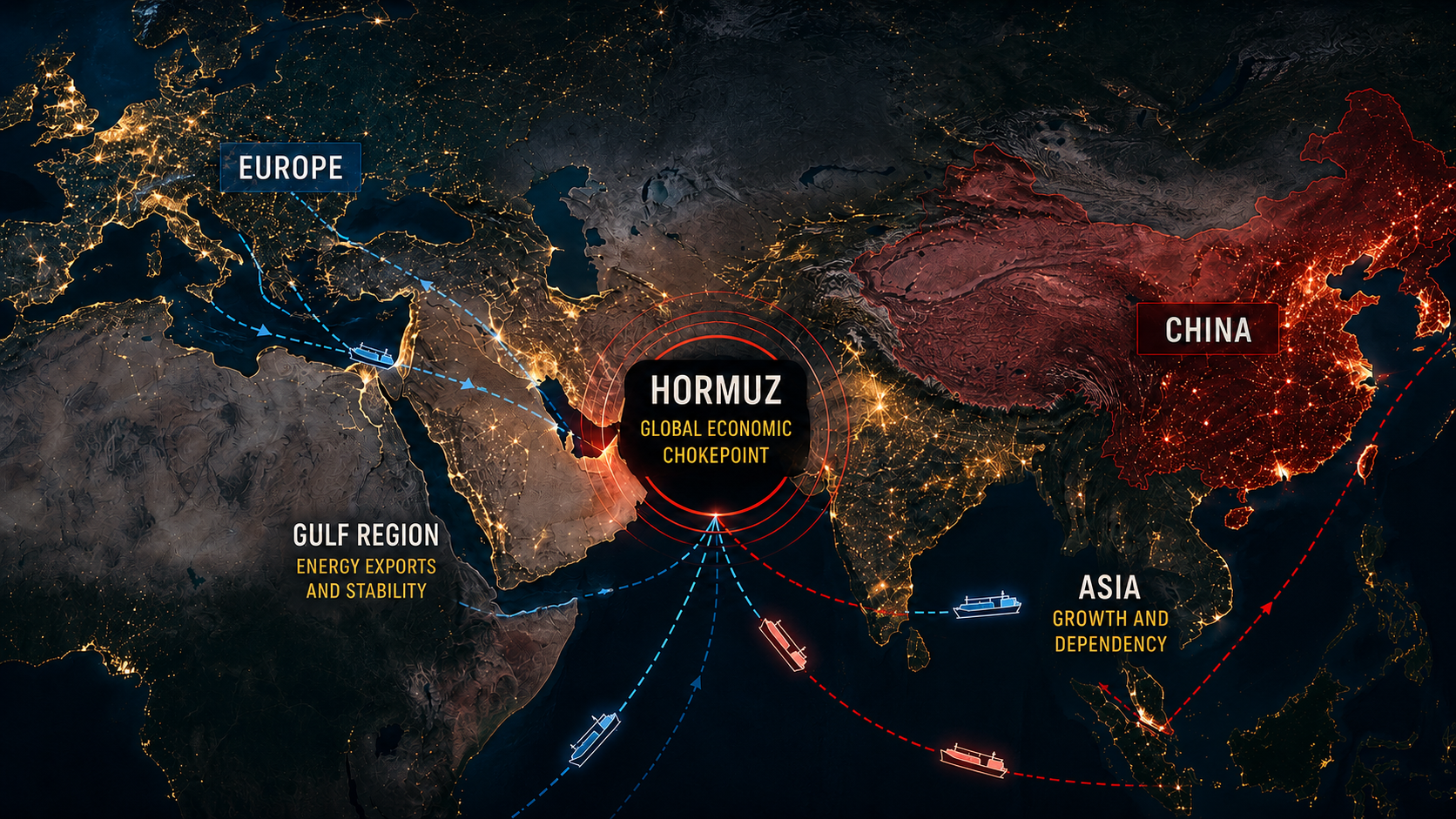
This Chokepoint Check assesses the current pressure on the Strait of Hormuz, Bab al-Mandab and critical water, power, port and energy infrastructure across the Gulf region. The key question is not merely whether a route remains geographically open, but whether transport, insurance, energy supply and site operations remain operationally viable.
No new commercial vessel strike has been confirmed, but a central Saudi export hub directly on the Gulf is now under attack pressure.
The Houthis report a ballistic missile attack on Ras Tanura. A fire near the terminal was contained, according to a source cited by Bloomberg.
The ground offensive and Houthi counter-operations are now concentrated directly on the strategic gateway to the southern Red Sea.
The Houthis said they had repelled an advance by Saudi-backed forces approaching Bab al-Mandab from the south.
For the first time in this escalation phase, one of Saudi Arabia’s most important refining and export sites is directly at the centre of a current attack.
At the same time, Saudi Arabia intercepted three ballistic missiles heading toward the Eastern Region and four drones targeting the Southern Region.
The Houthis stated on October 27 that they had struck Ras Tanura with a ballistic missile and caused a fire.
Saudi Arabia initially did not confirm the strike. A source familiar with the situation, however, reported a contained fire near the terminal.
Ras Tanura is Saudi Arabia’s largest refinery and one of its two central export hubs. Further strikes could affect oil loading, prices and insurance risks.
Verification status: partially confirmed. The Houthi attack is an official claim; a fire near the terminal was independently reported, but the missile impact itself was not confirmed by Saudi Arabia. Reuters, October 27, 2026 · SchaafMedia: Iran Check – 5 Escalation Signals from October 26, 2026
Saudi Arabia reported on October 27 three ballistic missiles heading toward the Eastern Region and four drones targeting the Southern Region.
All seven projectiles were destroyed according to the coalition. Early-warning alerts were triggered for the Eastern Region and Al-Kharj.
The repeated intensity of attacks ties up air-defence capacity and increases pressure on personnel, site and transport planning across several regions.
Verification status: confirmed for the interception reports and triggered early warnings. No major damage was reported. Arab News, October 27, 2026 · SchaafMedia: Middle East Escalation Check from October 25, 2026
The Houthis said they had repelled an advance by Saudi-backed forces approaching Bab al-Mandab from the south.
They reported the use of ballistic missiles and heavy weapons. No immediate Saudi confirmation of the detailed combat claims was initially available.
Heavy ground fighting along the southern approaches increases risks to Red Sea shipping, coastal logistics and maritime security missions.
Verification status: partially confirmed. Ongoing fighting in the area is confirmed; Houthi claims regarding casualties and destroyed vehicles have not been independently verified. Reuters / Times of Israel, October 27, 2026 · SchaafMedia: Middle East Escalation Check from October 25, 2026
Egypt’s parliament authorised President Abdel Fattah El-Sisi, by a two-thirds majority, to provide military support to Saudi Arabia.
No specific deployment has yet been activated. Cairo stresses that any potential operations would be exclusively defensive.
The authorisation expands Saudi Arabia’s potential protective umbrella to include one of the largest armed forces in the Arab world and changes regional response obligations.
Verification status: confirmed for the parliamentary authorisation. No concrete Egyptian troop deployment has yet been confirmed. Egypt Independent / Al-Masry Al-Youm, October 27, 2026 · SchaafMedia: Iran Check – 5 Escalation Signals from October 26, 2026
Netanyahu stated on October 26 that Trump was prepared to take further action against Iran if he remained in office.
Netanyahu also said he had instructed Mossad and the IDF to work toward the fall of the Iranian regime. No new attack took place.
A renewed Israel-Iran offensive would rapidly increase risks to Gulf airspace, energy facilities, shipping and regional business locations.
Verification status: confirmed for Netanyahu’s statements. The United States also stated that it did not plan a new strike on Iran before the November 3 midterm elections. Reuters, October 26, 2026 · SchaafMedia: Iran Check – 5 Escalation Signals from October 26, 2026
Ras Tanura comes under attack pressure, Saudi Arabia intercepts further missiles and drones, and heavy fighting continues at Bab al-Mandab.
Air defence, protection of critical energy facilities and regional defence cooperation are being expanded simultaneously.
Oil exports, air traffic, chokepoint security and military protection capacity are all facing increased planning pressure.
Energy, freight, insurance and site-continuity costs are becoming increasingly sensitive to attacks on export hubs and possible new regional war fronts.
No new commercial vessel strike, but Ras Tanura as an export hub and fighting directly at Bab al-Mandab increase maritime risk.
Both main corridors remain geographically open · their operational predictability nevertheless remains significantly constrainedRas Tanura is now directly within the attack spectrum, while several Saudi regions again report missile and drone alerts.
Central energy-export and regional infrastructure remains exposed to concrete military pressureEnergy attacks, Bab al-Mandab fighting, Egyptian military authorisation and Israel-Iran threats are unfolding in parallel.
Energy, chokepoints, alliance structures and direct regional military confrontation remain systemically interconnectedOverall risk remains high to critical. One 4/5 signal dominates the operational picture: the reported attack on Ras Tanura. This is compounded by three confirmed or partially confirmed 3/5 signals involving renewed attacks on Saudi Arabia, fighting at Bab al-Mandab and Egypt’s military authorisation. The Israel-Iran axis remains politically escalatory at 2/5, with no new direct attack confirmed today.
Disclaimer: This assessment was prepared with support from our Geo AI. AI can make mistakes. This analysis is intended as a source-based radar for potential escalation signals and does not constitute fully verified intelligence, security, insurance or investment advice. In fast-moving situations, status, source availability and risk assessments may change at short notice.
Independent of the subject covered in this article, this separate Executive Briefing provides an in-depth analysis of another critical risk domain affecting European companies.
The 27-page Executive Briefing “Black Swan Risk Mapping for Europe’s Next Mobility and Infrastructure Shock” examines how geopolitical, infrastructural and administrative developments that are currently viewed in isolation could reinforce one another.
Based on the GFDD Framework™, the report shows how these dynamics could affect operational continuity, access to critical resources and the strategic resilience of companies.
The briefing includes a structured systemic-shock analysis and a directly applicable Business Exposure Checklist for CEOs, CFOs, COOs, investors and strategy teams.
You are currently viewing a placeholder content from X. To access the actual content, click the button below. Please note that doing so will share data with third-party providers.
More Information