Executive Intelligence. Industrial Risk. Geopolitics.
Strategic Sparring
for Decision-Makers
Risk intelligence across technology, law, markets and power dynamics.


Verdeckte Geschäftsrisiken, strategische Widersprüche und kritische Abhängigkeiten frühzeitig erkennen.
Kostenlose Analyse starten →
Verdeckte Machtstrukturen, Führungsrisiken und organisatorische Blockaden frühzeitig erkennen.
Kostenlose Analyse starten →
Geopolitische Risiken, globale Abhängigkeiten und kritische Lieferkettenrisiken frühzeitig erkennen.
Kostenlose Analyse starten →
Identify hidden business risks, strategic contradictions and critical dependencies at an early stage.
Start Free Analysis →
Identify hidden power structures, leadership risks and organizational blockers at an early stage.
Start Free Analysis →
Identify geopolitical risks, global dependencies and critical supply-chain vulnerabilities at an early stage.
Start Free Analysis →
Verdeckte Geschäftsrisiken, strategische Widersprüche und kritische Abhängigkeiten frühzeitig erkennen.
Kostenlose Analyse starten →
Verdeckte Machtstrukturen, Führungsrisiken und organisatorische Blockaden frühzeitig erkennen.
Kostenlose Analyse starten →
Geopolitische Risiken, globale Abhängigkeiten und kritische Lieferkettenrisiken frühzeitig erkennen.
Kostenlose Analyse starten →
Identify hidden business risks, strategic contradictions and critical dependencies at an early stage.
Start Free Analysis →
Identify hidden power structures, leadership risks and organizational blockers at an early stage.
Start Free Analysis →
Identify geopolitical risks, global dependencies and critical supply-chain vulnerabilities at an early stage.
Start Free Analysis →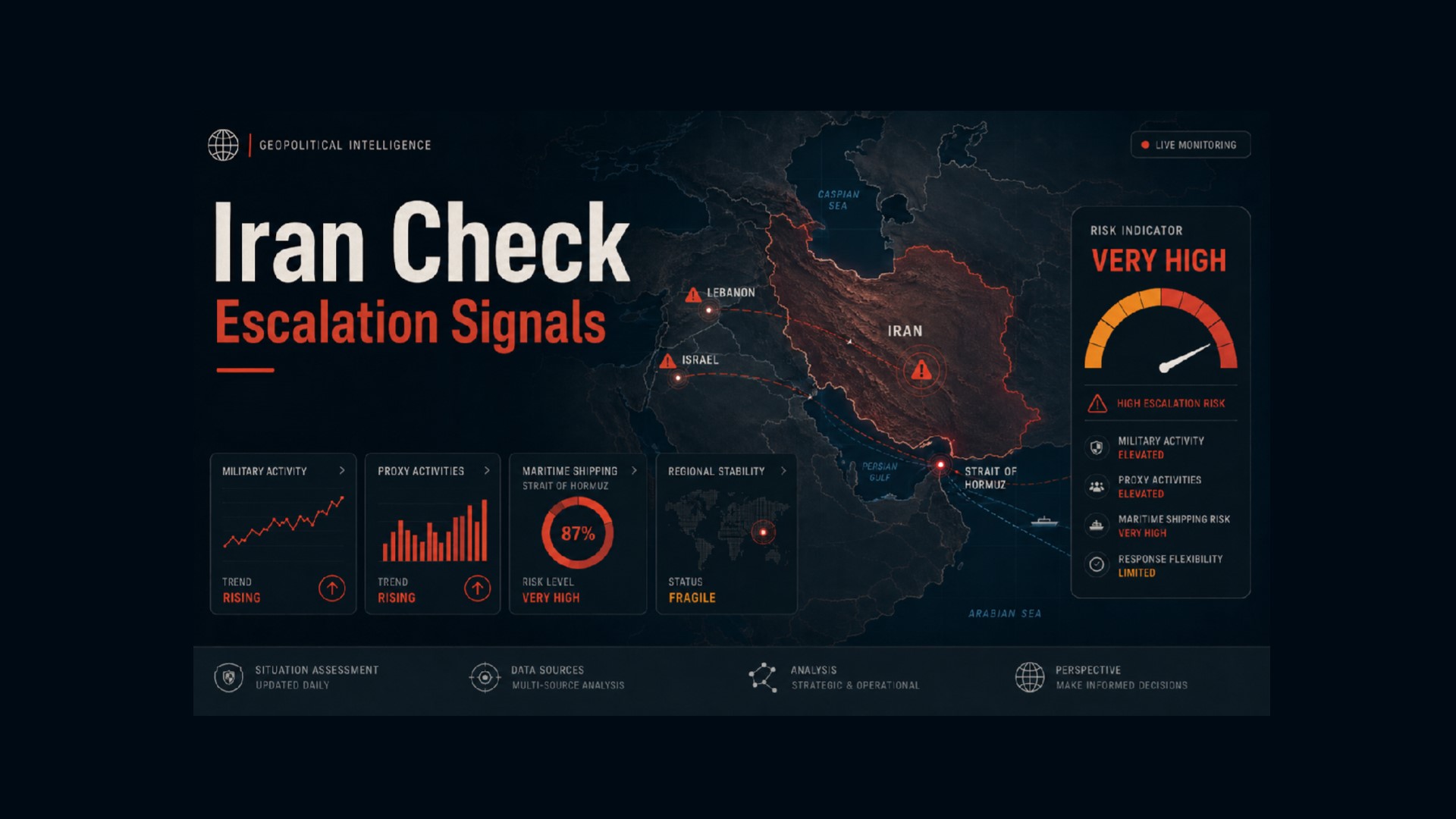
This escalation radar summarizes five relevant signals as of November 7, 2026. The focus is on verifiable statements by official sources, confirmed events and monitoring sources with potential implications for energy prices, supply chains, markets, maritime security, aviation and regional stability.
Iranian media report two impacts in the south of the strategically important island on the Strait of Hormuz. The perpetrator and extent of damage have not yet been officially confirmed.
The Revolutionary Guards declare the previous self-imposed range restriction to be over. This further sharpens Iran’s previously announced geographically unrestricted retaliation doctrine.
Bloomberg shipping data show no crude oil loaded onto tankers in September or October. Tehran is therefore losing its most important source of revenue at a time when war and government spending are increasing funding needs.
| Actor | Type | Severity | Status | Source / Verification | Business Impact |
|---|---|---|---|---|---|
| Iran / Qeshm / Hormuz | Two missiles strike strategically important Qeshm Island | Critical · Level 5/5 | Iranian media report on November 7 two missile impacts on Qeshm Island. Initial reports say the projectiles struck the Suza area in the south of the island. Witnesses reportedly heard an aircraft over the area beforehand. No official information on damage or casualties is initially available. The perpetrator of the attack has also not been confirmed. Power dynamics: Qeshm lies directly on the Strait of Hormuz and therefore remains a highly sensitive military and maritime node. | Current source: Reuters, November 7, 2026 . Verification status: partially confirmed. Iranian reports of two impacts are confirmed. The perpetrator, target and extent of damage remain unclear. Background: Schaaf Media · Iran Check: 5 Escalation Signals from November 5, 2026 . | Critical business impact on Hormuz, shipping, oil, LNG, aviation, insurance and regional infrastructure. Key point: New impacts on Qeshm immediately increase the risk of another military retaliation cycle. |
| Iran / IRGC / USA / Israel | Iran removes self-imposed range limit on ballistic missiles | Critical · Level 5/5 | The Revolutionary Guards state on November 7 that Iran has lifted its previous self-imposed limit of 2,000 kilometers for ballistic missiles. This removes a central political self-restraint from Iran’s missile strategy. An IRGC spokesperson does not, however, confirm what longer ranges Iran can currently deploy operationally. The announcement follows Tehran’s warning that any new US or Israeli attacks would be answered without geographic limits. Power dynamics: Iran is deliberately expanding uncertainty over which US or allied targets could become reachable in the future. | Confirmed by AP, November 7, 2026 . Verification status: confirmed for the lifting of the political range limit. No newly operational long-range missiles have been demonstrated. Further reading: Schaaf Media · Iran War: How the West Is Losing Its Dominance . | Critical business impact on US bases, Israel, locations closer to Europe, aviation, missile defense and insurance. The actual range remains unclear, but the deterrence message is being significantly expanded. |
| Iran / Oil / US Blockade / State Budget | Iran’s oil exports near zero as fiscal pressure rises sharply | High to Critical · Level 4/5 | Iran’s oil exports have almost completely collapsed under the US naval blockade. Shipping data analyzed by Bloomberg show that Iran loaded no crude oil onto tankers in September or October. FGE estimates that only around 200,000 to 300,000 barrels per day still reach the market through Iraq. Before the war, China was the main buyer. This is cutting off a central source of foreign currency and government financing. Power dynamics: Washington is increasing economic pressure without yet forcing Tehran into political concessions. | Bloomberg report: Bloomberg via gCaptain, November 6, 2026 . Verification status: confirmed for the sharp collapse in seaborne exports. Small volumes continue to reach the market through alternative routes. Background: Schaaf Media · Hormuz Blockade 2026: Protecting Margins and Supply Chains in the Chokepoint Shock . | High to critical business impact on Iranian public finances, the rial, inflation, sanctions, energy trade and regional stability. Particularly relevant: The war is increasing Iran’s spending while its most important source of revenue is nearly disappearing. |
| Iran / Qatar / USA / Hormuz | Qatar reports progress, but deal remains fragile | High to Critical · Level 4/5 | Qatar says on November 7 that mediation between Washington and Tehran is continuing intensively. Prime Minister Sheikh Mohammed bin Abdulrahman Al-Thani speaks of significant progress. Washington remains willing to reach an agreement. Qatar nevertheless warns against seeking a perfect deal instead of a workable solution. Iran continues to demand an end to the port blockade, the release of frozen funds and changes to the Hormuz regime. Power dynamics: Diplomacy is regaining space while the military situation remains highly dangerous. | Confirmed by Reuters, November 7, 2026 . Verification status: confirmed. Progress is being reported, but no agreement has yet been reached. Further reading: Schaaf Media · Middle East Escalation Check from November 6, 2026 . | High to critical business impact on Hormuz, oil, sanctions, Iranian exports, LNG and investment planning. A viable deal could significantly reduce chokepoint pressure in the short term; failure would keep the war risk elevated. |
| Israel / Eisenkot / Netanyahu | Eisenkot secures clear majority of recommendations to form government | High to Critical · Level 4/5 | Israel’s political shift is becoming more concrete. Gadi Eisenkot receives recommendations from parties representing a total of 67 of the Knesset’s 120 seats. Netanyahu receives only 46 recommendations. President Herzog plans to decide on November 8 who will receive the mandate to form a government. Eisenkot therefore has a clearly stronger parliamentary starting position. A viable coalition is nevertheless not guaranteed, as several parties exclude one another as coalition partners. Power dynamics: A change of government could significantly alter Israel’s relationship with Washington and its approach to the next phase of the Iran conflict. | Current regional source: Times of Israel, November 6, 2026 . Verification status: confirmed for the recommendations. A new government has not yet been formed. Background: Schaaf Media · Iran Check: 5 Escalation Signals from November 5, 2026 . | High to critical business impact on Israel, Iran strategy, defense, US-Israel relations, investment and regional planning. The main issue is a potential shift in Israel’s future decision-making and escalation policy. |
The most important operational development on November 7, 2026 is the renewed escalation directly around the Strait of Hormuz. According to Iranian reports, two missiles strike Qeshm Island. The perpetrator and extent of damage remain unclear, but the island sits directly on one of the world’s most important maritime corridors.
At the same time, Iran is strengthening its strategic deterrence posture. The Revolutionary Guards declare the previous self-imposed 2,000-kilometer limit on ballistic missiles to be over. This means that Iran’s geographically unrestricted retaliation threat is now accompanied by the political removal of an important missile restriction.
Economically, pressure on Tehran is rising substantially. Bloomberg data show no Iranian crude oil loaded onto tankers in September or October. This means a central source of government revenue is almost disappearing while war, inflation and public spending increase funding needs. Over the medium term, this raises the risk of larger budget deficits, currency pressure and additional domestic instability.
Diplomatically, a window nevertheless remains open. Qatar reports significant progress in mediation between the USA and Iran. At the same time, a potential political shift is emerging in Israel: Eisenkot receives 67 recommendations, compared with Netanyahu’s 46. EASA continues to maintain active warnings for Iran, Saudi Arabia, the Persian Gulf/Gulf of Oman, Iraq, Lebanon and Yemen; no new revision was identified on November 7.
The five most important signals for a German and European risk assessment are: the new missile impacts on Qeshm Island directly on the Strait of Hormuz, Iran’s removal of its self-imposed 2,000-kilometer limit on ballistic missiles, the near-total collapse of Iranian oil exports and the resulting fiscal pressure on Tehran, the progress reported by Qatar while US-Iran negotiations remain fragile, and Eisenkot’s clear lead in recommendations to form Israel’s next government and the potential implications for Israel’s Iran strategy.
Note: This assessment was prepared with the support of our Geo-AI. AI can make mistakes. The analysis is intended as a radar for potential escalation signals and does not replace a fully verified intelligence assessment.
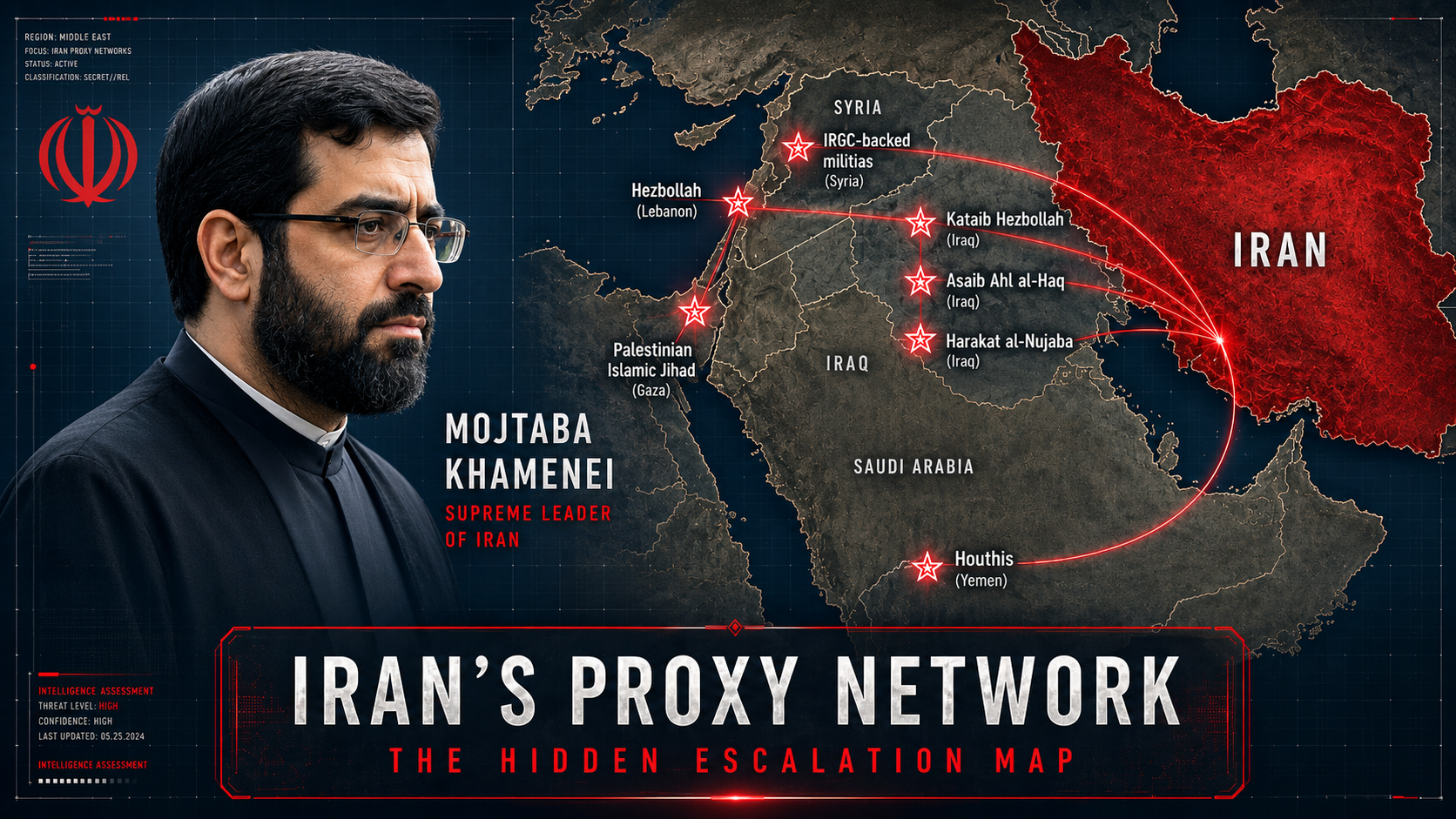
What decision-makers should watch now — before proxy escalation becomes a cost, compliance or supply-chain shock.
This 17-page executive briefing translates Iran’s proxy network into concrete business risks: energy price exposure, maritime chokepoints, war-risk premiums, sanctions, shadow fleets, supply-chain disruption and early-warning indicators for board-level decisions.
You are currently viewing a placeholder content from X. To access the actual content, click the button below. Please note that doing so will share data with third-party providers.
More Information