Executive Intelligence. Industrial Risk. Geopolitics.
Strategic Sparring
for Decision-Makers
Risk intelligence across technology, law, markets and power dynamics.

Verdeckte Geschäftsrisiken, strategische Widersprüche und kritische Abhängigkeiten frühzeitig erkennen.
Kostenlose Analyse starten →
Verdeckte Machtstrukturen, Führungsrisiken und organisatorische Blockaden frühzeitig erkennen.
Kostenlose Analyse starten →
Geopolitische Risiken, globale Abhängigkeiten und kritische Lieferkettenrisiken frühzeitig erkennen.
Kostenlose Analyse starten →
Identify hidden business risks, strategic contradictions and critical dependencies at an early stage.
Start Free Analysis →
Identify hidden power structures, leadership risks and organizational blockers at an early stage.
Start Free Analysis →
Identify geopolitical risks, global dependencies and critical supply-chain vulnerabilities at an early stage.
Start Free Analysis →
Verdeckte Geschäftsrisiken, strategische Widersprüche und kritische Abhängigkeiten frühzeitig erkennen.
Kostenlose Analyse starten →
Verdeckte Machtstrukturen, Führungsrisiken und organisatorische Blockaden frühzeitig erkennen.
Kostenlose Analyse starten →
Geopolitische Risiken, globale Abhängigkeiten und kritische Lieferkettenrisiken frühzeitig erkennen.
Kostenlose Analyse starten →
Identify hidden business risks, strategic contradictions and critical dependencies at an early stage.
Start Free Analysis →
Identify hidden power structures, leadership risks and organizational blockers at an early stage.
Start Free Analysis →
Identify geopolitical risks, global dependencies and critical supply-chain vulnerabilities at an early stage.
Start Free Analysis →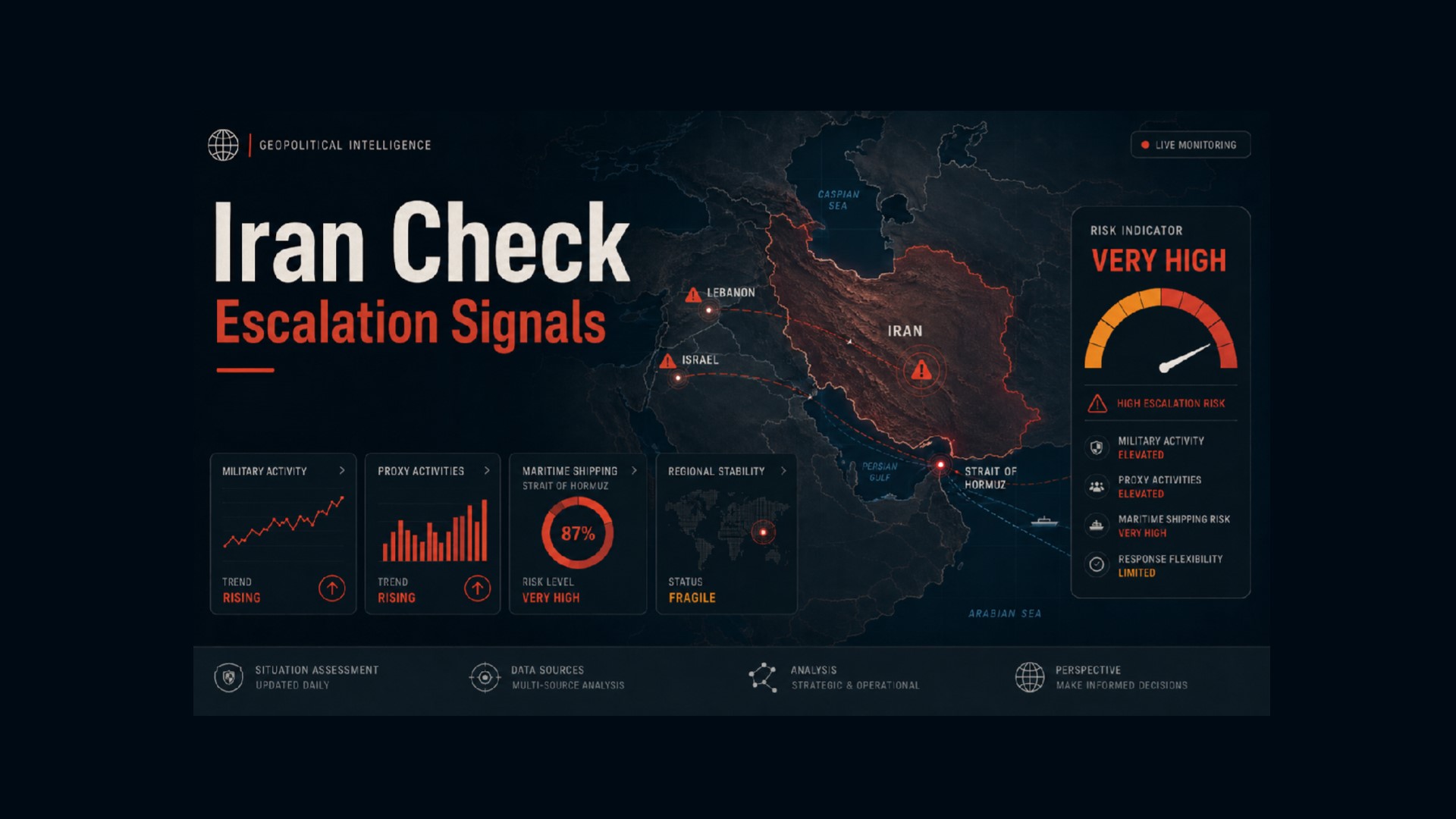
This escalation radar summarises five relevant signals as of August 21, 2026. It focuses on substantiated statements by official bodies, verified events and monitoring sources with potential implications for energy prices, supply chains, markets, maritime security, aviation and regional stability.
US Treasury Secretary Scott Bessent describes it as the largest coordinated economic isolation campaign ever. Allies and China are also being pressured to decide whether they support Washington’s Iran strategy. Tehran responds with “economic terrorism” rhetoric and new military warnings.
Offers of Iranian crude to Chinese buyers are falling sharply. Floating inventories are declining, supplies are becoming more expensive and Chinese refiners are increasingly switching to Brazilian and Iraqi oil.
Only seven merchant vessels transit Hormuz on Thursday, down from 14 the previous day. Bab el-Mandeb simultaneously falls to 23 transits. No large crude oil or LNG tanker is recorded at either chokepoint.
| Actor | Type | Severity | Status | Source / Verification Status | Business Impact |
|---|---|---|---|---|---|
| United States / Iran / China / US Treasury / IRGC | United States escalates economic war – Iran responds with military counter-message | Critical · Level 5/5 | Washington shifts the conflict decisively onto the global economic level on August 21. US Treasury Secretary Scott Bessent announces what he describes as the “largest coordinated economic isolation” of a state and warns allies that they will have to choose between supporting Washington and Iran. China is also explicitly put under pressure. Tehran describes the new campaign as “economic terrorism”. At the same time, an IRGC spokesperson says Iran would use more powerful warheads, more precise missiles and greater ranges in a new war. Power dynamics: The conflict is therefore shifting from bilateral sanctions towards a global secondary-sanctions and deterrence model. Economic and military escalation are increasingly running in parallel. | Confirmed by Saudi Gazette, August 21, 2026 and Astro Awani, August 21, 2026 . Verification status: confirmed regarding Bessent’s economic threat, Araghchi’s response and the new IRGC warning on more powerful weapons. Background: Schaaf Media · Middle East Escalation Check from August 20, 2026 . | Critical business impact on China, Iran and Gulf exposure, banks, trade finance, secondary sanctions, energy procurement, export controls and compliance. Companies increasingly need to assess whether even indirect Iran-related business could trigger new US sanctions risks. |
| Iran / China / Chinese refineries / oil trade | US blockade reduces physical availability of Iranian crude in China | Critical · Level 5/5 | The US blockade is increasingly showing tangible effects on Iran’s most important oil export relationship on August 21. Offers of Iranian crude to Chinese buyers are declining sharply. Iran’s floating oil inventories fall from around 105 million to 80 million barrels; only around 30 million barrels remain close to Asia. China’s imports of Iranian oil have recently fallen to around 534,000 barrels per day, significantly below previous peak levels. The pricing dynamic is also unusual: Iranian oil, normally sold at a discount, is in some cases being offered at a premium due to scarcity. Power dynamics: US pressure is therefore beginning to alter both Iran’s physical export capacity and China’s procurement strategy. | Confirmed by Reuters, August 21, 2026 . Verification status: confirmed regarding declining offers, falling inventories and Chinese substitution purchases. Further reading: Schaaf Media · Oil as a Weapon: Why Energy Dominates Geopolitics and Markets in 2026 . | Critical business impact on Chinese refineries, Asian energy prices, tankers, crude sourcing, margins, petrochemicals and industrial procurement. China increasingly has to source Brazilian, Iraqi and other replacement crude. |
| Iran / Oman / Yemen / international shipowners / Hormuz / Bab el-Mandeb | Both strategic maritime routes lose traffic again at the same time | Critical · Level 5/5 | The operational chokepoint situation is deteriorating again. Only seven merchant vessels transit Hormuz on Thursday, down from 14 on Wednesday. Four enter the Gulf, while three leave it. No VLCC and no LNG tanker is recorded. At the same time, traffic through Bab el-Mandeb falls from 34 vessels on each of the previous two days to 23. No VLCC or LNG tanker passes there either. Power dynamics: The Iran conflict is therefore once again affecting two central energy and trade corridors simultaneously. The decisive operational variable remains the actual willingness of large tankers and LNG carriers to use these routes. | Confirmed by The Independent, August 21, 2026 . Verification status: confirmed regarding seven Hormuz transits, the absence of large crude oil and LNG tankers and the continued severe reduction in traffic. AIS shutdowns can result in unobserved movements. Further reading: Schaaf Media · Hormuz Blockade 2026: Strategies for the Chokepoint Shock . | Critical business impact on oil, LNG, container shipping, tanker charters, war-risk premiums, Suez, delivery times and Europe-Asia transport. Simultaneous disruption at multiple chokepoints significantly reduces the number of reliable alternative routes. |
| United States / Iran / Hezbollah / Türkiye / UAE / Lebanon | US sanctions target transnational Iran-Hezbollah financing network | High to critical · Level 4/5 | The US Treasury intensifies economic pressure on Iran’s regional proxy structures. OFAC sanctions ten individuals linked to a network that allegedly transported cash between Iran, the UAE, Türkiye and Lebanon. According to the US Treasury, up to hundreds of millions of dollars were moved via commercial air connections. Hezbollah is also newly characterised as an organisation acting on behalf of the Iranian regime under the leadership of the IRGC-Quds Force. Power dynamics: Washington is therefore treating Hezbollah even more explicitly as a direct component of Iran’s regional power architecture. Sanctions targeting Iran and the Lebanon theatre are increasingly converging. | Confirmed by U.S. Department of the Treasury, August 20, 2026 . Verification status: officially confirmed regarding the ten sanctioned individuals, the described cash network and the connection to the IRGC-Quds Force. The source dates from the previous day but has immediate impact on the situation as of August 21. Background: Schaaf Media · Iran’s Proxies: The Hidden Escalation Map of the Middle East . | High to critical business impact on banks, payment providers, exchange houses, aviation, Türkiye, UAE and Lebanon exposure, AML, KYC and sanctions compliance. Cash flows and informal payment channels outside the conventional banking system are particularly relevant. |
| Pakistan / Gulf region / Hormuz / Karachi / Port Qasim | Hormuz crisis shifts regional freight flows towards Pakistan | High · Level 3/5 | The supply-chain shift caused by the Iran war becomes structurally visible on August 21. Port Qasim reports more than a fourfold increase in transshipment volumes. Since the start of the war, around 20,000 TEU have been handled, compared with about 4,000 during the comparable period a year earlier. Pakistan is simultaneously investing USD 250 million in deepening and widening Port Qasim’s 49-kilometre access channel. Shipping companies are establishing new routes, including direct connections to East and Southern Africa, while Hormuz, the Red Sea and in some cases Suez are being avoided. Power dynamics: The conflict is therefore increasingly reshaping the maritime geography of the region. Pakistan is attempting to turn temporary crisis-driven rerouting into a lasting logistics advantage. | Confirmed by Arab News, August 21, 2026 . Verification status: confirmed regarding the strong increase in transshipment, the USD 250 million project and new regional routes. Whether the shift remains permanent after the conflict is still uncertain. Background: Schaaf Media · Iran Check: 5 Escalation Signals from August 19, 2026 . | High business impact on Karachi, Port Qasim, Gulf ports, container shipping lines, freight forwarding, warehousing and Europe-Asia-Africa routes. Companies should assess whether Pakistan could become an additional regional transshipment hub. |
The most important systemic shift on August 21, 2026 is the expansion of the US-Iran conflict into a broader economic war. Washington no longer intends to sanction only Iran itself, but is also putting third countries under economic pressure. Tehran is responding not with concessions, but with sharper military rhetoric.
At the same time, economic pressure is increasingly producing tangible physical effects. Iranian oil is becoming scarce for Chinese buyers, inventories are declining and China is having to switch to alternative suppliers. The blockade is therefore changing not only Iran’s revenues, but increasingly Asia’s energy flows.
The operational chokepoint situation also remains critical. Only seven visible vessels transit Hormuz, while Bab el-Mandeb is again reporting significantly lower traffic. The absence of large crude oil and LNG tankers shows that genuine normalisation remains far away.
At the same time, the conflict is becoming increasingly logistical and financial. The United States is targeting a cash network linking Iran, Türkiye, the UAE and Lebanon, while physical freight flows are shifting towards Pakistan. EASA CZIBs for Iran, Iraq, Jordan, Lebanon, the Persian Gulf and the Gulf of Oman remain active until August 31, 2026; no new tightening was issued on August 21.
The five most important signals for a European and German risk assessment are: the announced global US isolation campaign against Iran and its trading partners, the significantly declining availability of Iranian crude for China, the renewed decline in traffic through Hormuz and Bab el-Mandeb, the new US sanctions against the transnational Iran-Hezbollah financing network, and the increasing shift of regional freight flows towards Pakistani ports.
Note: This assessment was prepared with the support of our Geo AI. AI can make mistakes. The analysis is intended as a radar for potential escalation signals and does not replace a fully verified intelligence assessment.
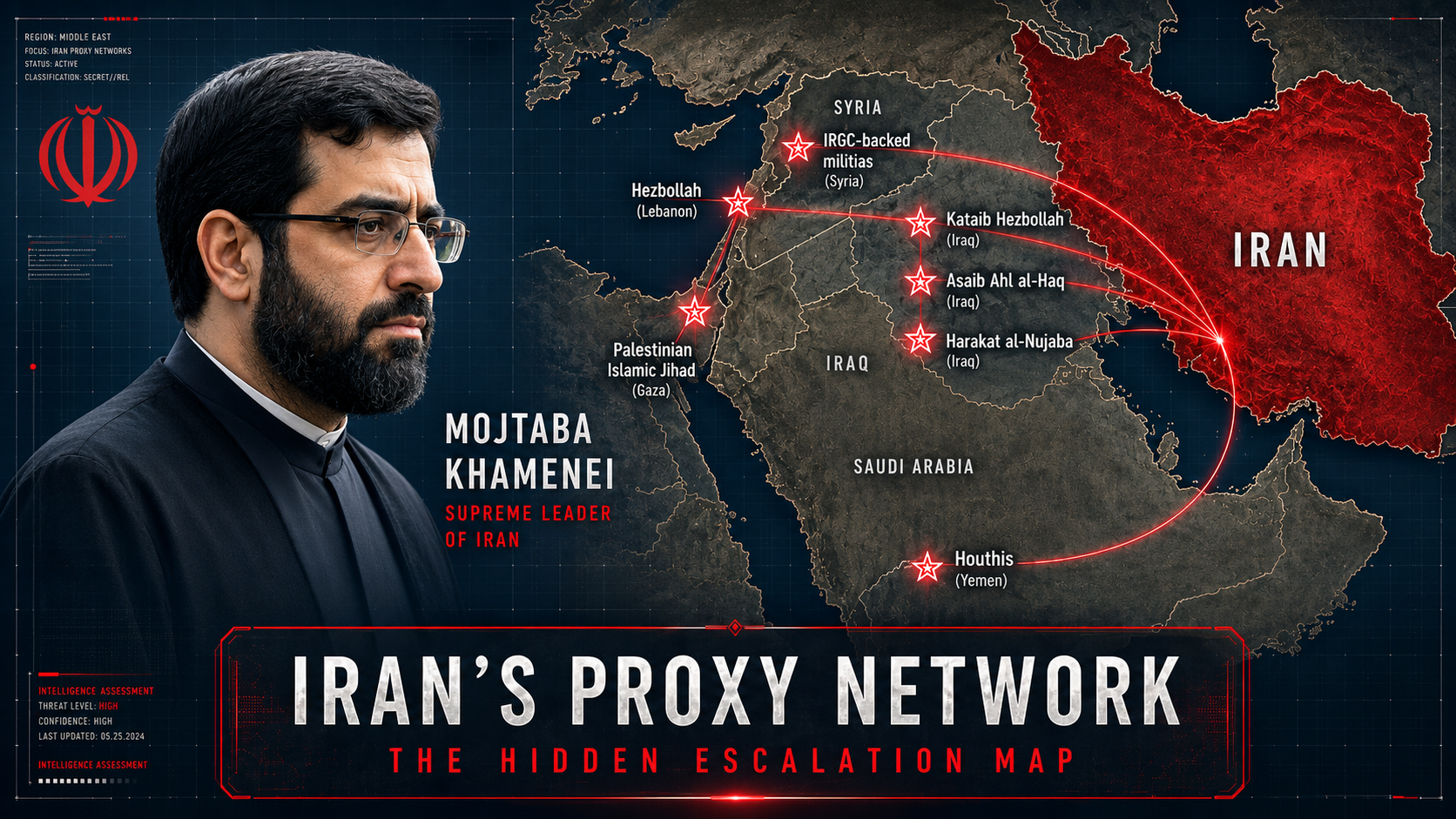
What decision-makers should watch now — before proxy escalation becomes a cost, compliance or supply-chain shock.
This 17-page executive briefing translates Iran’s proxy network into concrete business risks: energy price exposure, maritime chokepoints, war-risk premiums, sanctions, shadow fleets, supply-chain disruption and early-warning indicators for board-level decisions.
You are currently viewing a placeholder content from X. To access the actual content, click the button below. Please note that doing so will share data with third-party providers.
More Information