Executive Intelligence. Industrial Risk. Geopolitics.
Strategic Sparring
for Decision-Makers
Risk intelligence across technology, law, markets and power dynamics.

Verdeckte Geschäftsrisiken, strategische Widersprüche und kritische Abhängigkeiten frühzeitig erkennen.
Kostenlose Analyse starten →
Verdeckte Machtstrukturen, Führungsrisiken und organisatorische Blockaden frühzeitig erkennen.
Kostenlose Analyse starten →
Geopolitische Risiken, globale Abhängigkeiten und kritische Lieferkettenrisiken frühzeitig erkennen.
Kostenlose Analyse starten →
Identify hidden business risks, strategic contradictions and critical dependencies at an early stage.
Start Free Analysis →
Identify hidden power structures, leadership risks and organizational blockers at an early stage.
Start Free Analysis →
Identify geopolitical risks, global dependencies and critical supply-chain vulnerabilities at an early stage.
Start Free Analysis →
Verdeckte Geschäftsrisiken, strategische Widersprüche und kritische Abhängigkeiten frühzeitig erkennen.
Kostenlose Analyse starten →
Verdeckte Machtstrukturen, Führungsrisiken und organisatorische Blockaden frühzeitig erkennen.
Kostenlose Analyse starten →
Geopolitische Risiken, globale Abhängigkeiten und kritische Lieferkettenrisiken frühzeitig erkennen.
Kostenlose Analyse starten →
Identify hidden business risks, strategic contradictions and critical dependencies at an early stage.
Start Free Analysis →
Identify hidden power structures, leadership risks and organizational blockers at an early stage.
Start Free Analysis →
Identify geopolitical risks, global dependencies and critical supply-chain vulnerabilities at an early stage.
Start Free Analysis →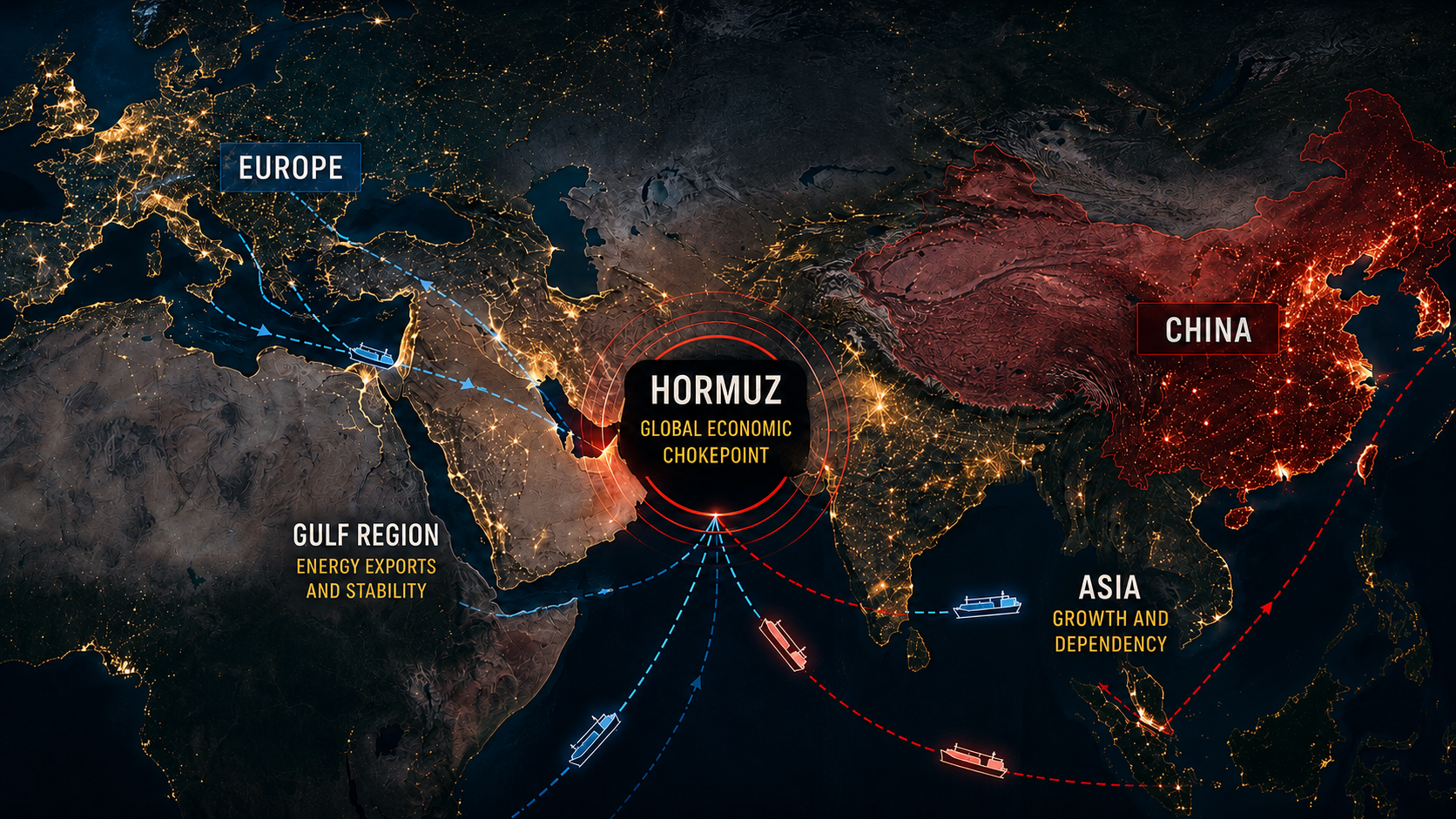
This Chokepoint Check assesses current pressure on the Strait of Hormuz, Bab al-Mandab and the Gulf region’s critical water, power, port and energy infrastructure. The key question is not only whether a route remains geographically open, but whether transport, insurance coverage, energy supply and site operations remain operationally viable.
The political reopening debate is still not translating into reliable commercial operations.
Kpler recorded only five commodity-vessel transits through Hormuz on Saturday; by the time of publication on Sunday, no transit had initially been recorded. The previous weekend had still registered 31 transits. AIS shutdowns may conceal individual movements.
The southern corridor remains operationally strained as anti-piracy operations around the Horn of Africa again take on a military dimension.
Kpler recorded 49 commodity-vessel transits over the weekend, compared with 55 previously. No Saudi oil transits were recorded. In parallel, Turkish and Somali forces freed a vessel held by pirates following a multi-day military operation.
No sufficiently confirmed new attack signal against fixed Gulf facilities was identified for August 29 or 30.
Systemic infrastructure pressure is shifting more strongly towards financial and trade channels today. The UAE Central Bank is investigating Banque Misr after the United States moved to cut its UAE operations off from dollar clearing over Iran-related transactions.
Kpler recorded only five commodity-vessel transits through Hormuz on Saturday. By the time of publication on Sunday, no transit had initially been recorded.
The previous weekend had still recorded 31 transits. Individual dark-transit movements may be missing, but visible traffic remains extremely low.
Chartering, delivery and insurance planning remain highly unreliable. Political reopening signals still cannot be treated as operational normalisation.
Verification Status: confirmed through current Kpler data; the Sunday figure remains a preliminary snapshot. Gulf Times / Reuters, 30.08.2026 · SchaafMedia: Strait of Hormuz Blockade 2026 – Strategies Against the Chokepoint Shock
Turkish naval forces and Somali security forces freed the MV LATUF following a ten-day operation. According to Somalia, four pirate boats were destroyed.
The operation was conducted under the Turkish-Somali defence agreement. It demonstrates the direct military internationalisation of anti-piracy operations.
Military protection reduces local hijacking risk, but also confirms that commercial shipping around the Horn of Africa again requires active state protection.
Verification Status: confirmed by the Somali government and AFP. Reports that the vessel was carrying weapons were not confirmed by Somalia. Arab News / AFP, 29.08.2026 · directly relevant on 30.08. · SchaafMedia: Chokepoint Check – Hormuz, Trade Routes & Supply Chain Risks
The United States intends to cut Banque Misr’s UAE branches off from dollar correspondent banking over Iran-related transactions. The UAE Central Bank subsequently launched an urgent special review.
US economic pressure is therefore extending directly into a major Gulf financial centre. The bank continues to operate for now; final disconnection has not yet taken place.
Banks and companies with Iran exposure face significantly higher dollar, compliance and counterparty risks. Payment flows may shift further.
Verification Status: confirmed. The US measure, Banque Misr’s response and the UAE Central Bank’s special review were confirmed on August 29. Reuters, 29.08.2026 · directly relevant on 30.08. · SchaafMedia: Iran War – How the West Fights and Loses Its Dominance
President Pezeshkian said on August 29 that Iran’s imports and exports had fallen by almost 35 percent as a result of sanctions and the US naval blockade.
Tehran is therefore acknowledging substantial economic damage, while simultaneously maintaining its claim to control over Hormuz and calling for revival of the June memorandum.
Economic pressure increases the risk of politically driven trade diversions, additional sanctions and further volatility in energy and payment flows.
Verification Status: confirmed for the Iranian statements and current political position. The 35 percent figure is an official Iranian estimate. Reuters, 29.08.2026 · directly relevant on 30.08. · SchaafMedia: Oil as a Geopolitical Weapon – Why Energy Dominates Geopolitics and Markets in 2026
Bangladesh’s government said on August 29 that it would review all aspects of possible accession to the Mecca Joint Defence Agreement before deciding.
No accession has yet been approved. Dhaka is nevertheless moving from general openness towards a more concrete political assessment of potential membership.
An expansion of the pact would broaden the security architecture linking the Gulf and South Asia and could reshape defence, trade and investment relationships.
Verification Status: confirmed for the political review; no formal accession has been approved. A final decision remains outstanding. Bangladesh Sangbad Sangstha, 29.08.2026 · directly relevant on 30.08. · SchaafMedia: Middle East Escalation Check from August 28, 2026
Hormuz again falls to near standstill over the weekend.
Shipping, anti-piracy protection and payment flows require additional state backing.
Transit and Iranian trade decline while alternative maritime and financial channels come under pressure.
Transport, insurance, dollar payments and geopolitical alliances are being reshaped simultaneously.
Hormuz remains geographically passable, but is again being used by only a very small number of visible vessels.
Route open · operational usability remains extremely constrainedNo new confirmed attack on fixed Gulf facilities was identified for August 29 or 30. Financial and export infrastructure is nevertheless coming under increasingly direct sanctions pressure.
No new facility attack · economic infrastructure remains under stressChokepoint disruption, anti-piracy operations, dollar sanctions and new defence frameworks are now operating in parallel.
Maritime, financial and security risks are fully interconnectedOverall risk remains critical. Compared with August 28, the operational situation in Hormuz has deteriorated again. At the same time, the conflict is spreading more deeply into financial systems and regional security architectures. Diplomatic channels remain open, but have still not produced reliable operational normalisation.
Note: This assessment was produced with support from our Geo-AI. AI can make mistakes. The analysis is intended as a source-based radar for potential escalation signals and does not replace fully verified intelligence, security, insurance or investment advice. In rapidly evolving situations, status, source availability and risk assessments may change at short notice.
Independent of the subject covered in this article, this separate Executive Briefing provides an in-depth analysis of another critical risk domain affecting European companies.
The 27-page Executive Briefing “Black Swan Risk Mapping for Europe’s Next Mobility and Infrastructure Shock” examines how geopolitical, infrastructural and administrative developments that are currently viewed in isolation could reinforce one another.
Based on the GFDD Framework™, the report shows how these dynamics could affect operational continuity, access to critical resources and the strategic resilience of companies.
The briefing includes a structured systemic-shock analysis and a directly applicable Business Exposure Checklist for CEOs, CFOs, COOs, investors and strategy teams.
You are currently viewing a placeholder content from X. To access the actual content, click the button below. Please note that doing so will share data with third-party providers.
More Information