Executive Intelligence. Industrial Risk. Geopolitics.
Strategic Sparring
for Decision-Makers
Risk intelligence across technology, law, markets and power dynamics.

Verdeckte Geschäftsrisiken, strategische Widersprüche und kritische Abhängigkeiten frühzeitig erkennen.
Kostenlose Analyse starten →
Verdeckte Machtstrukturen, Führungsrisiken und organisatorische Blockaden frühzeitig erkennen.
Kostenlose Analyse starten →
Geopolitische Risiken, globale Abhängigkeiten und kritische Lieferkettenrisiken frühzeitig erkennen.
Kostenlose Analyse starten →
Identify hidden business risks, strategic contradictions and critical dependencies at an early stage.
Start Free Analysis →
Identify hidden power structures, leadership risks and organizational blockers at an early stage.
Start Free Analysis →
Identify geopolitical risks, global dependencies and critical supply-chain vulnerabilities at an early stage.
Start Free Analysis →
Verdeckte Geschäftsrisiken, strategische Widersprüche und kritische Abhängigkeiten frühzeitig erkennen.
Kostenlose Analyse starten →
Verdeckte Machtstrukturen, Führungsrisiken und organisatorische Blockaden frühzeitig erkennen.
Kostenlose Analyse starten →
Geopolitische Risiken, globale Abhängigkeiten und kritische Lieferkettenrisiken frühzeitig erkennen.
Kostenlose Analyse starten →
Identify hidden business risks, strategic contradictions and critical dependencies at an early stage.
Start Free Analysis →
Identify hidden power structures, leadership risks and organizational blockers at an early stage.
Start Free Analysis →
Identify geopolitical risks, global dependencies and critical supply-chain vulnerabilities at an early stage.
Start Free Analysis →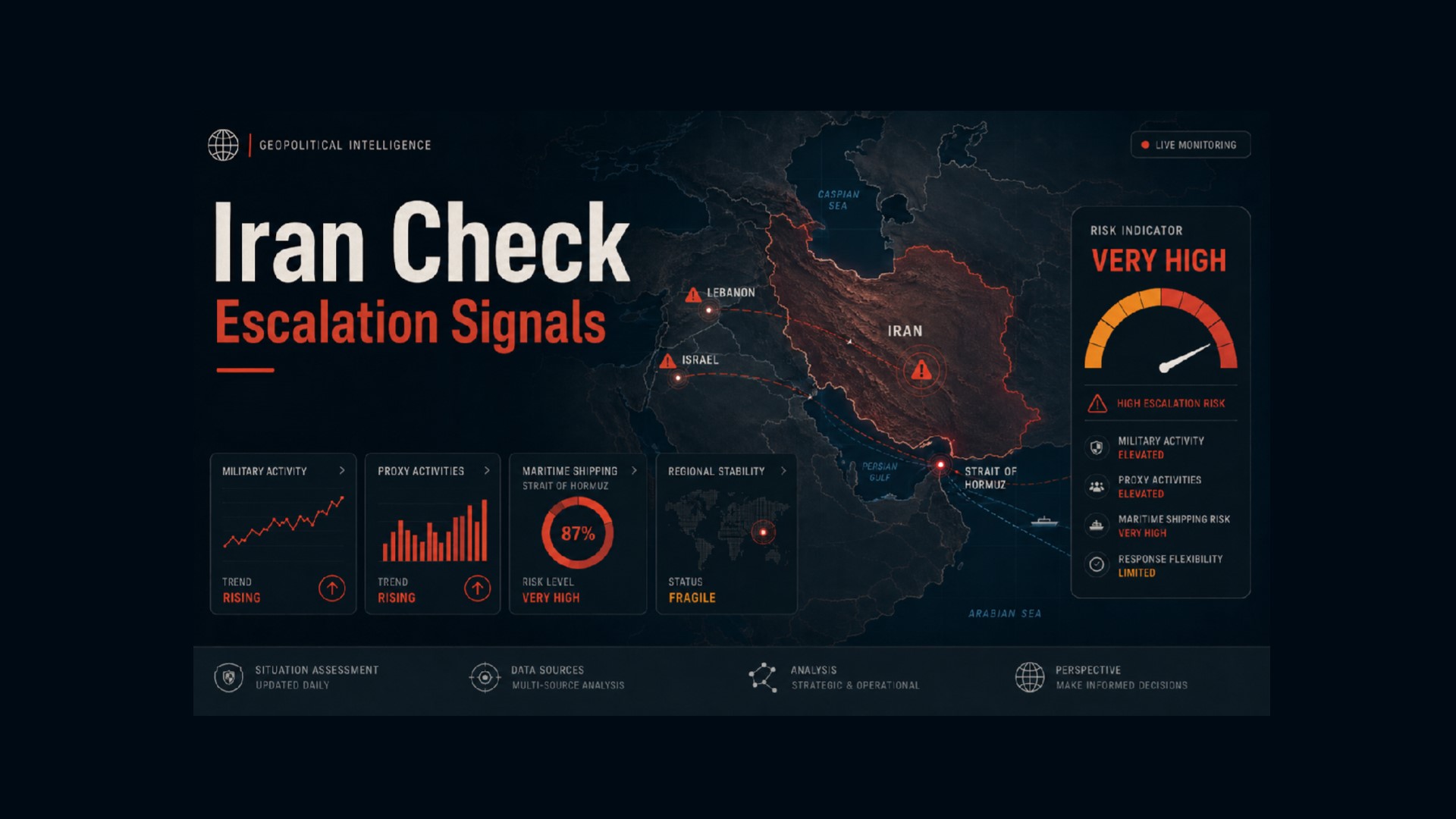
This escalation radar summarises five relevant signals as of August 29, 2026. It focuses on substantiated statements by official bodies, verified events and monitoring sources with potential implications for energy prices, supply chains, markets, maritime security, aviation and regional stability.
CENTCOM reports 82 redirected merchant vessels, three disabled vessels and two boarded ships. Traffic to and from Iranian ports is to take place only with US authorisation. Economic pressure is therefore increasingly becoming direct maritime control.
President Pezeshkian says exports and imports have fallen by almost 35 percent due to sanctions and the naval blockade. Inflation has simultaneously reached 66 percent. Tehran nevertheless signals no retreat on Hormuz.
QatarEnergy cancels five additional LNG cargoes for Edison. The total shortfall now reaches 29 cargoes, equivalent to around 3.8 billion cubic metres. The Hormuz crisis is therefore becoming a longer-term European gas supply issue.
| Actor | Type | Severity | Status | Source / Verification Status | Business Impact |
|---|---|---|---|---|---|
| United States / Iran / CENTCOM / international merchant shipping | CENTCOM reports 82 redirected vessels in enforcement of the Iran blockade | Critical · Level 5/5 | The US naval blockade takes on a significantly more concrete operational dimension on August 29. CENTCOM reports that by August 28, a total of 82 merchant vessels had been redirected. Three additional vessels had reportedly been disabled and two boarded. According to CENTCOM, no vessel may enter or leave an Iranian port without US authorisation; exemptions apply for humanitarian purposes. Power dynamics: Washington is therefore attempting not only to reduce Iranian revenues, but to actively control physical access to Iranian ports. Economic warfare and maritime coercive enforcement are increasingly merging. | Confirmed by Qatar News Agency / CENTCOM, August 29, 2026 . Verification status: confirmed regarding the figures reported by CENTCOM and the US rules governing access to Iranian ports. Details concerning individual interventions are based on the US military’s account. Background: Schaaf Media · Middle East Escalation Check from August 28, 2026 . | Critical business impact on Iran-related trade, shipping companies, charter contracts, insurance, port calls, sanctions and supply chains. Companies face a growing risk that Iran-related vessel movements will not only be sanctioned, but physically interrupted. |
| Iran / United States / UAE / Egypt / banks / foreign trade | Iran confirms sharp trade decline – US pressure reaches regional banks | Critical · Level 5/5 | Iran’s leadership acknowledges particularly clearly on August 29 the economic burden of the war. President Masoud Pezeshkian says Iranian imports and exports have fallen by almost 35 percent as a result of sanctions and the naval blockade. Annual inflation most recently stood at 66 percent. At the same time, Washington is targeting regional financial channels more aggressively: the UAE branches of Egypt’s Banque Misr are to be cut off from dollar transactions with US correspondent banks. Tehran nevertheless signals that it will not respond to sanctions and blockade with political concessions. Power dynamics: US pressure is therefore reaching both Iran’s domestic stability and its regional financial connections. | Confirmed by Reuters, August 29, 2026 . Verification status: confirmed regarding the decline in foreign trade, the inflation rate and the measures targeting Banque Misr in the UAE. Iran simultaneously says it intends to continue pursuing diplomacy and defence in parallel. Further reading: Schaaf Media · Oil as a Weapon: Why Energy Dominates Geopolitics and Markets in 2026 . | Critical business impact on banks, payments, UAE and Egypt exposure, trade finance, Iranian imports, secondary sanctions and compliance. The US campaign is increasingly shifting risk from direct Iran-related business to regional financial intermediaries. |
| Iran / Oman / United States / Hormuz / international shipowners | Iran and Oman agree on passage route – actual reopening remains tied to US concessions | Critical · Level 5/5 | President Pezeshkian confirms on August 28 that Iran and Oman have agreed on a specific passage route through Hormuz. According to him, the route has also been presented to Iran’s highest leadership. An actual reopening, however, remains tied by Tehran to several US concessions: lifting sanctions and the blockade, releasing Iranian assets, investment and ending the war in Lebanon. At the same time, Kpler data continue to show only seven visible merchant vessels transiting Hormuz, down from 17 the previous day. Power dynamics: The technical question of the corridor is moving closer to resolution, while the political quid pro quo is not. Hormuz therefore remains a central Iranian negotiating lever. | Confirmed by Anadolu Agency, August 28, 2026 . Verification status: confirmed regarding the agreed passage route and the conditions formulated by Iran. No final general reopening has been agreed. Further reading: Schaaf Media · Hormuz Blockade 2026: Strategies for the Chokepoint Shock . | Critical business impact on oil, LNG, LPG, tankers, charter rates, insurability, delivery times and long-term procurement planning. A technically agreed corridor does not yet create reliable commercial normalisation. |
| Qatar / Italy / Edison / Europe / LNG / Hormuz | QatarEnergy extends LNG force majeure for Italy until early November | Critical · Level 5/5 | QatarEnergy extends the war-related suspension of LNG deliveries to Italian utility Edison until early November. Five additional cargoes scheduled between late September and early November are cancelled. This increases the total number of cancelled cargoes to 29, equivalent to around 3.8 billion cubic metres of gas. Edison contractually receives around 6.4 billion cubic metres per year from Qatar, equivalent to roughly ten percent of Italian gas consumption. The company says it has so far been able to secure replacement supplies. Power dynamics: The Hormuz conflict is therefore no longer creating only a short-term disruption, but is now extending into European winter procurement. | Confirmed by Reuters, August 28, 2026 . Verification status: confirmed regarding five additional cancellations, a total of 29 cancelled cargoes and the extension until early November. Edison says it can currently continue supplying its customers in full. Background: Schaaf Media · Middle East Escalation Check from August 28, 2026 . | Critical business impact on Italy, European LNG procurement, gas prices, storage planning, industry and winter supply. Replacement procurement reduces the immediate shortfall, but increases costs and competition for available LNG cargoes. |
| Hezbollah / Israel / Lebanon / Iran / southern Lebanon | Hezbollah again rejects disarmament framework – Israel continues strikes near Nabatieh | High to critical · Level 4/5 | Hezbollah leader Naim Qassem again completely rejects the US-backed Lebanon-Israel framework. He rejects both disarmament and the proposed pilot zones and monitoring system. Hezbollah will not surrender. At the same time, another Israeli drone strike is reported on August 29 near Nabatieh al-Fawqa in southern Lebanon. Israel has recently intensified its strikes in this area. Power dynamics: The political disarmament process and operational reality therefore continue to diverge. As long as Hezbollah rejects the framework and Israel maintains military pressure, the Iran-linked Lebanon theatre remains an independent escalation channel. | Confirmed by Dawn / AFP, August 29, 2026 and Times of Israel, August 29, 2026 . Verification status: confirmed regarding Qassem’s rejection of the political framework. Today’s drone strike is reported by Lebanese media; an immediate IDF statement was initially unavailable. Background: Schaaf Media · Iran’s Proxies: The Hidden Escalation Map of the Middle East . | High to critical business impact on Lebanon, Israel, aviation, land logistics, ports, personnel movements, evacuation planning and investment. A blocked disarmament process increases the likelihood that military pressure will increasingly replace the political process. |
The most important escalation shift on August 29, 2026 lies in the operational enforcement of the US naval blockade. CENTCOM now reports 82 redirected merchant vessels as well as direct intervention against additional ships. Economic isolation is therefore increasingly becoming physical maritime control.
At the same time, the pressure is clearly affecting Iran domestically. Tehran itself acknowledges a decline of almost 35 percent in foreign trade, while inflation has reached 66 percent. This has not yet produced political concessions: Iran continues to retain Hormuz as leverage.
The situation at the strait itself remains contradictory. Iran and Oman have agreed on a passage route, but Tehran continues to tie reopening to far-reaching US concessions. At the same time, only seven visible merchant vessels are transiting the strait. Diplomatic progress therefore does not yet amount to operational normalisation.
For Europe, the crisis is becoming increasingly long-term. QatarEnergy is extending LNG supply disruptions for Italy until early November, while the Lebanon conflict remains deadlocked due to Hezbollah’s rejection of disarmament and continued Israeli strikes. The mandatory alliance review shows no newly confirmed Iranian accession or alliance status today. EASA CZIBs for Iran, Iraq, Jordan, Lebanon, the Persian Gulf and the Gulf of Oman remain active until August 31, 2026; no new tightening was issued on August 29.
The five most important signals for a European and German risk assessment are: the significantly intensified operational enforcement of the US naval blockade against Iran, Iran’s confirmed decline in foreign trade of almost 35 percent, the agreed Iran-Oman passage route with political reopening conditions still unresolved, the extension of QatarEnergy’s LNG supply disruptions for Italy until early November, and Hezbollah’s renewed rejection of the Lebanon-Israel framework while Israeli strikes continue in southern Lebanon.
Note: This assessment was prepared with the support of our Geo AI. AI can make mistakes. The analysis is intended as a radar for potential escalation signals and does not replace a fully verified intelligence assessment.
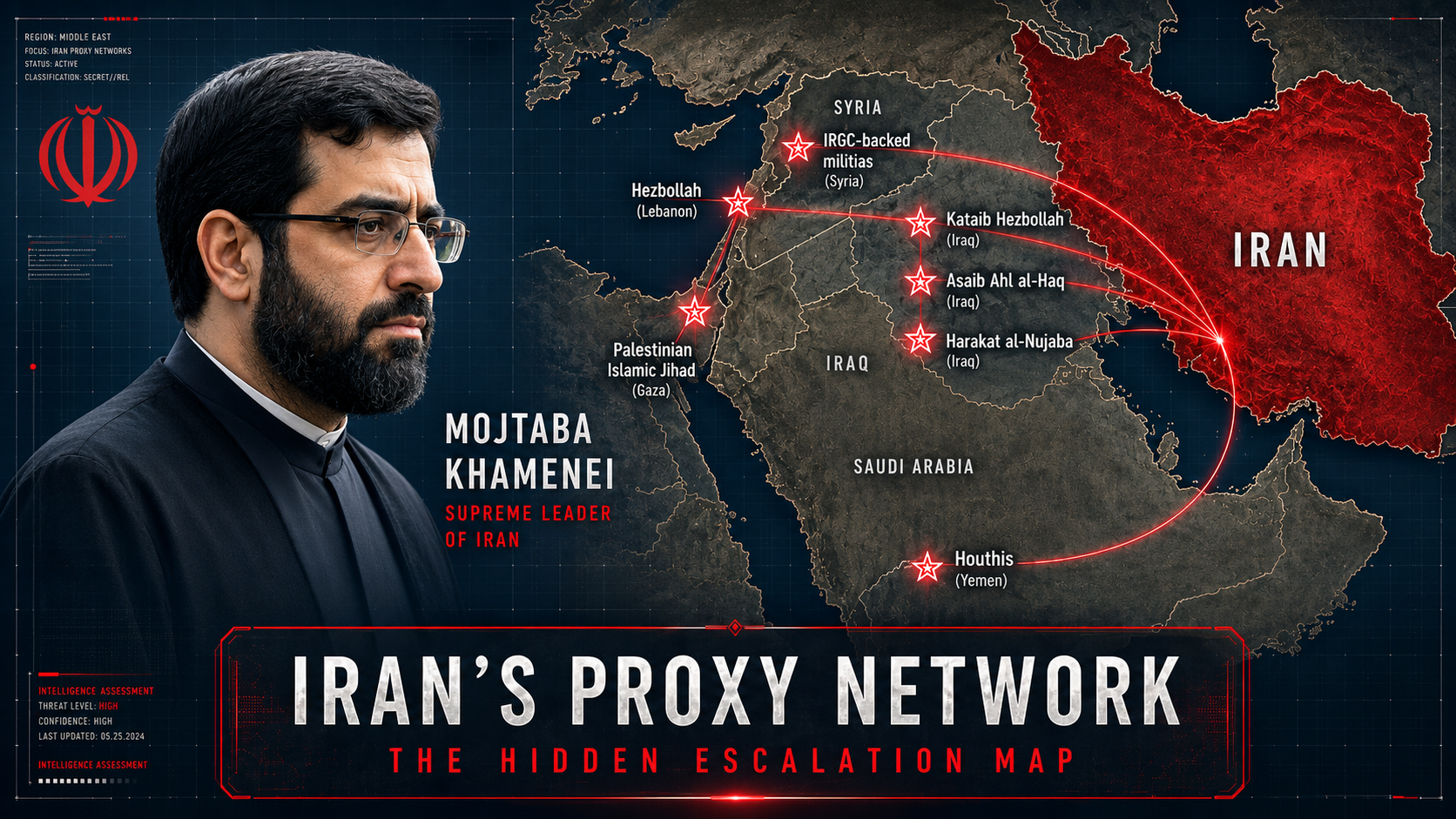
What decision-makers should watch now — before proxy escalation becomes a cost, compliance or supply-chain shock.
This 17-page executive briefing translates Iran’s proxy network into concrete business risks: energy price exposure, maritime chokepoints, war-risk premiums, sanctions, shadow fleets, supply-chain disruption and early-warning indicators for board-level decisions.
You are currently viewing a placeholder content from X. To access the actual content, click the button below. Please note that doing so will share data with third-party providers.
More Information