Executive Intelligence. Industrial Risk. Geopolitics.
Strategic Sparring
for Decision-Makers
Risk intelligence across technology, law, markets and power dynamics.

Verdeckte Geschäftsrisiken, strategische Widersprüche und kritische Abhängigkeiten frühzeitig erkennen.
Kostenlose Analyse starten →
Verdeckte Machtstrukturen, Führungsrisiken und organisatorische Blockaden frühzeitig erkennen.
Kostenlose Analyse starten →
Geopolitische Risiken, globale Abhängigkeiten und kritische Lieferkettenrisiken frühzeitig erkennen.
Kostenlose Analyse starten →
Identify hidden business risks, strategic contradictions and critical dependencies at an early stage.
Start Free Analysis →
Identify hidden power structures, leadership risks and organizational blockers at an early stage.
Start Free Analysis →
Identify geopolitical risks, global dependencies and critical supply-chain vulnerabilities at an early stage.
Start Free Analysis →
Verdeckte Geschäftsrisiken, strategische Widersprüche und kritische Abhängigkeiten frühzeitig erkennen.
Kostenlose Analyse starten →
Verdeckte Machtstrukturen, Führungsrisiken und organisatorische Blockaden frühzeitig erkennen.
Kostenlose Analyse starten →
Geopolitische Risiken, globale Abhängigkeiten und kritische Lieferkettenrisiken frühzeitig erkennen.
Kostenlose Analyse starten →
Identify hidden business risks, strategic contradictions and critical dependencies at an early stage.
Start Free Analysis →
Identify hidden power structures, leadership risks and organizational blockers at an early stage.
Start Free Analysis →
Identify geopolitical risks, global dependencies and critical supply-chain vulnerabilities at an early stage.
Start Free Analysis →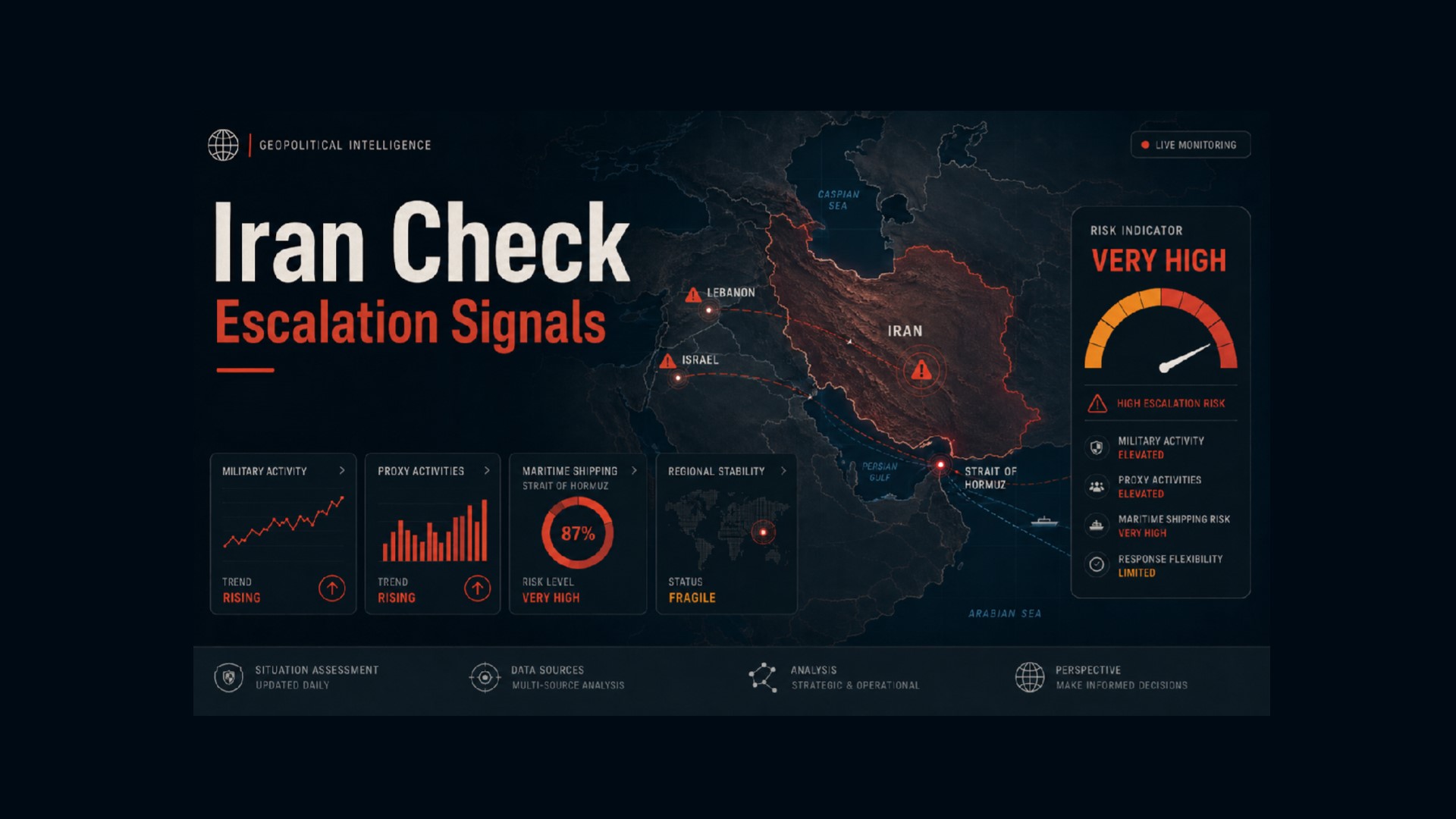
This escalation radar summarises five relevant signals as of August 31, 2026. It focuses on substantiated statements by official bodies, verified events and monitoring sources with potential implications for energy prices, supply chains, markets, maritime security, aviation and regional stability.
US forces strike two Iranian missile launchers on Larak in the Strait of Hormuz. Iran responds with ballistic missiles against US targets in Jordan. Eight missiles are intercepted according to the Jordanian military. The several-week pause in direct military attacks has therefore ended.
The IRGC says a supertanker travelling on an unauthorised route struck two naval mines, caught fire and came to a complete halt. Tehran explicitly warns of further consequences for vessels violating its transit rules.
US Treasury Secretary Scott Bessent announces regular new secondary sanctions. Banks are initially the primary focus. Institutions handling Iranian financial flows risk exclusion from the dollar-based financial system.
| Actor | Type | Severity | Status | Source / Verification Status | Business Impact |
|---|---|---|---|---|---|
| United States / Iran / Jordan / CENTCOM / IRGC | US strike on Larak triggers Iranian missile retaliation against US targets | Critical · Level 5/5 | The United States and Iran return to direct military attacks on August 31 for the first time since late July. US forces strike two Iranian missile launchers on the island of Larak in the Strait of Hormuz. According to the United States, IRGC forces there were preparing missiles with naval mines for Hormuz. Iran responds with ballistic missiles against US targets in Jordan. Jordan’s armed forces confirm that eight missiles were intercepted in Jordanian airspace. Power dynamics: The conflict is therefore shifting from economic warfare and blockade back to direct military retaliation. Hormuz is once again becoming an immediate US-Iran military theatre. | Confirmed by Reuters, August 31, 2026 . Verification status: confirmed regarding the US strike on Larak and Iranian missile retaliation against US targets in Jordan. Iran claims damage and casualties at US targets; these claims have not been independently confirmed. Background: Schaaf Media · Middle East Escalation Check from August 30, 2026 . | Critical business impact on Hormuz, Jordan, US military facilities, aviation, oil, LNG, insurance and regional operations. The return of direct attacks significantly increases the risk of short-notice airspace closures and further retaliatory strikes. |
| Iran / UAE / US military / Al Minhad / regional air defence | Iran claims attack on US base in UAE – Abu Dhabi disputes claim | Critical · Level 5/5 | Iran expands its retaliation messaging to the UAE on August 31. Iranian authorities claim that US personnel at Al Minhad Air Base were attacked. The UAE Ministry of Defence rejects this account. What is confirmed, however, is that Emirati air forces intercepted a drone approaching from the direction of Iran over territorial waters. Power dynamics: Even if the claimed strike on Al Minhad remains unconfirmed, Iranian military activity has again reached the immediate security environment of a Gulf state. This increases the risk that US-Iran retaliation will directly draw regional partners into the conflict. | Confirmed by The National / UAE Ministry of Defence, August 31, 2026 . Verification status: partially confirmed. The interception of a drone approaching from the direction of Iran is confirmed. Iran’s claim that Al Minhad was struck is explicitly rejected by the UAE. Background: Schaaf Media · Iran Check: 5 Escalation Signals from August 29, 2026 . | Critical business impact on UAE operations, Dubai and Abu Dhabi, aviation, logistics, insurance, employee travel and business continuity. The renewed involvement of UAE airspace significantly increases regional spillover risk. |
| Iran / IRGC / Hormuz / international shipowners / supertanker | Supertanker hits naval mines – IRGC threatens other vessels | Critical · Level 5/5 | The maritime situation in Hormuz escalates directly again on August 31. According to the IRGC Navy, a supertanker travelling on a route Iran considers illegal strikes two naval mines. The vessel catches fire and comes to a complete halt. The IRGC subsequently states that its transit rules are binding and that other vessels violating them could face a similar outcome. Power dynamics: Tehran is therefore enforcing its claim to determine authorised routes through Hormuz not only politically, but operationally. This directly conflicts with Washington’s freedom-of-navigation position. | Confirmed by Dawn, August 31, 2026 citing the IRGC. Verification status: confirmed regarding the Iranian report of two naval mines, fire and the tanker coming to a halt. The vessel, crew and exact extent of damage had not initially been independently identified. Further reading: Schaaf Media · Strait of Hormuz Blockade 2026: Strategies for the Chokepoint Shock . | Critical business impact on tankers, crude oil, LNG, insurability, crew safety, charter contracts and war-risk premiums. Naval mines and competing transit rules make even politically authorised routes operationally difficult to assess. |
| United States / Iran / G20 / international banks / US Treasury | Washington announces recurring secondary sanctions against Iran-linked networks | High to critical · Level 4/5 | In parallel with the military escalation, Washington is institutionalising its economic campaign against Iran. US Treasury Secretary Scott Bessent says new secondary sanctions could be imposed on a weekly basis. Banks handling Iranian financial flows are the initial focus. Washington threatens to cut institutions off entirely from the dollar-based financial system. Bessent also intends to use the G20 meeting to encourage additional countries to reduce economic ties with Iran. Power dynamics: Military pressure and sanctions are no longer being treated as alternatives, but are being applied in parallel. This substantially increases risk for third countries and financial intermediaries. | Confirmed by AP News, August 31, 2026 . Verification status: confirmed regarding the planned sanctioning of another financial institution and the intensified focus on banks. The scope and specific target banks of future weekly rounds are not yet fully known. Further reading: Schaaf Media · Oil as a Weapon: Why Energy Dominates Geopolitics and Markets in 2026 . | High to critical business impact on banks, payment service providers, trade finance, China and Gulf exposure, secondary sanctions and compliance. Recurring sanctions rounds significantly shorten response times for companies and financial institutions. |
| Iran / China / Russia / SCO / Pezeshkian / Xi / Putin | Iran uses SCO summit as strategic counterweight to US pressure | High to critical · Level 4/5 | President Masoud Pezeshkian attends the Shanghai Cooperation Organisation summit in Bishkek on August 31. China’s President Xi Jinping, Russia’s President Vladimir Putin and other Asian leaders are attending at the same time. The summit addresses security, energy, regional connectivity and economic cooperation. For Iran, this is strategically significant immediately following the renewed military escalation. Power dynamics: While Washington seeks to isolate Iran economically, Tehran is demonstrating institutional integration into a power framework led by China and Russia. This is not a new accession: Iran is already an SCO member. However, today’s summit strengthens the cross-theatre linkage between the US-Iran conflict, US-China strategic competition and the Russia-West confrontation. | Confirmed by The National, August 31, 2026 . Verification status: confirmed regarding Pezeshkian’s participation and the simultaneous presence of Xi and Putin. The mandatory alliance review shows no new Iranian membership status and no newly confirmed accession to the Mecca Pact. Further analysis: Schaaf Media · Iran War: How the West Is Fighting While Losing Its Dominance . | High to critical business impact on China-Iran trade, Russia-Iran relations, energy, alternative payment channels, sanctions and global supply chains. The more effectively Iran develops economic and political alternatives within non-Western institutions, the more difficult complete US isolation becomes. |
The most important escalation shift on August 31, 2026 is the return of direct military strikes between the United States and Iran. Washington attacks IRGC positions on Larak, Iran responds against US targets in Jordan and additionally claims an operation in the UAE. The several-week pause in direct military attacks has therefore effectively ended.
Hormuz remains particularly critical. In parallel with the US strike on Iranian mine-laying capabilities, the IRGC reports a supertanker striking two naval mines. Tehran explicitly warns other shipowners to comply with its transit rules. US and Iranian security regimes are therefore directly competing within the same chokepoint.
At the same time, Washington is structurally intensifying its economic campaign. New secondary sanctions are expected to follow at regular intervals, initially targeting banks. Companies must therefore prepare for significantly shorter adjustment periods across payments, trade and compliance.
The geopolitical cross-theatre linkage is also expanding. Iran is participating alongside China and Russia at the SCO summit and thereby demonstrating institutional alternatives to the US isolation strategy. No new Iranian alliance accession has been confirmed on August 31. EASA CZIBs for Iran, Iraq, Jordan, Lebanon, the Persian Gulf and the Gulf of Oman remain valid through August 31, 2026; no new extension had been published at the time of research.
The five most important signals for a European and German risk assessment are: the renewed direct military exchange between the United States and Iran, the expansion of Iranian retaliatory activity into Jordan and the UAE security environment, the supertanker stopped by naval mines and the intensified IRGC transit warning in Hormuz, the announced recurring US secondary sanctions targeting banks, and Iran’s demonstrative strategic integration into the SCO framework with China and Russia.
Note: This assessment was prepared with the support of our Geo AI. AI can make mistakes. The analysis is intended as a radar for potential escalation signals and does not replace a fully verified intelligence assessment.
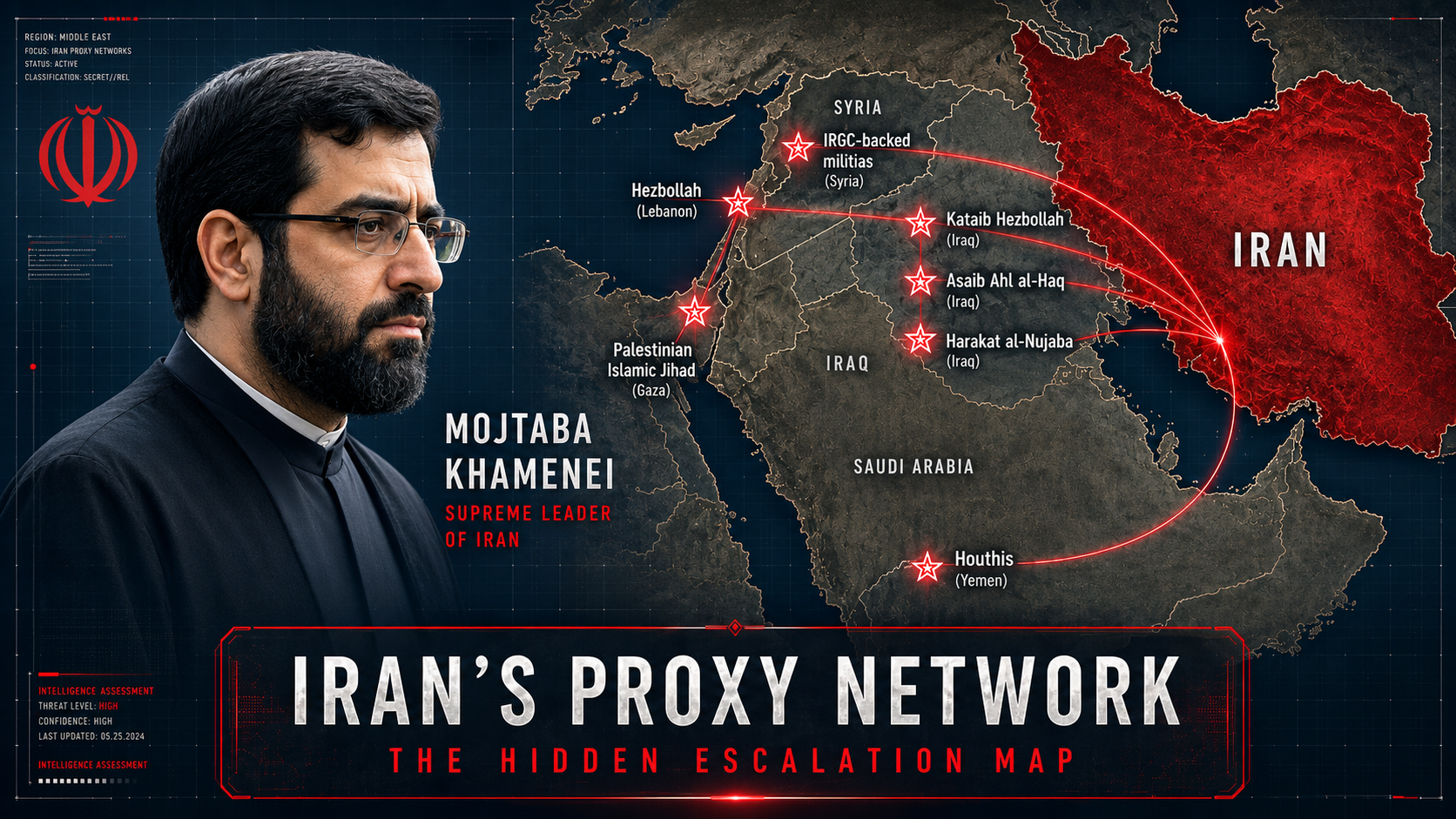
What decision-makers should watch now — before proxy escalation becomes a cost, compliance or supply-chain shock.
This 17-page executive briefing translates Iran’s proxy network into concrete business risks: energy price exposure, maritime chokepoints, war-risk premiums, sanctions, shadow fleets, supply-chain disruption and early-warning indicators for board-level decisions.
You are currently viewing a placeholder content from X. To access the actual content, click the button below. Please note that doing so will share data with third-party providers.
More Information