Executive Intelligence. Industrial Risk. Geopolitics.
Strategic Sparring
for Decision-Makers
Risk intelligence across technology, law, markets and power dynamics.

Verdeckte Geschäftsrisiken, strategische Widersprüche und kritische Abhängigkeiten frühzeitig erkennen.
Kostenlose Analyse starten →
Verdeckte Machtstrukturen, Führungsrisiken und organisatorische Blockaden frühzeitig erkennen.
Kostenlose Analyse starten →
Geopolitische Risiken, globale Abhängigkeiten und kritische Lieferkettenrisiken frühzeitig erkennen.
Kostenlose Analyse starten →
Identify hidden business risks, strategic contradictions and critical dependencies at an early stage.
Start Free Analysis →
Identify hidden power structures, leadership risks and organizational blockers at an early stage.
Start Free Analysis →
Identify geopolitical risks, global dependencies and critical supply-chain vulnerabilities at an early stage.
Start Free Analysis →
Verdeckte Geschäftsrisiken, strategische Widersprüche und kritische Abhängigkeiten frühzeitig erkennen.
Kostenlose Analyse starten →
Verdeckte Machtstrukturen, Führungsrisiken und organisatorische Blockaden frühzeitig erkennen.
Kostenlose Analyse starten →
Geopolitische Risiken, globale Abhängigkeiten und kritische Lieferkettenrisiken frühzeitig erkennen.
Kostenlose Analyse starten →
Identify hidden business risks, strategic contradictions and critical dependencies at an early stage.
Start Free Analysis →
Identify hidden power structures, leadership risks and organizational blockers at an early stage.
Start Free Analysis →
Identify geopolitical risks, global dependencies and critical supply-chain vulnerabilities at an early stage.
Start Free Analysis →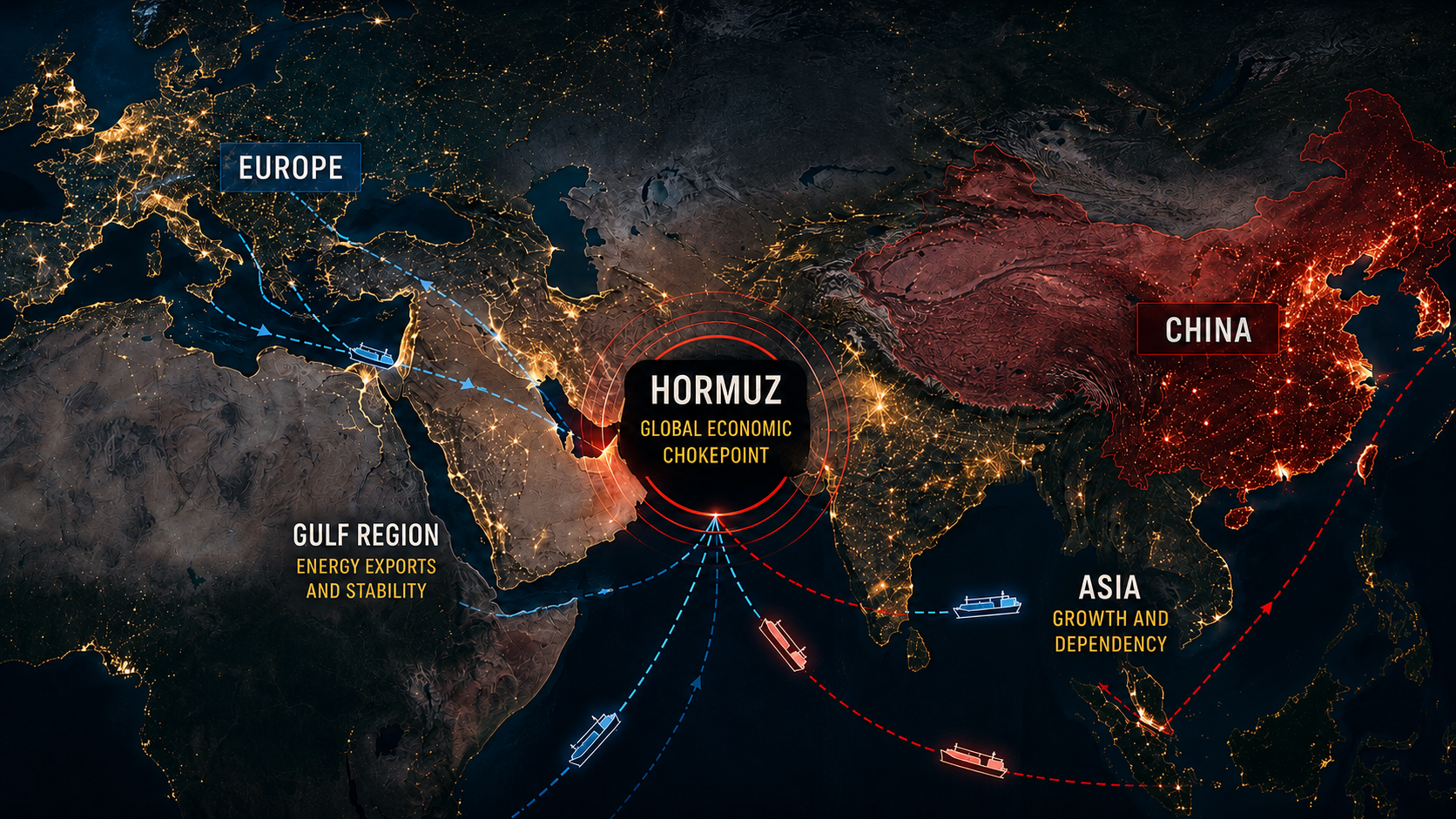
This Chokepoint Check assesses current pressure on the Strait of Hormuz, Bab al-Mandab and the Gulf region’s critical water, power, port and energy infrastructure. The key question is not only whether a route remains geographically open, but whether transport, insurance coverage, energy supply and site operations remain operationally viable.
The route remains geographically open, but is still not reliably usable from either a military or commercial perspective.
Only six commodity vessels passed through Hormuz on Tuesday, compared with a 10-day average of around twelve. On Wednesday, the IRGC additionally reported attacks on ten vessels inside a “prohibited” zone.
The maritime corridor remains open, while the Houthi-Saudi front is directly spilling over into energy and Red Sea security.
Bab al-Mandab recorded 25 commodity-vessel transits on Tuesday, compared with a 10-day average of around 27. At the same time, Houthi forces attacked several Saudi cities and energy facilities.
The escalation has again reached operational energy infrastructure in one of the Gulf’s key producing states.
Houthi missiles and drones struck targets in Abha, Najran and Jizan. Saudi Arabia confirmed fires and temporary operational shutdowns at individual energy facilities.
Iran fired ballistic missiles at a US-used base near Al Azraq in Jordan and reported attacks on ten vessels in Hormuz.
Jordan confirmed 20 Iranian missiles and said 18 were intercepted. The ten reported vessel attacks remain primarily an IRGC claim.
Direct attacks on military and maritime targets immediately increase crew-safety, insurance, chartering and transit risks across the Gulf.
Verification Status: partially confirmed. The missile attack on Jordan and US attacks on Iranian tankers are confirmed; the ten vessel attacks remain IRGC claims. Reuters, 09.09.2026 · SchaafMedia: Iran Check – 5 Escalation Signals from September 8, 2026
Houthi forces attacked Abha, Khamis Mushait, Jizan and Najran with missiles and drones. Seventy-three people were injured.
Saudi Arabia confirmed fires and operational disruptions at individual energy facilities. The coalition announced decisive countermeasures.
Saudi Arabia is critical to alternative oil flows outside Hormuz. Attacks on its energy infrastructure therefore materially increase global supply risk.
Verification Status: confirmed by Saudi authorities and international news agencies. The scale and duration of individual outages continue to be assessed. Reuters, 08.09.2026 · directly operationally relevant on 09.09. · SchaafMedia: Oil as a Geopolitical Weapon – Why Energy Dominates Geopolitics and Markets in 2026
Kpler recorded six commodity vessels through Hormuz on Tuesday. Bab al-Mandab reached 25 transits compared with a 10-day average of 27.
Hormuz remains significantly below its average of twelve. Five vessels entered, while only one exited.
Both key maritime routes remain below normal traffic levels. Companies continue to require additional buffers for capacity, lead times and procurement.
Verification Status: confirmed through Kpler data from September 9; dark transits are not included. Reuters / Kpler, 09.09.2026 · SchaafMedia: Chokepoint Risk Analysis – Hormuz & Supply Chain Risks
Pakistan’s Defence Minister Khawaja Asif said attacks on Saudi Arabia could make the Makkah Joint Defense Agreement operationally relevant.
The pact treats an attack on one member as an attack on all three states. No specific troop deployment has been announced.
Activation could draw Pakistan and Türkiye more deeply into the Gulf security architecture and alter both deterrence and escalation dynamics.
Verification Status: confirmed for the statement by Pakistan’s defence minister. The political commitment was explicitly emphasised; operational activation steps remain unconfirmed. Arab News Pakistan, 09.09.2026 · SchaafMedia: Middle East Escalation Check from September 7, 2026
ENOC estimates additional Hormuz transit costs at $10 million to $20 million. War-risk premiums have reached as much as ten percent.
Cargo insurance can add another five to six percent. Some market participants are already operating without insurance coverage entirely.
The Strait is therefore not only militarily dangerous, but also significantly less economically viable for individual cargoes.
Verification Status: confirmed through current comments by an ENOC executive at the APPEC conference on September 9. Reuters / ENOC, 09.09.2026 · SchaafMedia: Strait of Hormuz Blockade 2026 – Protecting Margins and Supply Chains in the Chokepoint Shock
Vessels, a US-used base and Saudi energy facilities are being attacked simultaneously.
Shipowners, oil companies and insurers tighten route, security and coverage requirements.
Hormuz remains at six transits while individual Saudi energy facilities experience disruptions.
Oil prices, insurance premiums, freight and procurement costs rise simultaneously.
Hormuz remains significantly below normal traffic levels. Iran additionally reports direct attacks on ten vessels.
Route open · attack, insurance and control risks prevent reliable normal operationsHouthi attacks caused fires and operational disruptions at Saudi energy facilities.
Energy infrastructure directly hit · operational impact confirmedHormuz attacks, Saudi energy disruptions, the US-Iran confrontation and potential alliance activation are occurring simultaneously.
Maritime, energy, military and alliance risks are fully interconnectedOverall risk remains critical. Compared with September 7, conditions have clearly shifted from structural chokepoint control back towards direct military attacks. At the same time, the escalation is now affecting Saudi energy infrastructure and could for the first time trigger collective-defence obligations.
Note: This assessment was produced with support from our Geo-AI. AI can make mistakes. The analysis is intended as a source-based radar for potential escalation signals and does not replace fully verified intelligence, security, insurance or investment advice. In rapidly evolving situations, status, source availability and risk assessments may change at short notice.
Independent of the subject covered in this article, this separate Executive Briefing provides an in-depth analysis of another critical risk domain affecting European companies.
The 27-page Executive Briefing “Black Swan Risk Mapping for Europe’s Next Mobility and Infrastructure Shock” examines how geopolitical, infrastructural and administrative developments that are currently viewed in isolation could reinforce one another.
Based on the GFDD Framework™, the report shows how these dynamics could affect operational continuity, access to critical resources and the strategic resilience of companies.
The briefing includes a structured systemic-shock analysis and a directly applicable Business Exposure Checklist for CEOs, CFOs, COOs, investors and strategy teams.
You are currently viewing a placeholder content from X. To access the actual content, click the button below. Please note that doing so will share data with third-party providers.
More Information