Executive Intelligence. Industrial Risk. Geopolitics.
Strategic Sparring
for Decision-Makers
Risk intelligence across technology, law, markets and power dynamics.


Verdeckte Geschäftsrisiken, strategische Widersprüche und kritische Abhängigkeiten frühzeitig erkennen.
Kostenlose Analyse starten →
Verdeckte Machtstrukturen, Führungsrisiken und organisatorische Blockaden frühzeitig erkennen.
Kostenlose Analyse starten →
Geopolitische Risiken, globale Abhängigkeiten und kritische Lieferkettenrisiken frühzeitig erkennen.
Kostenlose Analyse starten →
Identify hidden business risks, strategic contradictions and critical dependencies at an early stage.
Start Free Analysis →
Identify hidden power structures, leadership risks and organizational blockers at an early stage.
Start Free Analysis →
Identify geopolitical risks, global dependencies and critical supply-chain vulnerabilities at an early stage.
Start Free Analysis →
Verdeckte Geschäftsrisiken, strategische Widersprüche und kritische Abhängigkeiten frühzeitig erkennen.
Kostenlose Analyse starten →
Verdeckte Machtstrukturen, Führungsrisiken und organisatorische Blockaden frühzeitig erkennen.
Kostenlose Analyse starten →
Geopolitische Risiken, globale Abhängigkeiten und kritische Lieferkettenrisiken frühzeitig erkennen.
Kostenlose Analyse starten →
Identify hidden business risks, strategic contradictions and critical dependencies at an early stage.
Start Free Analysis →
Identify hidden power structures, leadership risks and organizational blockers at an early stage.
Start Free Analysis →
Identify geopolitical risks, global dependencies and critical supply-chain vulnerabilities at an early stage.
Start Free Analysis →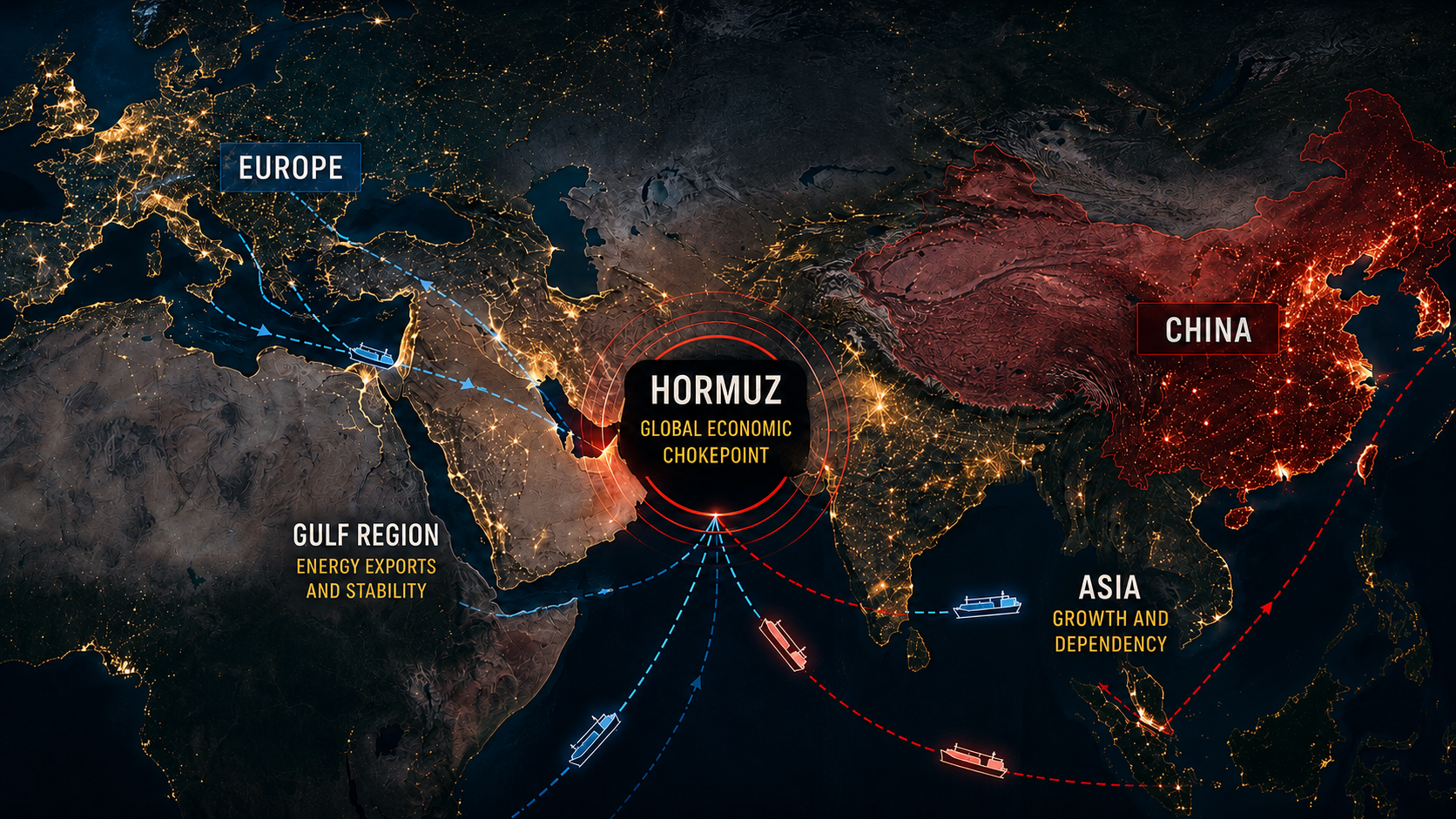
This Chokepoint Check assesses current pressure on the Strait of Hormuz, Bab al-Mandab and the Gulf region’s critical water, power, port and energy infrastructure. The key question is not only whether a route remains geographically open, but whether transport, insurance coverage, energy supply and site operations remain operationally viable.
The route remains geographically open, but is increasingly shaped by competing US and Iranian control regimes.
The 10-day average of visible commodity-vessel transits fell to ten ships per day – the lowest level since May. Iran is also announcing a restricted zone beyond Hormuz and a new shipping corridor with Oman.
No sufficiently confirmed new daily signal was identified for this area on September 6 or 7.
The corridor remains operationally usable, but continues to face elevated Houthi, drone and shipping risks. No weaker or older transit development is being artificially upgraded today.
No new confirmed attack on Gulf facilities – but the operational fuel shortage for shipping and power generation is intensifying.
Fuel-oil inventories at major hubs including Fujairah, Singapore and ARA are around 30 percent below seasonal levels. The Iran war and Ukrainian attacks on Russian refineries are contributing simultaneously.
Security Council Secretary Mohsen Rezaei announced a new restricted zone in the Gulf. At the same time, the charts for a new corridor with Oman have reportedly been agreed.
Vessels operating without Iranian approval could be placed on sanctions lists. The Oman corridor, however, has not yet been formally signed.
Shipowners face an additional regulatory and navigational risk. At the same time, a formal corridor could eventually enable more predictable transits.
Verification Status: confirmed for the announcement and agreed charts; the restricted zone and new corridor have not yet been fully implemented. Anadolu Agency, 07.09.2026 · SchaafMedia: Strait of Hormuz Blockade 2026 – Protecting Margins and Supply Chains in the Chokepoint Shock
The 10-day average fell to ten commodity vessels per day. Six vessels transited on Sunday, mostly using the Iranian route.
A product tanker arriving from Saudi Arabia attempted to exit but was turned back. No VLCC has left Hormuz since Wednesday.
Liquid-energy exports remain particularly difficult to plan. The risk of rejection, delay and additional controls remains high.
Verification Status: confirmed through Kpler and LSEG data. Dark transits may conceal individual movements. Reuters / Kpler / LSEG, 07.09.2026 · SchaafMedia: Chokepoint Risk Analysis – Hormuz & Supply Chain Risks
Israeli air strikes hit Kfar Rumman in southern Lebanon on Monday. Lebanese authorities reported at least eleven fatalities and additional injuries.
According to Lebanese authorities, a residential building and a vehicle were hit. Israel separately announced further strikes against alleged Hezbollah targets.
The fragile ceasefire is continuing to lose operational effectiveness. Aviation, infrastructure and investment risks in the eastern Mediterranean remain elevated.
Verification Status: confirmed for the attack and Lebanese casualty figures; an Israeli statement regarding the specific Kfar Rumman targets was initially unavailable. Reuters, 07.09.2026 · SchaafMedia: Iran War – How the West Is Losing Its Dominance
Global refinery disruptions are tightening fuel-oil supply. The expected third-quarter deficit has risen to around 218,000 barrels per day.
The Iran war is constraining Gulf flows, while Ukrainian attacks are affecting Russian refining capacity. Both conflict theatres now feed into the same market.
Higher bunker prices directly increase shipping and supply-chain costs. Asia and the global hub of Singapore remain particularly exposed.
Verification Status: confirmed for current inventory, refinery and market developments. The cross-theatre link is supported by their combined impact on fuel oil. Reuters, 07.09.2026 · SchaafMedia: Oil as a Weapon – Why Energy Dominates Geopolitics and Markets in 2026
Saudi Arabia, Russia, Iraq, Kuwait, Kazakhstan, Algeria and Oman agreed to maintain September production targets unchanged in October.
After six months of rising targets, OPEC+ is pausing further increases. Because of the Hormuz disruption, actual production is already below targeted levels.
The market receives no additional quota buffer in the short term. Physical transport disruptions remain more important than nominal production targets.
Verification Status: confirmed by OPEC. The decision was taken on September 6 and remains directly relevant to today’s energy and supply situation. OPEC, 06.09.2026 · directly relevant on 07.09. · SchaafMedia: Iran Check – 5 Escalation Signals from September 6, 2026
Iran announces a new control zone while Hormuz traffic and refinery supply remain low.
Shipowners must reassess permits, routes, fuel availability and security requirements simultaneously.
Hormuz traffic, tanker exports and available bunker-fuel volumes remain structurally restricted.
Freight, fuel, oil prices, inflation and procurement costs come under simultaneous pressure.
Hormuz is at its lowest 10-day transit level since May. Iran is also announcing an additional control zone.
Route open · competing control regimes prevent reliable normal operationsNo new confirmed facility attack was identified for September 6 or 7. Refinery and fuel-oil disruptions are nevertheless affecting transport and energy supply.
No new facility destruction · supply system remains operationally strainedHormuz regulation, the Lebanon front, the Iran war and Ukraine-related refinery outages are acting simultaneously.
Maritime, energy and cross-theatre risks are fully interconnectedOverall risk remains critical. Compared with September 5, the focus is shifting away from individual attacks towards more permanent control of shipping routes. At the same time, Hormuz is reaching a new traffic low, while global fuel-oil shortages are economically connecting the Middle East and Ukraine wars.
Note: This assessment was produced with support from our Geo-AI. AI can make mistakes. The analysis is intended as a source-based radar for potential escalation signals and does not replace fully verified intelligence, security, insurance or investment advice. In rapidly evolving situations, status, source availability and risk assessments may change at short notice.
Independent of the subject covered in this article, this separate Executive Briefing provides an in-depth analysis of another critical risk domain affecting European companies.
The 27-page Executive Briefing “Black Swan Risk Mapping for Europe’s Next Mobility and Infrastructure Shock” examines how geopolitical, infrastructural and administrative developments that are currently viewed in isolation could reinforce one another.
Based on the GFDD Framework™, the report shows how these dynamics could affect operational continuity, access to critical resources and the strategic resilience of companies.
The briefing includes a structured systemic-shock analysis and a directly applicable Business Exposure Checklist for CEOs, CFOs, COOs, investors and strategy teams.
You are currently viewing a placeholder content from X. To access the actual content, click the button below. Please note that doing so will share data with third-party providers.
More Information