Executive Intelligence. Industrial Risk. Geopolitics.
Strategic Sparring
for Decision-Makers
Risk intelligence across technology, law, markets and power dynamics.

Verdeckte Geschäftsrisiken, strategische Widersprüche und kritische Abhängigkeiten frühzeitig erkennen.
Kostenlose Analyse starten →
Verdeckte Machtstrukturen, Führungsrisiken und organisatorische Blockaden frühzeitig erkennen.
Kostenlose Analyse starten →
Geopolitische Risiken, globale Abhängigkeiten und kritische Lieferkettenrisiken frühzeitig erkennen.
Kostenlose Analyse starten →
Identify hidden business risks, strategic contradictions and critical dependencies at an early stage.
Start Free Analysis →
Identify hidden power structures, leadership risks and organizational blockers at an early stage.
Start Free Analysis →
Identify geopolitical risks, global dependencies and critical supply-chain vulnerabilities at an early stage.
Start Free Analysis →
Verdeckte Geschäftsrisiken, strategische Widersprüche und kritische Abhängigkeiten frühzeitig erkennen.
Kostenlose Analyse starten →
Verdeckte Machtstrukturen, Führungsrisiken und organisatorische Blockaden frühzeitig erkennen.
Kostenlose Analyse starten →
Geopolitische Risiken, globale Abhängigkeiten und kritische Lieferkettenrisiken frühzeitig erkennen.
Kostenlose Analyse starten →
Identify hidden business risks, strategic contradictions and critical dependencies at an early stage.
Start Free Analysis →
Identify hidden power structures, leadership risks and organizational blockers at an early stage.
Start Free Analysis →
Identify geopolitical risks, global dependencies and critical supply-chain vulnerabilities at an early stage.
Start Free Analysis →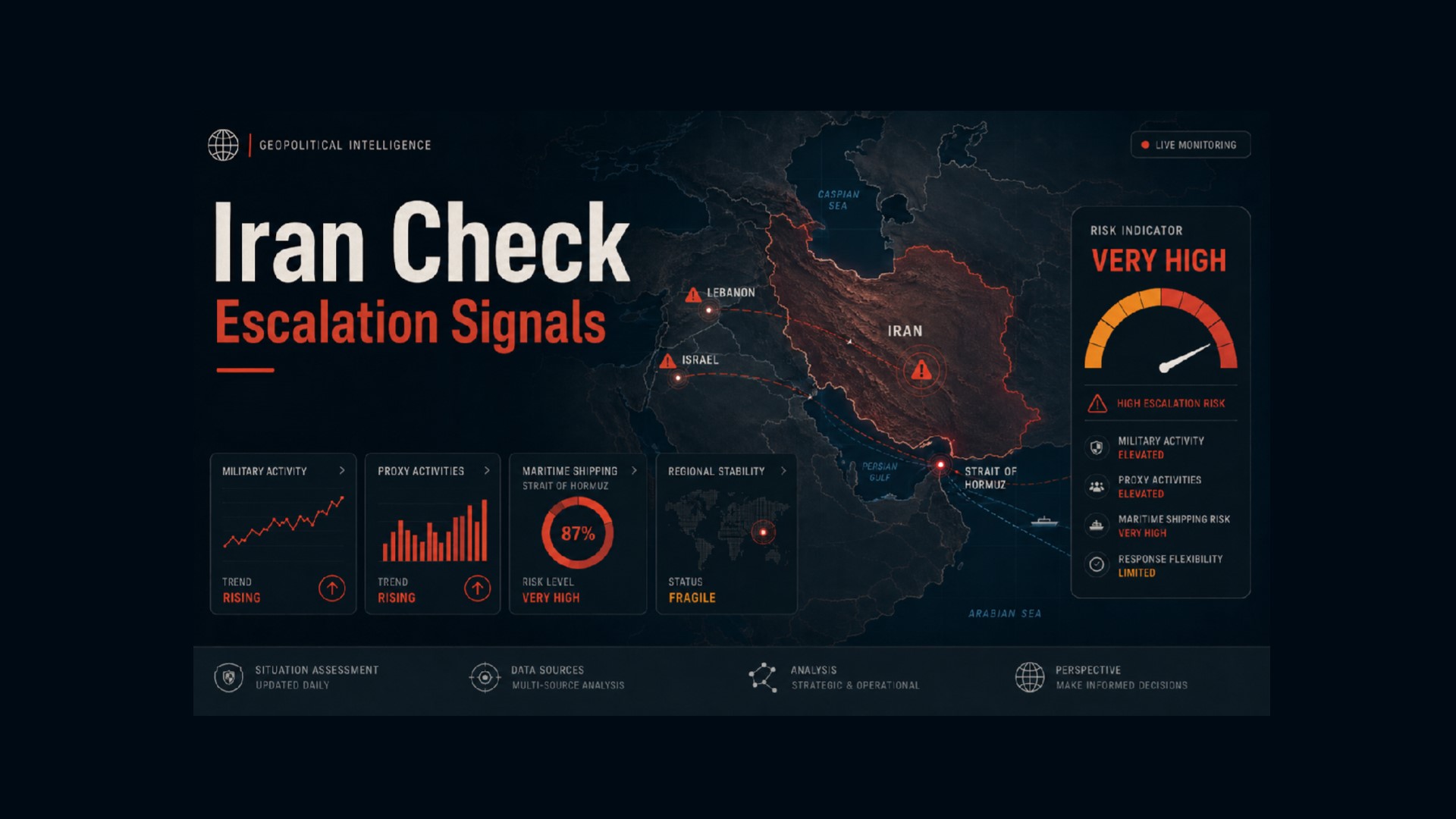
This escalation radar summarizes five relevant signals as of September 18, 2026. The focus is on verifiable statements by official sources, confirmed events and monitoring data with potential implications for energy prices, supply chains, markets, maritime security, aviation and regional stability.
Iran says the Togo-flagged tanker Trend was attacked during an allegedly unauthorized transit. The vessel reportedly caught fire and was brought to a halt. No independent confirmation has yet been provided.
Only four visible commodity vessels passed through the Strait of Hormuz on Thursday. The 10-day average stands at 16. Commercial use therefore remains far below normal levels.
Saudi Arabia has launched new strikes in Yemen, while Houthi drones have targeted Saudi territory. For the first time in the latest escalation, Saudi Arabia has reported a fatality.
| Actor | Type | Severity | Status | Source / Verification | Business Impact |
|---|---|---|---|---|---|
| Iran / IRGC / United States / Togo / Hormuz | IRGC reports attack on Togo-flagged oil tanker in the Hormuz corridor | Critical · Level 5/5 | The IRGC Navy says it attacked the oil tanker Trend during a passage through the Strait of Hormuz. According to the IRGC, the vessel had attempted to transit the chokepoint without Iranian approval. Following the strike, the tanker reportedly caught fire and was brought to a halt. The IRGC again warned that unauthorized transits would result in the destruction of the vessels involved. Power dynamics: Iran is attempting to enforce its own transit rules through military means. Hormuz is therefore becoming not merely a disrupted route, but effectively a controlled conflict zone. | Confirmed as an Iranian statement by Anadolu Agency, September 18, 2026 . Additional regional reporting: Saudi Gazette, September 18, 2026 . Verification status: partially confirmed. The official IRGC statement is confirmed. The actual strike, fire and condition of the vessel have not yet been independently verified. Further analysis: Schaaf Media · Strait of Hormuz Blockade 2026: Protecting Margins and Supply Chains in the Chokepoint Shock . | Critical business impact on tankers, crude oil, LNG, marine insurance, war-risk premiums and supply chains. The explicit threat against unauthorized transits significantly increases liability and insurance exposure. |
| Iran / international shipping companies / Hormuz / Bab el-Mandeb | Hormuz remains at four visible transits – both chokepoints under pressure | Critical · Level 5/5 | Commercial use of Hormuz remains extremely restricted. Only four commodity vessels were recorded on Thursday. Three entered the Gulf, while one departed. The 10-day average stands at around 16 vessels. At the same time, 23 commodity vessels passed through Bab el-Mandeb, also below the average for that route. AIS shutdowns mean that some vessel movements may not be visible. Power dynamics: Hormuz remains heavily constrained, while the principal alternative Red Sea route is simultaneously becoming more militarily insecure. | Confirmed by Reuters, September 18, 2026 . Verification status: confirmed for the visible transits and the 10-day averages. Dark shipping remains a significant source of uncertainty. Background: Schaaf Media · Iran War: How the West Is Fighting While Losing Its Dominance . | Critical business impact on oil, LNG, container shipping, freight rates, insurance and Europe-Asia supply chains. Simultaneous pressure on Hormuz and Bab el-Mandeb reduces reliable rerouting options. |
| Saudi Arabia / Houthis / Iran / Yemen / Bab el-Mandeb | Saudi Arabia and Houthis exchange new direct attacks | Critical · Level 5/5 | The Yemen conflict is escalating further into a direct Saudi-Houthi confrontation. Saudi Arabia has struck targets in Hajjah near the Red Sea coast as well as near Taiz. At the same time, a Houthi drone was intercepted over Taif in Saudi Arabia. Falling debris killed a Yemeni resident and injured two other people. It is the first fatality reported by Riyadh since the beginning of the latest attack wave. Power dynamics: The conflict is shifting from a proxy-war structure back toward direct cross-border confrontation. | Confirmed by Reuters, September 17/18, 2026 . Current regional confirmation: RTHK, September 18, 2026 . Verification status: confirmed for the Saudi airstrikes, the intercepted drone and the fatality. Background: Schaaf Media · Iran’s Proxies: The Hidden Escalation Map of the Middle East . | Critical business impact on Bab el-Mandeb, Saudi Arabia, energy infrastructure, civil aviation, shipping and insurance. A sustained direct Saudi-Houthi confrontation increases the risk of a second major regional front. |
| China / Iran / Saudi Arabia / Houthis / Bab el-Mandeb | China presses Iran directly to use its influence over the Houthis | High to Critical · Level 4/5 | China is assuming a more active diplomatic role. According to three Iranian sources, Beijing has asked Iran to use its influence over the Houthis. The move followed a Saudi request for Chinese assistance. Riyadh is responding to Houthi advances along the Red Sea coast and around Bab el-Mandeb. China is also calling for safe navigation, restraint and containment of the regional escalation. Power dynamics: Beijing is using its relationships with both Iran and Saudi Arabia to influence the operational conflict dynamic directly. This creates a new China-Iran-Saudi mediation axis. | Reported by Business Recorder / Reuters, September 18, 2026 . Additional reporting: Kathmandu Post / Reuters, September 18, 2026 . Verification status: partially confirmed. China’s public call for restraint and safe navigation is confirmed. The private request to Iran is based on several unnamed Iranian sources. Further analysis: Schaaf Media · Middle East Escalation Check – September 17, 2026 . | High to critical business impact on China-Gulf relations, energy security, Bab el-Mandeb, shipping and investment risk. Successful Chinese pressure could reduce escalation risks. Failure, however, would indicate that Iran’s influence over the Houthis is either limited or politically unavailable. |
| Pakistan / Saudi Arabia / Turkey / Houthis / Iran | Pakistan strengthens defence pledge – Saudi Arabia to be defended “to any extent” | High to Critical · Level 4/5 | The regional alliance architecture is being tested directly by the Houthi attacks. Pakistan’s military spokesman says Islamabad will defend Saudi Arabia “to any extent.” Support would be both diplomatic and physical and explicitly “unconditional.” The statement refers to existing defence arrangements between Pakistan, Saudi Arabia and Turkey. No specific operational measures or additional troop deployments have been confirmed. Power dynamics: An Iran-aligned actor is increasingly facing a formalized regional counter-alliance. This raises the risk that the Yemen conflict could become institutionally internationalized. | Confirmed by The Express Tribune, September 18, 2026 . Original interview: Arab News, September 17, 2026 . Verification status: confirmed for Pakistan’s defence commitment. It has not been confirmed whether Saudi Arabia has already requested additional Pakistani forces or operational support. The mandatory alliance review shows no new Iranian membership status. Background: Schaaf Media · Middle East Escalation Check – September 17, 2026 . | High to critical business impact on regional security architecture, Saudi risk exposure, military logistics, energy, insurability and investment. Actual activation of collective defence commitments would expand the conflict significantly beyond Iran and Yemen. |
The most important operational development on September 18, 2026 remains the Strait of Hormuz. Iran says it attacked a Togo-flagged oil tanker over an allegedly unauthorized transit. At the same time, only four visible commodity vessels continue to pass through the chokepoint. A reliable commercial normalization is therefore not yet in sight.
At the same time, the second maritime front is intensifying. Saudi Arabia and the Houthis are exchanging direct attacks, while Bab el-Mandeb is already under significant military pressure. For the first time, Riyadh has reported a fatality from the latest wave of Houthi attacks.
The significantly stronger involvement of external actors is new. China is pressing Iran, at Saudi Arabia’s request, to rein in the Houthis. In parallel, Pakistan has declared that it would defend Saudi Arabia physically if necessary and “to any extent.” Diplomatic and military alliance structures are therefore becoming an increasingly direct part of the operational conflict.
No new Iranian alliance, partner or observer status has been confirmed as of September 18. EASA CZIBs for Iran, Iraq, Jordan, Lebanon, the Persian Gulf and Gulf of Oman remain active until September 30, 2026; no new revision was published on September 18. Aviation therefore remains part of the existing risk environment, without a new European warning level being introduced today.
The five most important signals for a European risk assessment are: Iran’s newly reported attack on the Togo-flagged oil tanker Trend in the Strait of Hormuz, shipping traffic through Hormuz remaining limited to just four visible transits, the new direct Saudi-Houthi attacks and the first Saudi-reported fatality of the latest escalation, China’s direct mediation between Saudi Arabia, Iran and the Houthis, and Pakistan’s significantly strengthened and explicitly physical defence commitment to Saudi Arabia.
Note: This assessment was prepared with support from our Geo-AI. AI can make mistakes. The analysis is intended as a radar for potential escalation signals and does not replace a fully verified intelligence assessment.
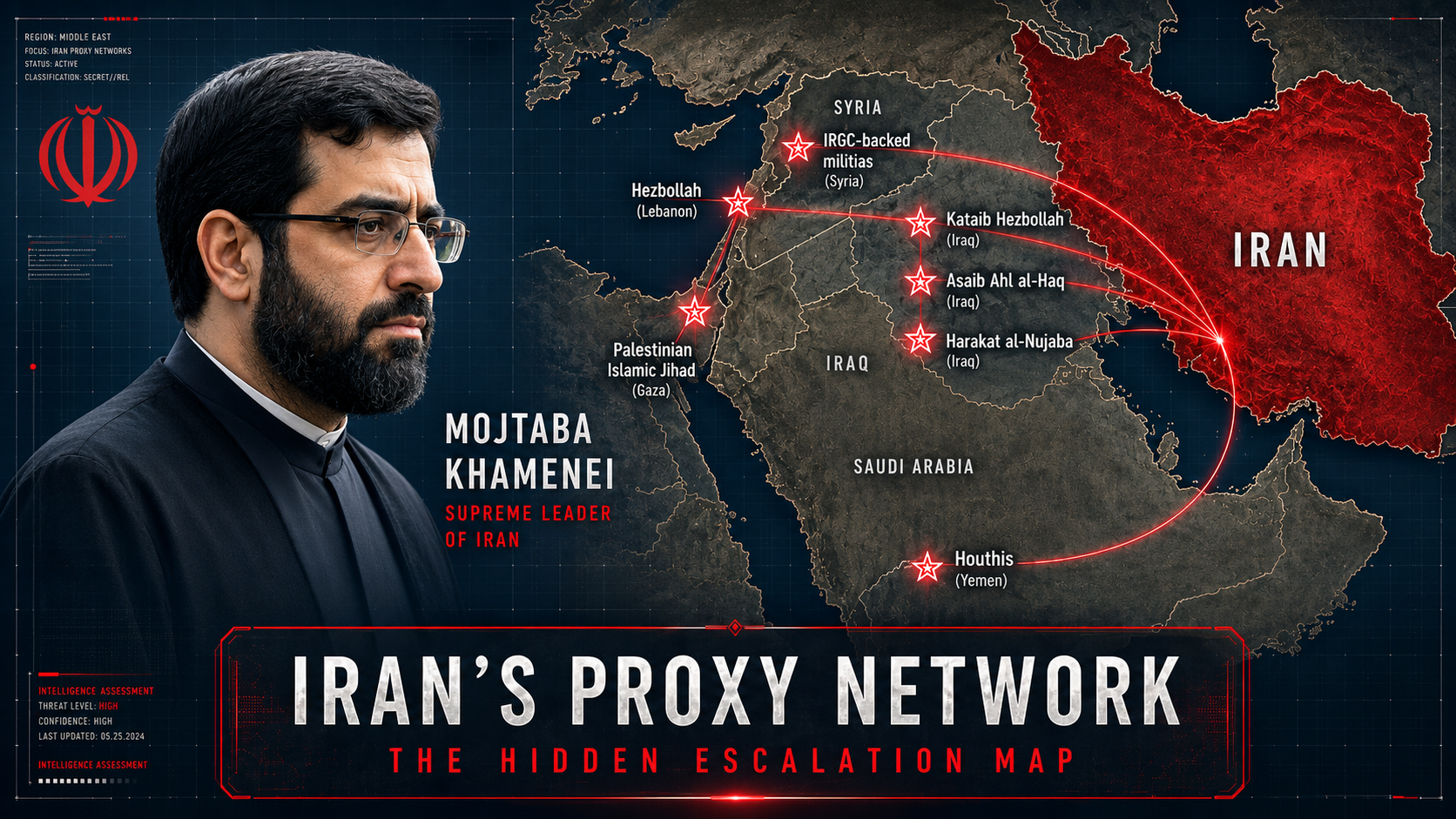
What decision-makers should watch now — before proxy escalation becomes a cost, compliance or supply-chain shock.
This 17-page executive briefing translates Iran’s proxy network into concrete business risks: energy price exposure, maritime chokepoints, war-risk premiums, sanctions, shadow fleets, supply-chain disruption and early-warning indicators for board-level decisions.
You are currently viewing a placeholder content from X. To access the actual content, click the button below. Please note that doing so will share data with third-party providers.
More Information