Executive Intelligence. Industrial Risk. Geopolitics.
Strategic Sparring
for Decision-Makers
Risk intelligence across technology, law, markets and power dynamics.


Verdeckte Geschäftsrisiken, strategische Widersprüche und kritische Abhängigkeiten frühzeitig erkennen.
Kostenlose Analyse starten →
Verdeckte Machtstrukturen, Führungsrisiken und organisatorische Blockaden frühzeitig erkennen.
Kostenlose Analyse starten →
Geopolitische Risiken, globale Abhängigkeiten und kritische Lieferkettenrisiken frühzeitig erkennen.
Kostenlose Analyse starten →
Identify hidden business risks, strategic contradictions and critical dependencies at an early stage.
Start Free Analysis →
Identify hidden power structures, leadership risks and organizational blockers at an early stage.
Start Free Analysis →
Identify geopolitical risks, global dependencies and critical supply-chain vulnerabilities at an early stage.
Start Free Analysis →
Verdeckte Geschäftsrisiken, strategische Widersprüche und kritische Abhängigkeiten frühzeitig erkennen.
Kostenlose Analyse starten →
Verdeckte Machtstrukturen, Führungsrisiken und organisatorische Blockaden frühzeitig erkennen.
Kostenlose Analyse starten →
Geopolitische Risiken, globale Abhängigkeiten und kritische Lieferkettenrisiken frühzeitig erkennen.
Kostenlose Analyse starten →
Identify hidden business risks, strategic contradictions and critical dependencies at an early stage.
Start Free Analysis →
Identify hidden power structures, leadership risks and organizational blockers at an early stage.
Start Free Analysis →
Identify geopolitical risks, global dependencies and critical supply-chain vulnerabilities at an early stage.
Start Free Analysis →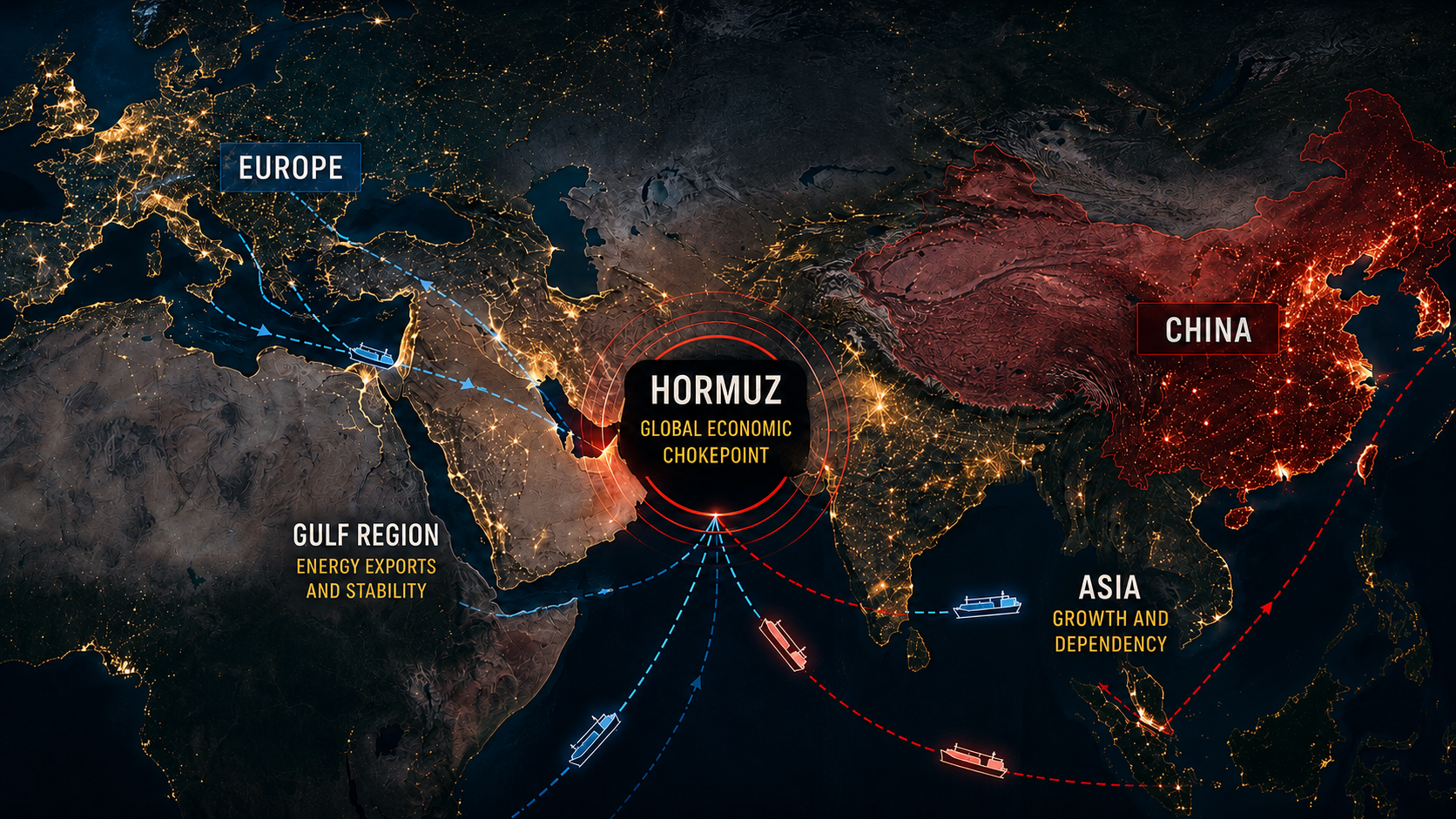
This Chokepoint Check assesses the current pressure on the Strait of Hormuz, Bab al-Mandab and critical water, power, port and energy infrastructure across the Gulf region. The key question is not merely whether a route remains geographically open, but whether transport, insurance, energy supply and site operations remain operationally viable.
The maritime crisis is increasingly being enforced through direct military action; reliable normal commercial use remains impossible.
A US fighter jet struck the Panama-flagged Ocean Molica in the Gulf of Oman and disabled its propulsion system.
The Red Sea front remains highly active militarily and risks further escalation following the attack on Riyadh.
The Saudi-led coalition announced on October 11 a decisive response to the Houthi attacks.
Saudi Arabia’s main international airport is facing severe operational disruption following another major attack.
Twelve people were killed and 309 injured. Saudi Arabia subsequently extended the airport closure.
Saudi Arabia confirmed twelve deaths and 309 injuries following the October 10 attack on King Khalid International Airport. The closure was extended.
It is the deadliest attack on Saudi Arabia in more than a decade. Repeated strikes have now taken a major international transport hub operationally offline.
Flight cancellations, diversions, staff rotations and air freight are directly affected. Travel and security costs continue to rise.
Verification status: confirmed by Saudi Arabia’s aviation authority and international news agencies. The airport remains operationally restricted. Associated Press, October 11, 2026 · SchaafMedia: Iran Check – 5 Escalation Signals from October 10, 2026
CENTCOM said the Ocean Molica ignored warnings and attempted to breach the US naval blockade against Iran. A fighter jet subsequently struck the stern.
The strike completely disabled the vessel’s propulsion. The blockade is therefore now being militarily enforced directly against a civilian commercial vessel.
Vessels linked to Iran face significantly higher seizure, operational-loss and physical attack risks.
Verification status: confirmed for the US strike by CENTCOM. The crew remained uninjured. The US account of a blockade violation is the operational justification. Reuters, October 11, 2026 · SchaafMedia: Chokepoint Check – Hormuz, Trade Routes & Supply Chain Risks
On October 11, the Houthis again warned airlines, airport personnel and travellers against using Saudi airports and Saudi airspace.
The warning follows directly after the deadly Riyadh attack. With actual flight cancellations and airport closures already occurring, it has clear operational relevance.
Airlines must rapidly adjust routing and risk assessments. Personnel, cargo and business-travel planning remain severely constrained.
Verification status: confirmed for the new Houthi warning. It remains a threat; further specific attacks resulting from it have not yet been confirmed. Reuters, October 11, 2026 · SchaafMedia: Iran Check – 5 Escalation Signals from October 10, 2026
The coalition supporting the Yemeni government announced on October 11 a decisive response to the Riyadh attack.
President Trump said in parallel that Washington was considering additional support. Direct US combat involvement against the Houthis has not yet been decided.
A further expansion of Yemen operations would increase risks for Bab al-Mandab, Red Sea shipping and regional aviation.
Verification status: confirmed for the Saudi response announcement. Additional direct US military involvement remains under consideration only. The National, October 11, 2026 · SchaafMedia: Middle East Escalation Check from October 9, 2026
Pakistan reaffirmed on October 11 its firm commitment to Saudi Arabia’s security under the Makkah Joint Defence Agreement.
Islamabad is therefore responding directly to the latest attack. No additional operational troop deployment or new combat mission was announced today.
The alliance architecture is gaining significance in the ongoing conflict. This strengthens deterrence, but also increases regional response dependencies.
Verification status: confirmed by Pakistan’s government. Today’s statement confirms political support, but no new operational deployment decision. Dawn, October 11, 2026 · SchaafMedia: Middle East Escalation Check from October 9, 2026
An international airport remains closed while a commercial vessel is militarily disabled in the Gulf of Oman.
Flights are diverted, travel warnings tighten and Iran-linked vessels face direct military enforcement of the blockade.
Aviation capacity is reduced, while maritime routes remain constrained by blockade, attack and insurance risks.
Travel, freight, insurance and energy-supply costs remain structurally elevated.
A US fighter jet disables a commercial vessel in the Gulf of Oman while enforcing the blockade.
Commercial shipping remains possible · military blockade enforcement prevents normal useRiyadh Airport remains closed after an attack that killed twelve people and injured 309.
Civil aviation infrastructure is directly and severely affected by the military escalationAirport closure, maritime military force, retaliation threats and alliance responses are occurring simultaneously.
Aviation, maritime, military and alliance risks are systemically interconnectedOverall risk remains critical. The 5/5 infrastructure signal in Riyadh coincides with a high-to-critical maritime escalation in the Gulf of Oman as well as continuing aviation and retaliation risks. Alliance responses are additionally broadening the regional conflict framework.
Disclaimer: This assessment was prepared with support from our Geo AI. AI can make mistakes. This analysis is intended as a source-based radar for potential escalation signals and does not constitute fully verified intelligence, security, insurance or investment advice. In fast-moving situations, status, source availability and risk assessments may change at short notice.
Independent of the subject covered in this article, this separate Executive Briefing provides an in-depth analysis of another critical risk domain affecting European companies.
The 27-page Executive Briefing “Black Swan Risk Mapping for Europe’s Next Mobility and Infrastructure Shock” examines how geopolitical, infrastructural and administrative developments that are currently viewed in isolation could reinforce one another.
Based on the GFDD Framework™, the report shows how these dynamics could affect operational continuity, access to critical resources and the strategic resilience of companies.
The briefing includes a structured systemic-shock analysis and a directly applicable Business Exposure Checklist for CEOs, CFOs, COOs, investors and strategy teams.
You are currently viewing a placeholder content from X. To access the actual content, click the button below. Please note that doing so will share data with third-party providers.
More Information