Executive Intelligence. Industrial Risk. Geopolitics.
Strategic Sparring
for Decision-Makers
Risk intelligence across technology, law, markets and power dynamics.


Verdeckte Geschäftsrisiken, strategische Widersprüche und kritische Abhängigkeiten frühzeitig erkennen.
Kostenlose Analyse starten →
Verdeckte Machtstrukturen, Führungsrisiken und organisatorische Blockaden frühzeitig erkennen.
Kostenlose Analyse starten →
Geopolitische Risiken, globale Abhängigkeiten und kritische Lieferkettenrisiken frühzeitig erkennen.
Kostenlose Analyse starten →
Identify hidden business risks, strategic contradictions and critical dependencies at an early stage.
Start Free Analysis →
Identify hidden power structures, leadership risks and organizational blockers at an early stage.
Start Free Analysis →
Identify geopolitical risks, global dependencies and critical supply-chain vulnerabilities at an early stage.
Start Free Analysis →
Verdeckte Geschäftsrisiken, strategische Widersprüche und kritische Abhängigkeiten frühzeitig erkennen.
Kostenlose Analyse starten →
Verdeckte Machtstrukturen, Führungsrisiken und organisatorische Blockaden frühzeitig erkennen.
Kostenlose Analyse starten →
Geopolitische Risiken, globale Abhängigkeiten und kritische Lieferkettenrisiken frühzeitig erkennen.
Kostenlose Analyse starten →
Identify hidden business risks, strategic contradictions and critical dependencies at an early stage.
Start Free Analysis →
Identify hidden power structures, leadership risks and organizational blockers at an early stage.
Start Free Analysis →
Identify geopolitical risks, global dependencies and critical supply-chain vulnerabilities at an early stage.
Start Free Analysis →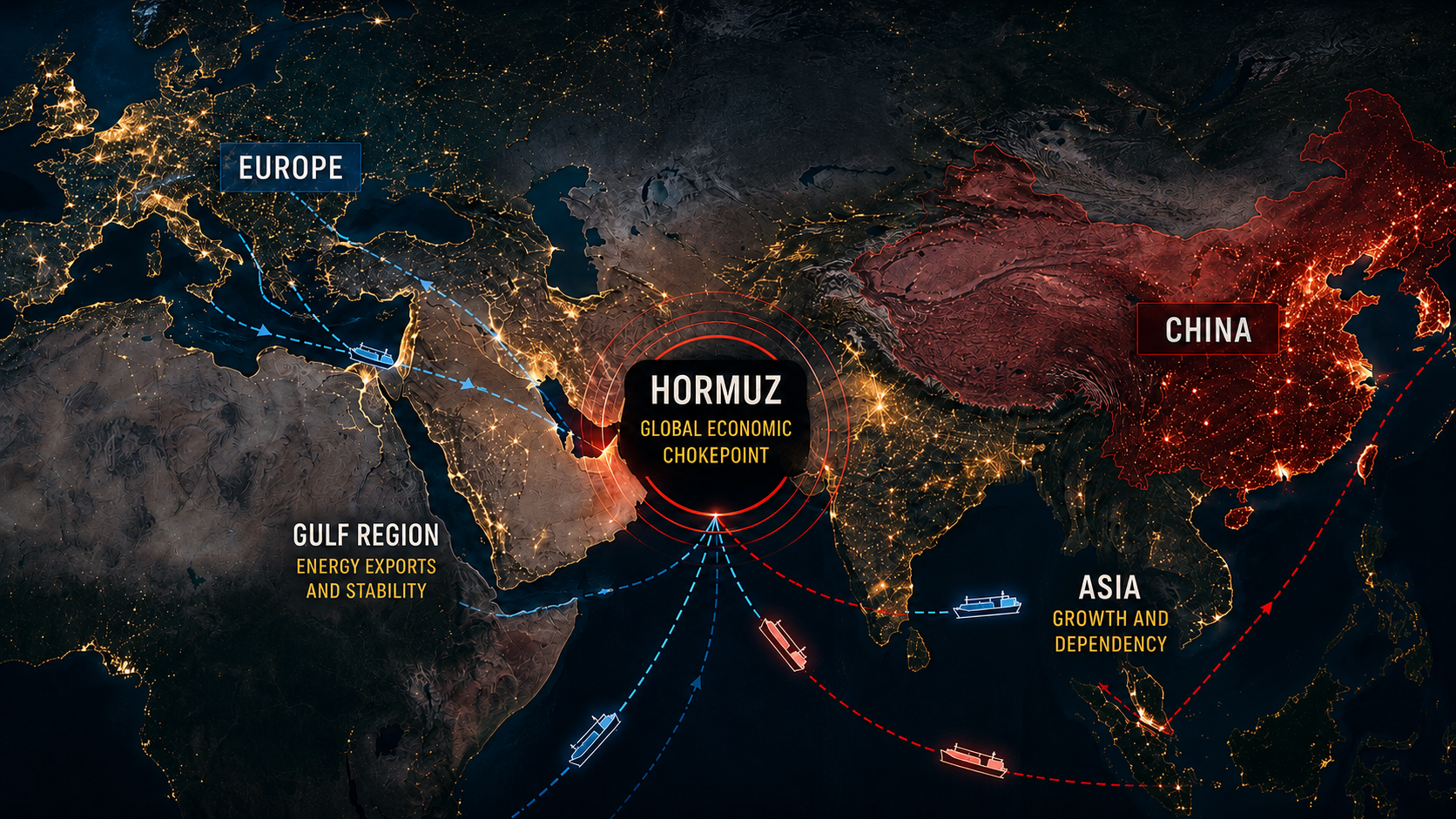
This Chokepoint Check assesses current pressure on the Strait of Hormuz, Bab al-Mandab and the Gulf region’s critical water, power, port and energy infrastructure. The key question is not only whether a route remains geographically open, but whether transport, insurance coverage, energy supply and site operations remain operationally viable.
Iran is increasingly institutionalising its control over Hormuz as a binding access regime.
Iran’s new Persian Gulf Strait Authority warns that violations of its transit rules may result in fines, detention or seizure. At the same time, Kpler recorded only four visible transits on Sunday. AIS-tracked traffic remains around 90 percent below pre-war levels.
The Saudi Red Sea route has again been physically hit, further reducing its value as an alternative corridor to Hormuz.
A tanker was struck on August 24 around 63 nautical miles west of Yanbu by an unidentified projectile. A fire broke out on the main deck; the crew remained safe. At the same time, 24 merchant vessels transited Bab al-Mandab on Sunday, down from 32 on Saturday.
No sufficiently confirmed new daily signal has emerged for fixed Gulf or Red Sea facilities.
Today’s attack struck a vessel rather than the Yanbu facilities themselves. However, its proximity to Saudi Arabia’s strategically important Red Sea oil export corridor increases operational risks for loading, insurance and the use of Yanbu as an alternative to Hormuz.
A tanker was struck on August 24 around 63 nautical miles west of Yanbu. A fire subsequently broke out on the main deck.
UKMTO confirms the projectile strike. All crew members are safe; no environmental damage has been reported. The attacker remains unidentified.
The attack immediately increases risk for tankers, insurers and the Saudi Red Sea route, which serves as a key alternative to constrained Hormuz transit.
Verification Status: confirmed for the projectile strike, fire and safe status of the crew. Responsibility remains unclear. Gulf News / AFP / UKMTO, 24.08.2026 · SchaafMedia: Chokepoint Check – Hormuz, Trade Routes & Supply Chain Risks
Iran’s Persian Gulf Strait Authority stated on August 24 that non-compliant vessels could face fines, detention or seizure.
Ship-to-ship or transshipment transactions involving listed vessels may also trigger restrictions. No new seizure was confirmed today.
Shipping companies and charterers now face a regulatory seizure and compliance risk in addition to military risk inside one of the world’s key energy chokepoints.
Verification Status: confirmed for the new Iranian warning and restrictions regime. The announced measures against vessels are not equivalent to a confirmed seizure today. Reuters, 24.08.2026 · SchaafMedia: Iran Check – 5 Escalation Signals from August 23, 2026
Kpler recorded only four merchant-vessel transits through Hormuz on Sunday, down from 13 on Saturday and 16 on Friday. Bab al-Mandab fell from 32 to 24.
According to UKMTO, AIS-tracked Hormuz transits remain around 90 percent below pre-war levels. AIS shutdowns may conceal some vessel movements.
The combination of very low capacity and volatile transit volumes continues to prevent reliable schedules, charter decisions and dependable energy deliveries.
Verification Status: confirmed through current Kpler and UKMTO data, published on August 24. Reuters / Kpler / UKMTO, 24.08.2026 · SchaafMedia: Hormuz Blockade 2026 – Strategies Against the Chokepoint Shock
Preliminary Kpler data show China receiving around 534,000 barrels per day of Iranian oil so far in August, down from around 823,000 barrels per day in July.
The decline follows the renewed US blockade of Iranian vessels and ports. China remains Iran’s most important oil market, while rejecting unilateral US sanctions.
Lower Iranian supply increases procurement pressure on Chinese refiners and shifts demand towards alternative crude sources and transport capacity.
Verification Status: confirmed for the current preliminary Kpler data. Final August figures may still change. Reuters / Kpler, 24.08.2026 · SchaafMedia: Oil as a Weapon – Why Energy Dominates Geopolitics and Markets in 2026
Mehdi Rahimi, head of the Iranian parliament’s news agency, stated that Iran had received an invitation to join the Mecca Pact and was reviewing the proposal.
The foreign ministries of Iran and the three founding states have not yet officially confirmed the invitation. Iranian membership therefore remains uncertain.
Iranian accession could fundamentally reshape regional deterrence and security structures, with longer-term implications for energy, investment and chokepoint risk.
Verification Status: partially confirmed. A statement by an Iranian parliamentary representative exists, but there is still no official confirmation of the invitation from Iran, Saudi Arabia, Türkiye or Pakistan. Times of India, 24.08.2026 · SchaafMedia: Iran War – How the West Fights and Loses Its Dominance
Tanker hit off Yanbu while Iran tightens its Hormuz transit rules.
Shipping companies face physical, regulatory and insurance risks simultaneously.
Hormuz traffic remains around 90 percent below earlier AIS-tracked transit levels.
Energy trade, procurement, insurance availability and alternative routes remain under simultaneous pressure.
A tanker has been hit on the Saudi Red Sea route, while Hormuz remains extremely lightly used and subject to additional regulatory controls.
Physical and administrative constraints are operating simultaneouslyNo new confirmed physical strike on fixed facilities was identified on August 24. However, access to the key Saudi export corridor at Yanbu is being directly attacked.
No facility strike · operational export access remains at riskBoth maritime corridors remain under pressure, energy flows to China are declining and a new regional security architecture may be emerging.
Maritime, energy and geopolitical risks remain systemically interconnectedThe situation remains critical and has deteriorated operationally compared with August 22. Hormuz remains severely constrained, while the Saudi Red Sea alternative route has again been physically hit. At the same time, the reported invitation for Iran to join the Mecca Defence Pact could eventually initiate a fundamental reshaping of regional security relationships. It is still too early to treat this as reliable de-escalation.
Note: This assessment was produced with support from our Geo-AI. AI can make mistakes. The analysis is intended as a source-based radar for potential escalation signals and does not replace fully verified intelligence, security, insurance or investment advice. In rapidly evolving situations, status, source availability and risk assessments may change at short notice.
Independent of the subject covered in this article, this separate Executive Briefing provides an in-depth analysis of another critical risk domain affecting European companies.
The 27-page Executive Briefing “Black Swan Risk Mapping for Europe’s Next Mobility and Infrastructure Shock” examines how geopolitical, infrastructural and administrative developments that are currently viewed in isolation could reinforce one another.
Based on the GFDD Framework™, the report shows how these dynamics could affect operational continuity, access to critical resources and the strategic resilience of companies.
The briefing includes a structured systemic-shock analysis and a directly applicable Business Exposure Checklist for CEOs, CFOs, COOs, investors and strategy teams.
You are currently viewing a placeholder content from X. To access the actual content, click the button below. Please note that doing so will share data with third-party providers.
More Information