Executive Intelligence. Industrial Risk. Geopolitics.
Strategic Sparring
for Decision-Makers
Risk intelligence across technology, law, markets and power dynamics.

Verdeckte Geschäftsrisiken, strategische Widersprüche und kritische Abhängigkeiten frühzeitig erkennen.
Kostenlose Analyse starten →
Verdeckte Machtstrukturen, Führungsrisiken und organisatorische Blockaden frühzeitig erkennen.
Kostenlose Analyse starten →
Geopolitische Risiken, globale Abhängigkeiten und kritische Lieferkettenrisiken frühzeitig erkennen.
Kostenlose Analyse starten →
Identify hidden business risks, strategic contradictions and critical dependencies at an early stage.
Start Free Analysis →
Identify hidden power structures, leadership risks and organizational blockers at an early stage.
Start Free Analysis →
Identify geopolitical risks, global dependencies and critical supply-chain vulnerabilities at an early stage.
Start Free Analysis →
Verdeckte Geschäftsrisiken, strategische Widersprüche und kritische Abhängigkeiten frühzeitig erkennen.
Kostenlose Analyse starten →
Verdeckte Machtstrukturen, Führungsrisiken und organisatorische Blockaden frühzeitig erkennen.
Kostenlose Analyse starten →
Geopolitische Risiken, globale Abhängigkeiten und kritische Lieferkettenrisiken frühzeitig erkennen.
Kostenlose Analyse starten →
Identify hidden business risks, strategic contradictions and critical dependencies at an early stage.
Start Free Analysis →
Identify hidden power structures, leadership risks and organizational blockers at an early stage.
Start Free Analysis →
Identify geopolitical risks, global dependencies and critical supply-chain vulnerabilities at an early stage.
Start Free Analysis →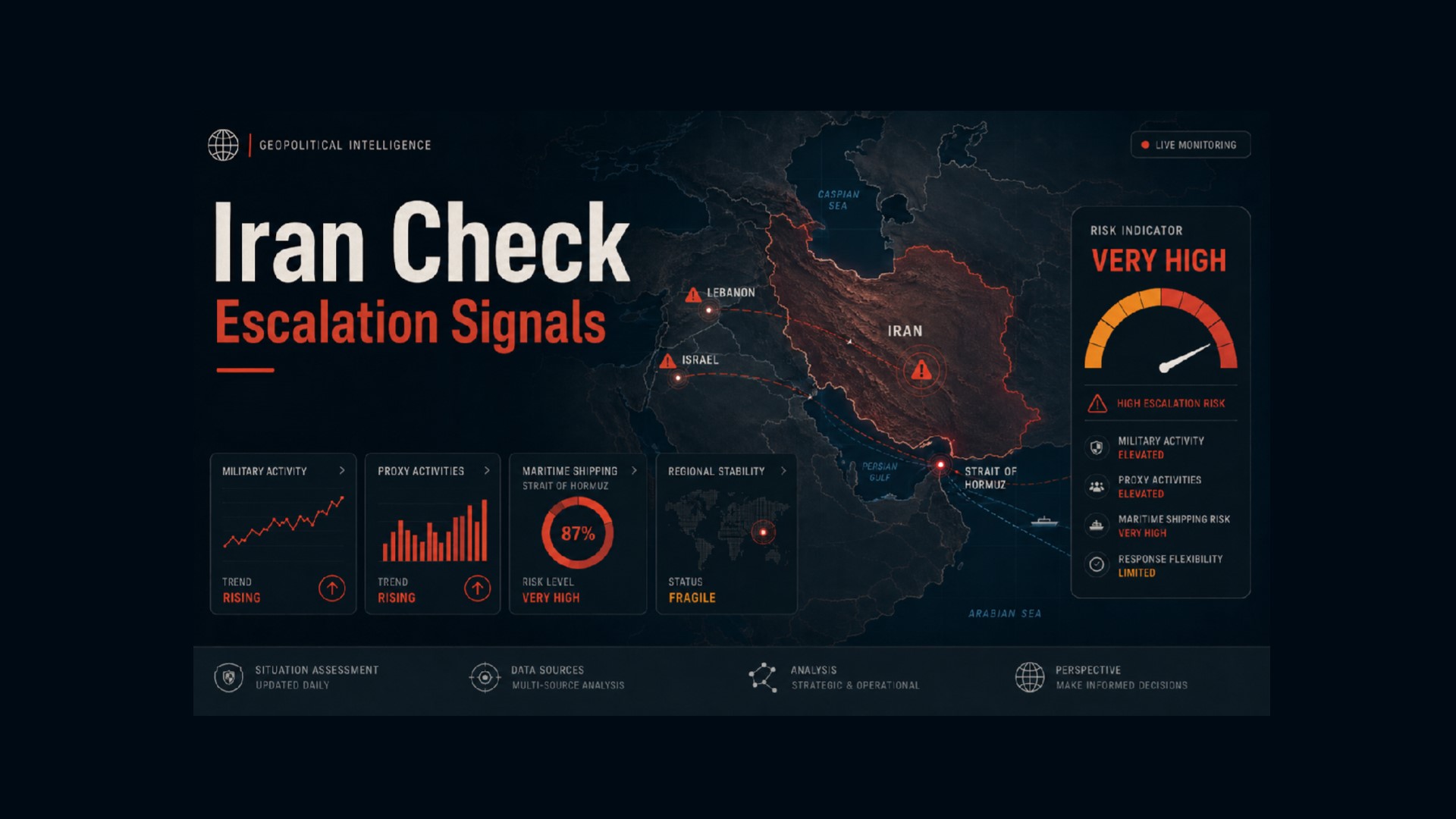
This escalation radar summarises five relevant signals as of August 25, 2026. It focuses on substantiated statements by official bodies, verified events and monitoring sources with potential implications for energy prices, supply chains, markets, maritime security, aviation and regional stability.
Washington sanctions around 60 Iran-linked individuals, companies and vessels and threatens trading partners with further measures. Tehran announces countermeasures and again warns that US interests could be targeted if escalation continues.
An oil tanker is hit shortly after midnight nine nautical miles off Oman by an unknown projectile. The engine room is damaged, leaving the vessel unable to manoeuvre. The crew remains unharmed.
A tanker is hit by a projectile west of Yanbu. A fire breaks out on deck. Alongside Hormuz, Saudi Arabia’s key Red Sea alternative route is therefore also facing direct security pressure.
| Actor | Type | Severity | Status | Source / Verification Status | Business Impact |
|---|---|---|---|---|---|
| United States / Iran / China / US Treasury / Iranian armed forces | New US sanctions round targets around 60 entities – Iran announces retaliation | Critical · Level 5/5 | Washington intensifies economic pressure on Iran on August 25. The new round targets around 60 individuals, companies and vessels linked to Iran’s oil, nuclear, missile and cyber networks. Trading partners are also warned that continued business with Iran could put their access to the dollar-based financial system at risk. Tehran announces countermeasures. Economy Minister Ali Madanizadeh says Iran has prepared a two-year plan to counter the new sanctions campaign. At the same time, the Iranian military warns that US interests could be targeted if Iranian infrastructure is attacked again. Power dynamics: Economic warfare and military deterrence are continuing to merge. | Confirmed by Reuters, August 25, 2026 . Verification status: confirmed regarding the expanded sanctions, Iran’s announced retaliation and the renewed military threat. The United States has not yet immediately activated all threatened secondary sanctions against third countries. Background: Schaaf Media · Middle East Escalation Check from August 24, 2026 . | Critical business impact on Iran, China and Gulf exposure, banks, shipping, trade finance, secondary sanctions, export controls and compliance. Companies should assess in particular whether indirect payment, logistics or oil-related transactions fall within the expanded US sanctions perimeter. |
| Oman / Iran / international shipowners / Strait of Hormuz | Oil tanker hit and disabled on the Omani side of Hormuz | Critical · Level 5/5 | Shortly after midnight on August 25, an oil tanker is hit around nine nautical miles north-east of Ash Shishah in Oman. An unknown projectile damages the engine room and disables the vessel. The crew remains unharmed. The location is critical: the incident occurs on the Omani side of the Hormuz corridor, which had recently been regarded as a comparatively safer transit option. Power dynamics: Even the alternative route along Oman no longer provides a reliable operational security guarantee. Political transit arrangements lose value when shipowners cannot price the physical attack risk. | Confirmed by Gulf News / UKMTO, August 25, 2026 . Verification status: confirmed regarding location, timing, impact, engine-room damage and crew safety. The attacker and projectile type have not yet been confirmed. Further reading: Schaaf Media · Hormuz Blockade 2026: Strategies for the Chokepoint Shock . | Critical business impact on crude oil, LNG, tanker charters, war-risk premiums, crew safety, insurability and delivery times. The attack weakens the assumption that shifting traffic towards the Omani side sufficiently reduces Hormuz risk. |
| Saudi Arabia / Yanbu / Red Sea / tanker traffic | Projectile hits tanker near Saudi Arabia’s strategic alternative to Hormuz | Critical · Level 5/5 | A tanker is hit on August 24 around 63 nautical miles west of Yanbu by an unknown projectile. A fire breaks out on the main deck. All crew members are safe and no environmental impact is reported. Security companies identify the vessel as Saudi-flagged, while UKMTO itself does not officially identify either the vessel or the attacker. The incident remains highly relevant on August 25 because Yanbu and Saudi Arabia’s East-West Pipeline form the kingdom’s key structural bypass around Hormuz. Power dynamics: Security pressure is therefore shifting from the chokepoint itself towards its most important alternative infrastructure. | Confirmed by India Shipping News, August 25, 2026 . Verification status: UKMTO confirms the projectile strike and the fire. Identification as a Saudi tanker comes from commercial security sources. No actor has yet officially claimed responsibility. Further reading: Schaaf Media · Oil as a Weapon: Why Energy Dominates Geopolitics and Markets in 2026 . | Critical business impact on Yanbu, Saudi oil exports, the East-West Pipeline, the Red Sea, tankers, insurance and Suez routes. Companies increasingly need to assess Hormuz bypass routes as separate military risk zones. |
| Pakistan / Iran / United States / Oman / Hormuz | Pakistan reports de-escalation progress – Oman takes over the next Hormuz channel | High to critical · Level 4/5 | Pakistan reports “significant progress” on August 25 following talks between army chief Asim Munir and the Iranian leadership in Tehran. The discussions focus on preventing further escalation, achieving a political settlement and reopening Hormuz. Iran signals that Washington must first fulfil commitments under the Islamabad memorandum. At the same time, Oman’s foreign minister is expected in Tehran on August 25 to continue the separate Hormuz dialogue. Power dynamics: Pakistan is mediating between Washington and Tehran, while Oman is focused directly on the chokepoint. Two parallel diplomatic channels are therefore emerging, without a peace agreement having been reached so far. | Confirmed by Dawn, August 25, 2026 . Verification status: confirmed regarding Munir’s talks, Pakistan’s assessment of progress and the planned Omani visit. No breakthrough on reopening Hormuz or a new US-Iran agreement has yet been confirmed. Background: Schaaf Media · Iran Check: 5 Escalation Signals from August 23, 2026 . | High to critical business impact on oil prices, Hormuz scenarios, political risk premiums, shipping and long-term investment planning. A credible transit compromise could materially ease the situation; for now, however, progress remains diplomatic. |
| Iran / Saudi Arabia / Türkiye / Pakistan / Mecca Defence Pact | No formal membership offer – but regional security talks with Iran are confirmed | High to critical · Level 4/5 | The debate over a possible Iranian accession to the Mecca Defence Pact takes on new strategic significance on August 25. Mehdi Rahimi, head of the Iranian parliament’s news agency, is quoted as saying that Iran has received a proposal and is reviewing it. Iran’s Foreign Ministry, however, rejects reports of a formal membership invitation. Spokesperson Esmaeil Baghaei confirms only that proposals have been made for talks on collective regional security. The Mecca Pact between Saudi Arabia, Türkiye and Pakistan includes a mutual-defence clause: an attack on one member is regarded as an attack on all three. Power dynamics: Iran is not yet a member. However, even institutionalised security talks with this alliance could fundamentally alter the existing regional alignment. | Current reporting: The Business Standard, August 25, 2026 and Outlook India, August 24, 2026 . Verification status: partially confirmed. Regional security proposals and related talks are confirmed. A formal invitation for Iran to join has not been confirmed. There is therefore neither an Iranian application nor an approved or effective membership. Further analysis: Schaaf Media · Iran War: How the West Is Fighting While Losing Its Dominance . | High to critical business impact on regional security planning, Gulf states, defence industries, military logistics, energy, sanctions and investment decisions. An actual Iranian accession would fundamentally reshape the regional deterrence architecture. The current situation, however, remains clearly short of that threshold. |
The most important escalation shift on August 25, 2026 is the simultaneous increase in economic and security pressure. Washington is expanding sanctions, while Tehran is announcing countermeasures and again threatening military retaliation. The current pause in attacks therefore remains strategically highly fragile.
Operationally, the maritime situation is deteriorating. One tanker is hit directly on the Omani side of Hormuz, while another strike near Yanbu puts Saudi Arabia’s most important alternative to Hormuz under pressure. Risk is therefore increasingly shifting from a single chokepoint to the entire regional route system.
At the same time, diplomacy remains possible. Pakistan reports progress in its talks in Tehran, while Oman continues the separate dialogue on a Hormuz arrangement. However, there is still neither a general reopening nor a new US-Iran peace mechanism.
Strategically, the debate around the Mecca Pact is also particularly relevant. Iran denies having received a formal invitation, but confirms proposals for regional security talks. No geopolitical realignment has taken place, but an institutional rapprochement with the emerging Saudi-Türkiye-Pakistan security architecture is now being discussed more concretely for the first time. EASA CZIBs for Iran, Iraq, Jordan, Lebanon, the Persian Gulf and the Gulf of Oman remain active until August 31, 2026; no new tightening was issued on August 25.
The five most important signals for a European and German risk assessment are: the expanded US sanctions round and Iran’s announced retaliation, the new tanker attack on the Omani side of Hormuz, the projectile strike near Saudi Arabia’s Yanbu alternative route, the parallel Pakistani and Omani mediation efforts, and the first concretely confirmed regional security talks between Iran and the environment surrounding the Mecca Defence Pact, while a formal membership invitation remains unconfirmed.
Note: This assessment was prepared with the support of our Geo AI. AI can make mistakes. The analysis is intended as a radar for potential escalation signals and does not replace a fully verified intelligence assessment.
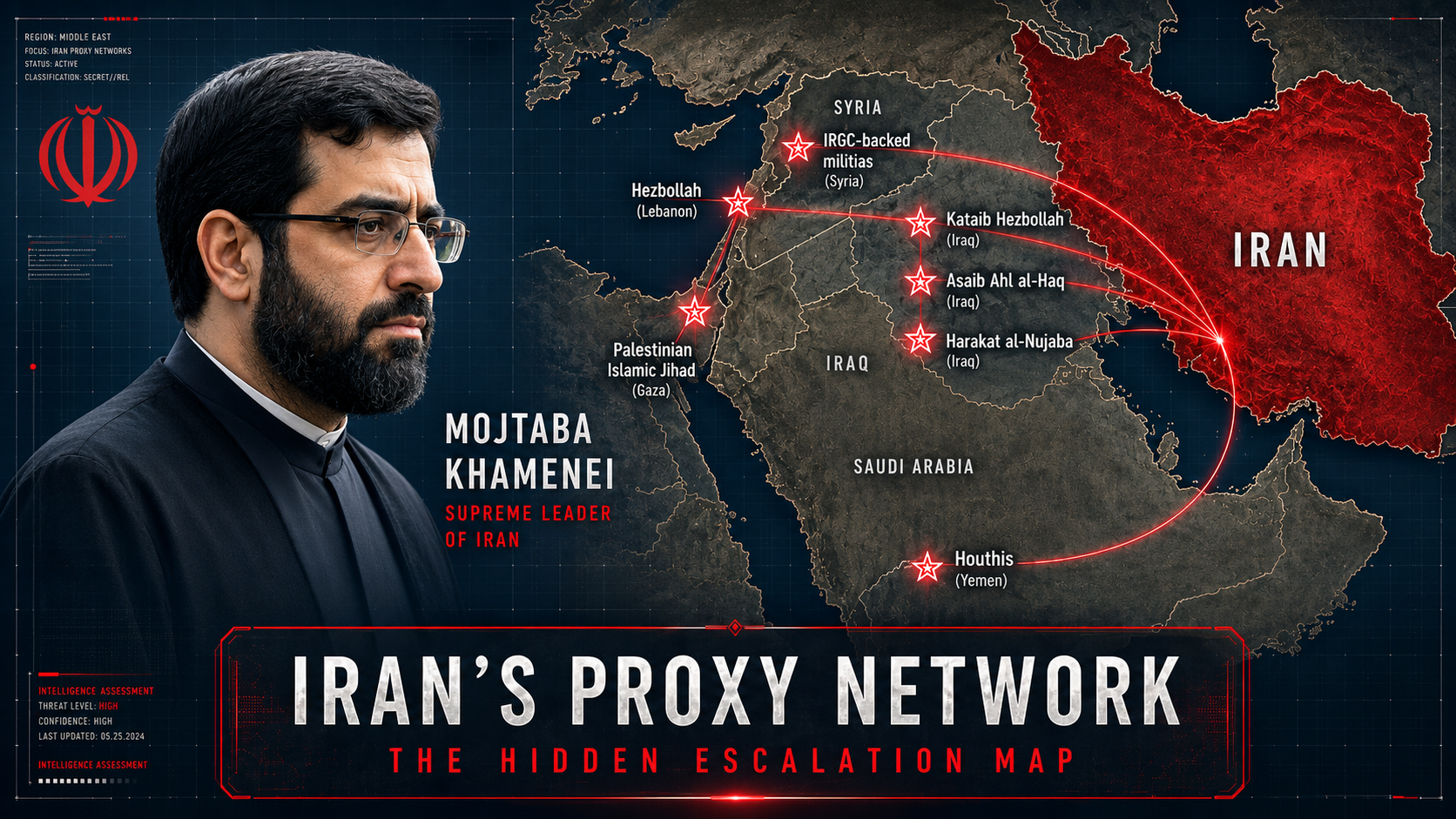
What decision-makers should watch now — before proxy escalation becomes a cost, compliance or supply-chain shock.
This 17-page executive briefing translates Iran’s proxy network into concrete business risks: energy price exposure, maritime chokepoints, war-risk premiums, sanctions, shadow fleets, supply-chain disruption and early-warning indicators for board-level decisions.
You are currently viewing a placeholder content from X. To access the actual content, click the button below. Please note that doing so will share data with third-party providers.
More Information