Executive Intelligence. Industrial Risk. Geopolitics.
Strategic Sparring
for Decision-Makers
Risk intelligence across technology, law, markets and power dynamics.


Verdeckte Geschäftsrisiken, strategische Widersprüche und kritische Abhängigkeiten frühzeitig erkennen.
Kostenlose Analyse starten →
Verdeckte Machtstrukturen, Führungsrisiken und organisatorische Blockaden frühzeitig erkennen.
Kostenlose Analyse starten →
Geopolitische Risiken, globale Abhängigkeiten und kritische Lieferkettenrisiken frühzeitig erkennen.
Kostenlose Analyse starten →
Identify hidden business risks, strategic contradictions and critical dependencies at an early stage.
Start Free Analysis →
Identify hidden power structures, leadership risks and organizational blockers at an early stage.
Start Free Analysis →
Identify geopolitical risks, global dependencies and critical supply-chain vulnerabilities at an early stage.
Start Free Analysis →
Verdeckte Geschäftsrisiken, strategische Widersprüche und kritische Abhängigkeiten frühzeitig erkennen.
Kostenlose Analyse starten →
Verdeckte Machtstrukturen, Führungsrisiken und organisatorische Blockaden frühzeitig erkennen.
Kostenlose Analyse starten →
Geopolitische Risiken, globale Abhängigkeiten und kritische Lieferkettenrisiken frühzeitig erkennen.
Kostenlose Analyse starten →
Identify hidden business risks, strategic contradictions and critical dependencies at an early stage.
Start Free Analysis →
Identify hidden power structures, leadership risks and organizational blockers at an early stage.
Start Free Analysis →
Identify geopolitical risks, global dependencies and critical supply-chain vulnerabilities at an early stage.
Start Free Analysis →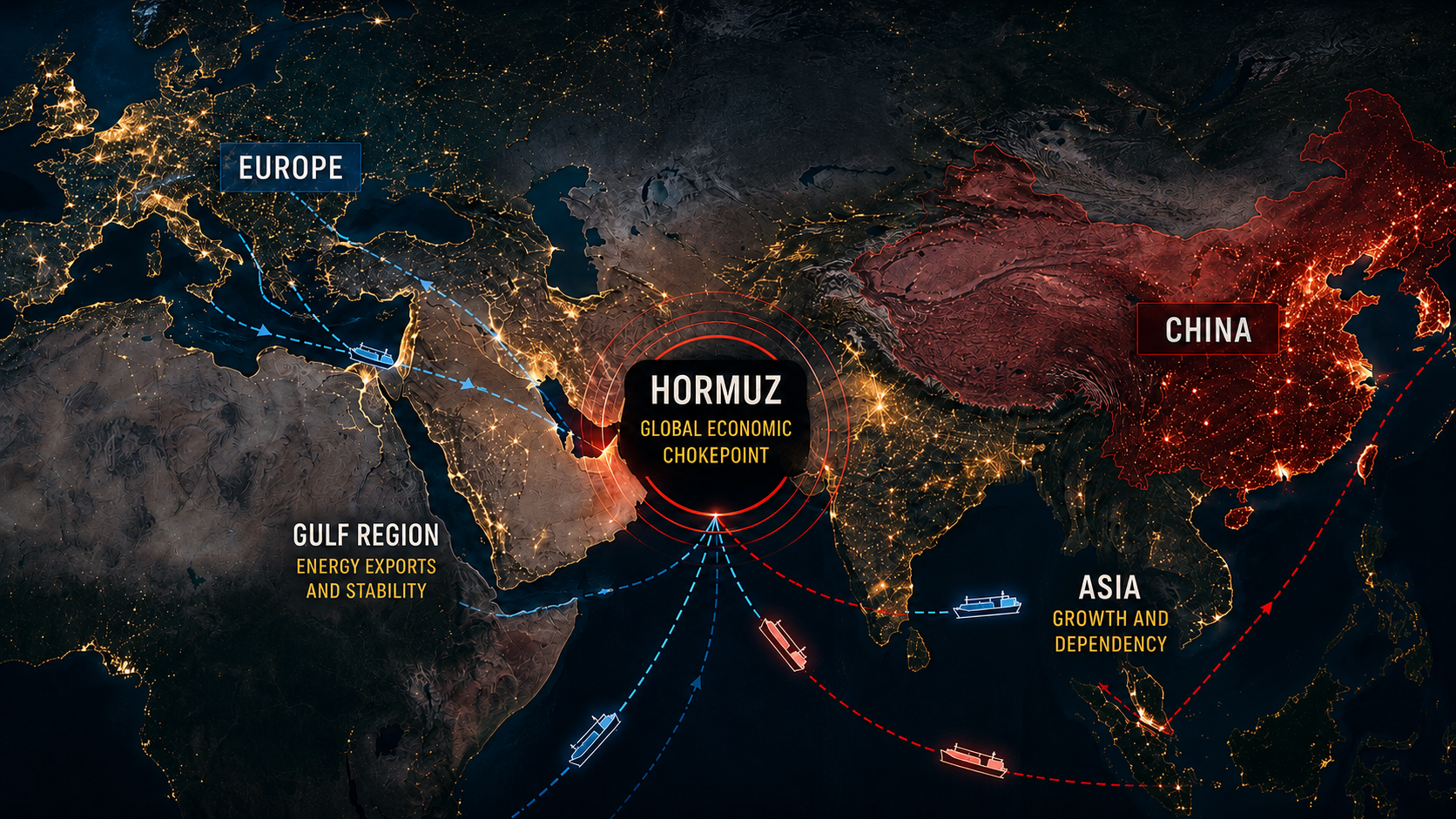
This Chokepoint Check assesses current pressure on the Strait of Hormuz, Bab al-Mandab and the Gulf region’s critical water, power, port and energy infrastructure. The key question is not only whether a route remains geographically open, but whether transport, insurance coverage, energy supply and site operations remain operationally viable.
The route remains geographically open, but operationally far from normal conditions.
Kpler recorded only four commodity-vessel transits through Hormuz on Thursday, down from nine the previous day and compared with a 10-day average of around 15. Unobserved dark transits are not included.
The southern corridor remains usable, but visible traffic has weakened again after the recent recovery.
Kpler recorded 22 commodity-vessel transits through Bab al-Mandab on Thursday, down from 31 the previous day and again below the 10-day average of around 24 vessels.
Military pressure is moving directly towards Iran’s most important oil export corridor.
Iranian media reported on September 5 that an oil tanker around six miles off Kharg Island had been hit by four US missiles. No confirmation from CENTCOM or independent sources was available at the time of review.
Iranian media report that a tanker near Kharg Island was hit by four US missiles on September 5.
According to Iranian reports, the crew was evacuated. CENTCOM had not confirmed the strike at the time of review.
Even a credible risk of direct attacks near Kharg substantially increases export, insurance and chartering risks for Iranian oil shipments.
Verification Status: partially confirmed. The incident is being reported by Iranian media and internationally; independent US confirmation remains unavailable. Reuters, 05.09.2026 · SchaafMedia: Oil as a Weapon – Why Energy Dominates Geopolitics and Markets in 2026
Kpler recorded four vessels through Hormuz on Thursday, compared with a 10-day average of 15. Bab al-Mandab fell to 22 transits.
Hormuz remains the clearly more critical corridor. The southern chokepoint has also fallen back below its average.
Companies cannot treat either Gulf or Red Sea routes as fully reliable. Capacity planning remains dependent on short-notice security developments.
Verification Status: confirmed through current Kpler data from September 4; directly operationally relevant on September 5. Reuters / Kpler, 04.09.2026 · directly relevant on 05.09. · SchaafMedia: Chokepoint Risk Analysis – Hormuz & Supply Chain Risks
Hezbollah attacked Israeli soldiers with a drone. Israel responded on September 4 with new strikes in southern Lebanon.
The front remains operationally active despite the ceasefire. The exchange of drone and air strikes increases the risk of further retaliation.
A renewed expansion of the Lebanon front increases regional aviation, infrastructure and investment risks beyond the immediate Gulf region.
Verification Status: confirmed. The Hezbollah drone attack and Israeli retaliatory strikes were reported by Israeli and Lebanese authorities. Reuters / Straits Times, 05.09.2026 · SchaafMedia: Iran War – How the West Is Losing Its Dominance
Washington designated Golden Global Bank and two subsidiaries under sanctions. The bank is accused of transferring Iranian oil revenues from China.
Operation Economic Outcast is therefore extending directly to a financial institution in a NATO member state for the first time. The bank rejects the allegations.
Banks, traders and companies with Iran, China or Türkiye exposure face higher dollar, compliance and counterparty risks.
Verification Status: confirmed for the US sanctions. The underlying Iran-related connections are allegations made by the US Treasury. US Treasury / OFAC, 04.09.2026 · directly relevant on 05.09. · SchaafMedia: Middle East Escalation Check from August 28, 2026
The United States, United Kingdom, France and Germany have prepared a draft resolution that could refer Iran to the UN Security Council over nuclear violations.
This remains a draft, not an adopted decision. Russia and China could limit subsequent UN measures.
A formal referral would create additional sanctions and compliance pressure. In the short term, however, the development remains political rather than operational.
Verification Status: confirmed for the draft resolution; no vote or UN referral has yet taken place. Associated Press, 05.09.2026 · SchaafMedia: Oil as a Weapon – Why Energy Dominates Geopolitics and Markets in 2026
Tanker reportedly hit off Kharg, Hormuz remains heavily constrained and the Lebanon front becomes active again.
Shipowners, banks and energy traders increase security, compliance and route screening.
Only four visible Hormuz transits keep energy and transport capacity structurally restricted.
Oil, diesel, freight, insurance and international financial channels react simultaneously.
Hormuz is down to only four visible transits, while new tanker attacks are also being reported.
Route open · low utilisation and attack risk prevent normal operationsThe reported tanker strike immediately off Kharg brings military pressure directly towards Iran’s most important oil export hub.
Export corridor under direct risk · destruction of civilian facilities not yet confirmedGulf conflict, the Lebanon front, financial sanctions and nuclear diplomacy are escalating in parallel.
Maritime, military, financial and geopolitical risks remain fully interconnectedOverall risk remains critical. Compared with September 3, military pressure is moving closer to Iran’s core oil export infrastructure. At the same time, both chokepoints remain under pressure, while the Lebanon and sanctions fronts are escalating again. No credible operational de-escalation is currently visible.
Note: This assessment was produced with support from our Geo-AI. AI can make mistakes. The analysis is intended as a source-based radar for potential escalation signals and does not replace fully verified intelligence, security, insurance or investment advice. In rapidly evolving situations, status, source availability and risk assessments may change at short notice.
Independent of the subject covered in this article, this separate Executive Briefing provides an in-depth analysis of another critical risk domain affecting European companies.
The 27-page Executive Briefing “Black Swan Risk Mapping for Europe’s Next Mobility and Infrastructure Shock” examines how geopolitical, infrastructural and administrative developments that are currently viewed in isolation could reinforce one another.
Based on the GFDD Framework™, the report shows how these dynamics could affect operational continuity, access to critical resources and the strategic resilience of companies.
The briefing includes a structured systemic-shock analysis and a directly applicable Business Exposure Checklist for CEOs, CFOs, COOs, investors and strategy teams.
You are currently viewing a placeholder content from X. To access the actual content, click the button below. Please note that doing so will share data with third-party providers.
More Information