Executive Intelligence. Industrial Risk. Geopolitics.
Strategic Sparring
for Decision-Makers
Risk intelligence across technology, law, markets and power dynamics.


Verdeckte Geschäftsrisiken, strategische Widersprüche und kritische Abhängigkeiten frühzeitig erkennen.
Kostenlose Analyse starten →
Verdeckte Machtstrukturen, Führungsrisiken und organisatorische Blockaden frühzeitig erkennen.
Kostenlose Analyse starten →
Geopolitische Risiken, globale Abhängigkeiten und kritische Lieferkettenrisiken frühzeitig erkennen.
Kostenlose Analyse starten →
Identify hidden business risks, strategic contradictions and critical dependencies at an early stage.
Start Free Analysis →
Identify hidden power structures, leadership risks and organizational blockers at an early stage.
Start Free Analysis →
Identify geopolitical risks, global dependencies and critical supply-chain vulnerabilities at an early stage.
Start Free Analysis →
Verdeckte Geschäftsrisiken, strategische Widersprüche und kritische Abhängigkeiten frühzeitig erkennen.
Kostenlose Analyse starten →
Verdeckte Machtstrukturen, Führungsrisiken und organisatorische Blockaden frühzeitig erkennen.
Kostenlose Analyse starten →
Geopolitische Risiken, globale Abhängigkeiten und kritische Lieferkettenrisiken frühzeitig erkennen.
Kostenlose Analyse starten →
Identify hidden business risks, strategic contradictions and critical dependencies at an early stage.
Start Free Analysis →
Identify hidden power structures, leadership risks and organizational blockers at an early stage.
Start Free Analysis →
Identify geopolitical risks, global dependencies and critical supply-chain vulnerabilities at an early stage.
Start Free Analysis →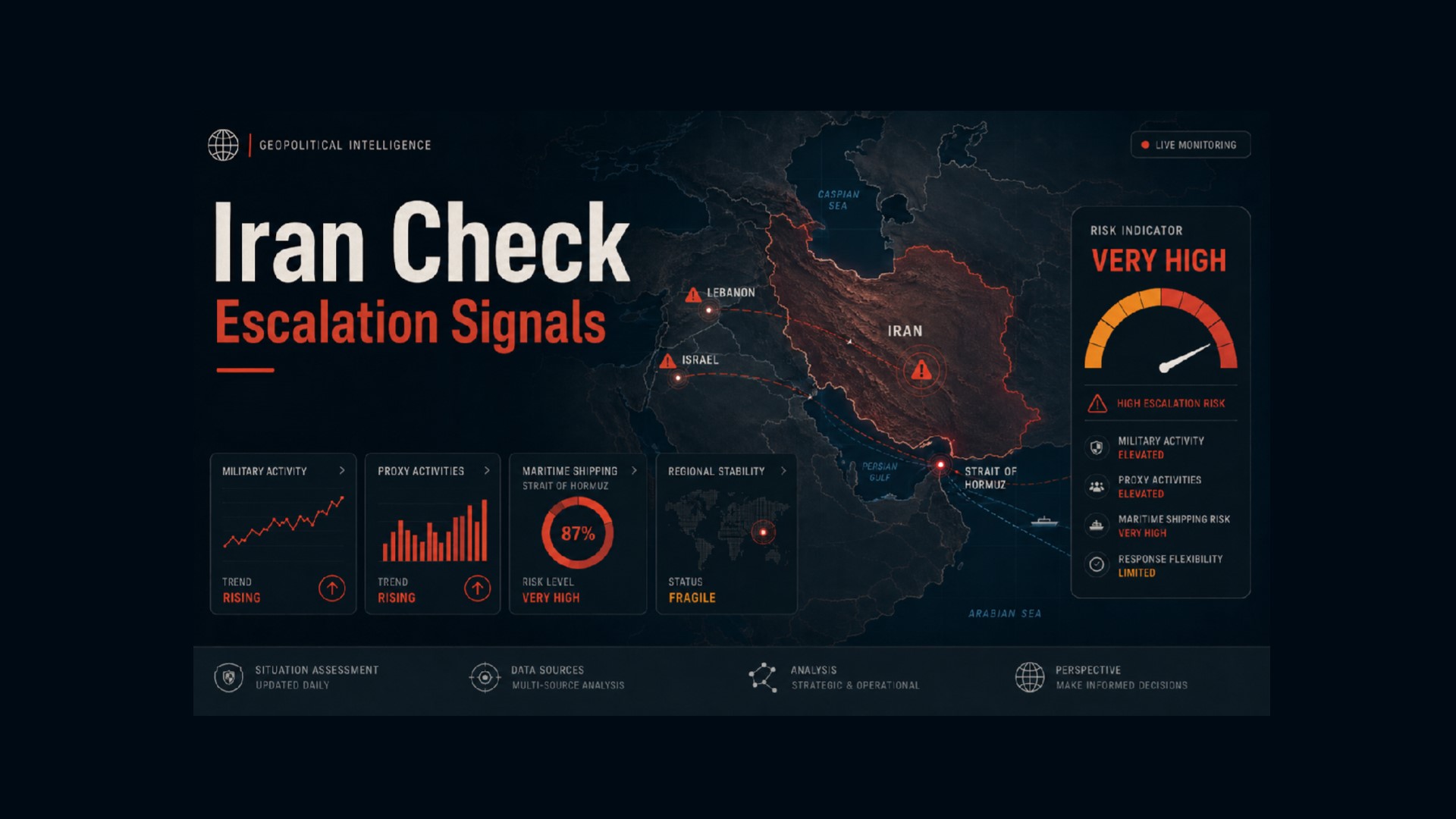
This escalation radar summarises five relevant signals as of September 4, 2026. It focuses on substantiated statements by official bodies, verified events and monitoring sources with potential implications for energy prices, supply chains, markets, maritime security, aviation and regional stability.
Only four visible merchant vessels again transit the Strait of Hormuz on Thursday, compared with a ten-day average of 15. Bab el-Mandeb also falls to 22 vessels. There is therefore still no sign of operational normalisation.
Washington says negotiations will resume only once Iran stops attacking commercial shipping. Tehran, meanwhile, says future responses will be asymmetric, multi-layered and targeted at US economic vulnerabilities.
Israel says it has achieved operational control over Ali al-Taher in southern Lebanon. The move follows an Iranian warning that a major Israeli assault in the area could trigger a large-scale Iranian response.
| Actor | Type | Severity | Status | Source / Verification Status | Business Impact |
|---|---|---|---|---|---|
| Iran / United States / Oman / Hormuz / Bab el-Mandeb / international shipowners | Hormuz remains at four visible merchant vessels as Bab el-Mandeb also weakens | Critical · Level 5/5 | Actual shipping traffic through Hormuz remains at an extremely low level on September 4. Kpler records just four merchant vessels for Thursday: two product tankers, one Kamsarmax bulk carrier and one Handysize vessel. The ten-day average now stands at around 15 vessels. Before the war, around 125 commercial vessels transited the strait each day. At the same time, traffic through Bab el-Mandeb falls to 22 visible vessels, down from 31 the previous day. Power dynamics: Despite US statements about control, actual commercial use of Hormuz remains severely constrained. The crisis therefore continues to affect both key energy and trade corridors. | Confirmed by Reuters, September 4, 2026 . Verification status: confirmed regarding four visible Hormuz transits, the ten-day average and 22 transits through Bab el-Mandeb. Vessels with AIS disabled may not be fully captured. Further reading: Schaaf Media · Strait of Hormuz Blockade 2026: Strategies for the Chokepoint Shock . | Critical business impact on oil, LNG, LPG, tanker charters, freight rates, war-risk premiums, Suez and Europe-Asia supply chains. Companies should still not expect a rapid return to normal transit capacity. |
| United States / Iran / Vance / Aref / commercial shipping | Washington sets condition for talks as Iran announces asymmetric retaliation | Critical · Level 5/5 | The political confrontation hardens further on September 4. US Vice President JD Vance says Washington will not negotiate with Iran while Tehran continues attacking commercial shipping. Military pressure explicitly remains an option. Iran’s First Vice President Mohammad Reza Aref says in response that the latest US attacks have changed Iran’s security and defence doctrine. Future responses will be “asymmetric” and “multi-layered”. He explicitly threatens economic consequences for the United States. Power dynamics: Both sides are now linking diplomacy directly to military and economic coercion. This makes a rapid return to negotiations more difficult. | Current reporting: Al Jazeera, September 4, 2026 . Verification status: confirmed regarding Vance’s condition for negotiations and Aref’s new retaliation rhetoric. The scope and concrete operational implementation of Iran’s announced doctrine remain unclear. Background: Schaaf Media · Iran Check: 5 Escalation Signals from September 2, 2026 . | Critical business impact on Hormuz, regional operations, oil, transport, insurance, financial markets and business continuity. An asymmetric strategy increases uncertainty in particular over which economic or logistics targets could be affected next. |
| Israel / Hezbollah / Iran / Lebanon / IRGC / Ali al-Taher | Israel reports operational control over strategic Ali al-Taher ridge | Critical · Level 5/5 | The southern Lebanon theatre gains new operational significance on September 4. Israel’s military says it has achieved operational control over the strategic Ali al-Taher ridge. According to the IDF, Hezbollah fighters were pushed out of two underground routes; several were reportedly killed. The ridge is regarded as a location containing extensive underground Hezbollah infrastructure. Particularly significant: Iran had previously warned Washington that a major Israeli assault on the area could trigger a large-scale Iranian response. Power dynamics: A local territorial advance in southern Lebanon therefore touches directly on an Iranian deterrence threshold. This creates a clear cross-theatre linkage between Lebanon and the US-Iran conflict. | Confirmed by Arab News / Asharq Al-Awsat, September 4, 2026 . Verification status: confirmed regarding the Israeli report of operational control over the ridge. The earlier Iranian retaliation warning was reported by several sources familiar with the message; the White House has disputed parts of that account. Background: Schaaf Media · Iran’s Proxies: The Hidden Escalation Map of the Middle East . | Critical business impact on Lebanon, Israel, aviation, land logistics, ports, evacuation planning and regional investment. If Iran enforces its announced red line, a local territorial gain could trigger a new regional retaliation cycle. |
| Israel / Iran / Netanyahu / IDF / energy infrastructure | Netanyahu describes removal of Iranian leadership as a central mission | Critical · Level 5/5 | Israel is intensifying its public definition of war aims. Prime Minister Benjamin Netanyahu describes the removal of Iran’s leadership as a central mission and says the objective is achievable. At the same time, Defence Minister Israel Katz warns that another Iranian attack on Israel would remove all previous constraints. Israel could then also target Iranian energy infrastructure. Power dynamics: Israel’s publicly stated objective is therefore shifting from deterrence and military degradation more clearly towards regime change. At the same time, energy infrastructure is being explicitly identified as a potential retaliation target. | Current summary: The National, September 4, 2026 . Verification status: confirmed regarding Netanyahu’s public regime-change rhetoric and Katz’s threat against Iranian infrastructure. No new Israeli operation against Iranian energy facilities had been confirmed at the time of research. Further analysis: Schaaf Media · Iran War: How the West Is Fighting While Losing Its Dominance . | Critical business impact on Iranian energy facilities, oil and gas supply, refineries, electricity supply, insurability and regional prices. The explicit targeting signal increases the tail-risk scenario of a direct strike on energy infrastructure. |
| Iran / United States / Russia / Ukraine / global energy markets | Oil rises to around $95 as Iran and Ukraine risks reinforce each other | High to critical · Level 4/5 | Geopolitical escalation is feeding directly into energy markets. Brent trades on September 4 at around $95.5 per barrel, with WTI at around $91.4. On a weekly basis, Brent is up around 7.6 percent and WTI by more than ten percent. In addition to renewed US-Iran attacks, Ukrainian strikes on Russian refineries are increasing concerns about available supply buffers. Power dynamics: The Iran conflict and the Russia-Ukraine war are increasingly affecting the same global energy market simultaneously. This is direct cross-theatre escalation through energy. | Confirmed by Reuters, September 4, 2026 . Verification status: confirmed regarding current oil prices, weekly gains and the simultaneous impact of Iran and Russia-related risks. Further reading: Schaaf Media · Oil as a Weapon: Why Energy Dominates Geopolitics and Markets in 2026 . | High to critical business impact on energy prices, diesel, transport, inflation, industry, chemicals and supply chains. Simultaneous supply risks from the Gulf region and Russia significantly reduce the global security buffer. |
The most important operational finding on September 4, 2026 is the continued lack of normalisation in Hormuz. Only four visible merchant vessels are transiting the strait, while Bab el-Mandeb is also below its average. Two central global trade corridors therefore remain under substantial pressure simultaneously.
Politically, the positions of Washington and Tehran are hardening further. The United States is ruling out talks while Iran continues attacking commercial shipping. Iran, in turn, is announcing an asymmetric and multi-layered response to further US strikes. This increases uncertainty over the form of the next escalation.
In southern Lebanon, a new dangerous threshold is emerging. Israel reports operational control over Ali al-Taher, even though Iran had previously linked a major assault on this area to large-scale retaliation. The Lebanon and US-Iran escalation dynamics are therefore directly converging.
Israel is also intensifying its strategic objectives towards Tehran. Netanyahu openly describes the removal of Iran’s leadership as a central mission, while energy infrastructure is being identified as a potential retaliation target. Oil prices are simultaneously rising due to overlapping risks in Iran and Russia. The mandatory alliance review shows no new Iranian accession or partner status today. EASA CZIBs for Iran, Iraq, Jordan, Lebanon, the Persian Gulf and the Gulf of Oman remain active until September 30, 2026; no new tightening was issued on September 4.
The five most important signals for a European and German risk assessment are: the continued extremely low level of traffic through Hormuz and Bab el-Mandeb, the US refusal to resume negotiations alongside Iran’s announced asymmetric retaliation strategy, Israel’s operational control over the strategic Ali al-Taher ridge in southern Lebanon, Netanyahu’s open regime-change objective and Israel’s threat against Iranian energy infrastructure, and the sharp rise in oil prices driven by the combined impact of the Iran conflict and Russia-Ukraine energy risks.
Note: This assessment was prepared with the support of our Geo AI. AI can make mistakes. The analysis is intended as a radar for potential escalation signals and does not replace a fully verified intelligence assessment.
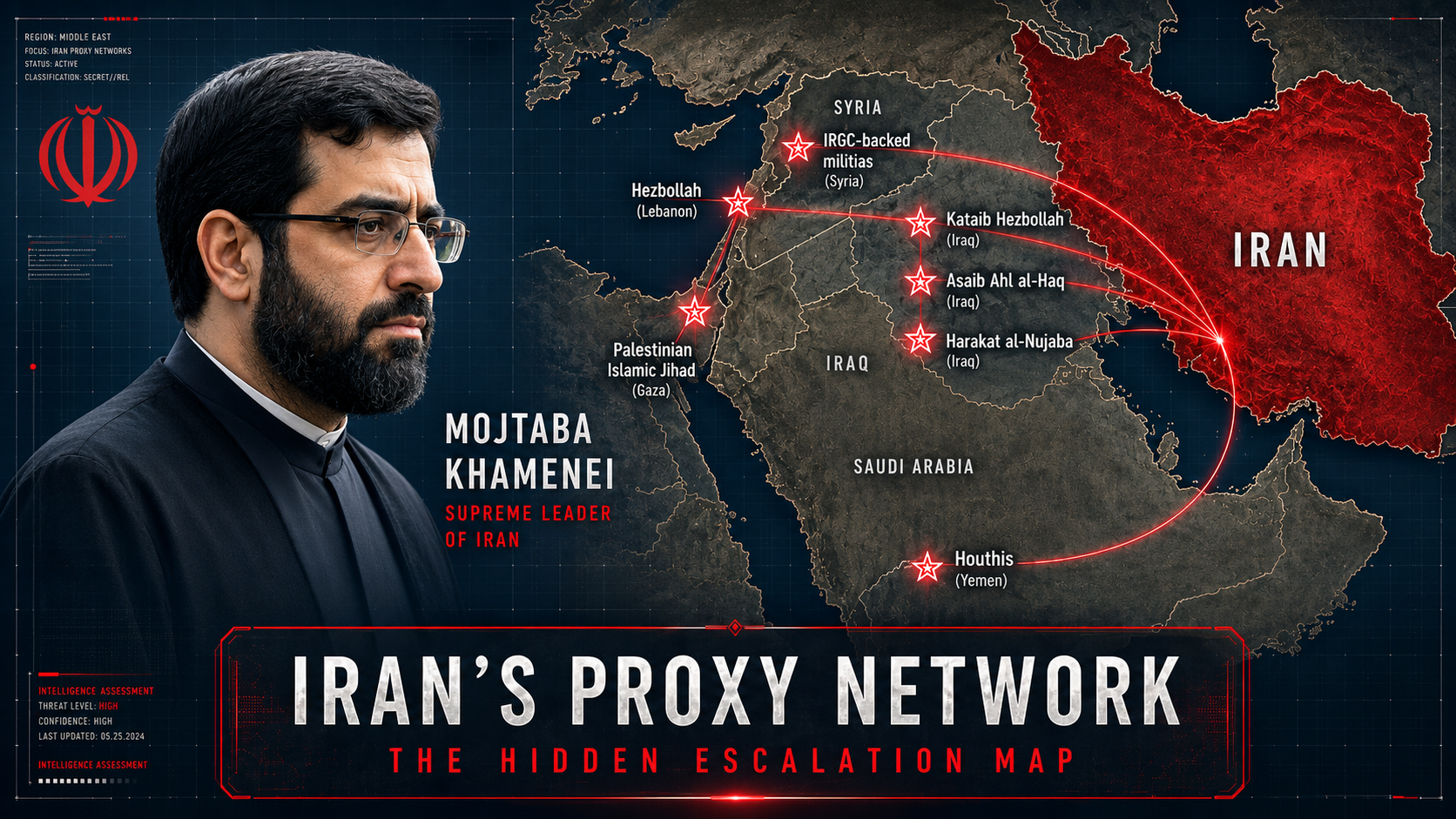
What decision-makers should watch now — before proxy escalation becomes a cost, compliance or supply-chain shock.
This 17-page executive briefing translates Iran’s proxy network into concrete business risks: energy price exposure, maritime chokepoints, war-risk premiums, sanctions, shadow fleets, supply-chain disruption and early-warning indicators for board-level decisions.
You are currently viewing a placeholder content from X. To access the actual content, click the button below. Please note that doing so will share data with third-party providers.
More Information