Executive Intelligence. Industrial Risk. Geopolitics.
Strategic Sparring
for Decision-Makers
Risk intelligence across technology, law, markets and power dynamics.

Verdeckte Geschäftsrisiken, strategische Widersprüche und kritische Abhängigkeiten frühzeitig erkennen.
Kostenlose Analyse starten →
Verdeckte Machtstrukturen, Führungsrisiken und organisatorische Blockaden frühzeitig erkennen.
Kostenlose Analyse starten →
Geopolitische Risiken, globale Abhängigkeiten und kritische Lieferkettenrisiken frühzeitig erkennen.
Kostenlose Analyse starten →
Identify hidden business risks, strategic contradictions and critical dependencies at an early stage.
Start Free Analysis →
Identify hidden power structures, leadership risks and organizational blockers at an early stage.
Start Free Analysis →
Identify geopolitical risks, global dependencies and critical supply-chain vulnerabilities at an early stage.
Start Free Analysis →
Verdeckte Geschäftsrisiken, strategische Widersprüche und kritische Abhängigkeiten frühzeitig erkennen.
Kostenlose Analyse starten →
Verdeckte Machtstrukturen, Führungsrisiken und organisatorische Blockaden frühzeitig erkennen.
Kostenlose Analyse starten →
Geopolitische Risiken, globale Abhängigkeiten und kritische Lieferkettenrisiken frühzeitig erkennen.
Kostenlose Analyse starten →
Identify hidden business risks, strategic contradictions and critical dependencies at an early stage.
Start Free Analysis →
Identify hidden power structures, leadership risks and organizational blockers at an early stage.
Start Free Analysis →
Identify geopolitical risks, global dependencies and critical supply-chain vulnerabilities at an early stage.
Start Free Analysis →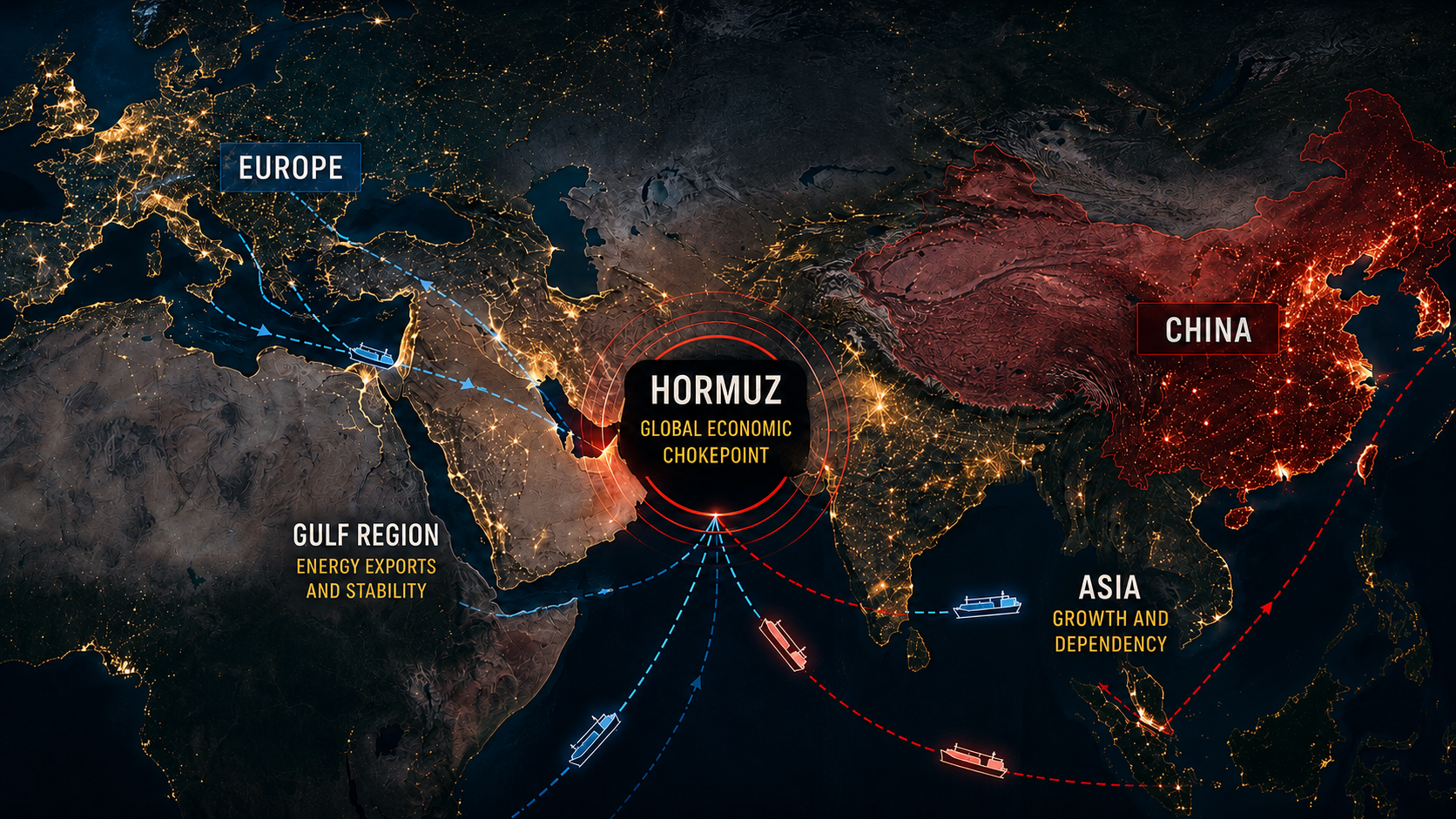
This Chokepoint Check assesses current pressure on the Strait of Hormuz, Bab al-Mandab and the Gulf region’s critical water, power, port and energy infrastructure. The key question is not only whether a route remains geographically open, but whether transport, insurance coverage, energy supply and site operations remain operationally viable.
The route remains open, but is heavily constrained by regulatory, military and commercial risks.
Kpler recorded only six commodity-vessel transits through Hormuz on Wednesday, down from eleven the previous day and compared with a 10-day average of around 13. Iran simultaneously expanded its list of restricted vessels to 56.
Visible shipping traffic is recovering, although regional security risks remain.
Kpler recorded 31 commodity-vessel transits through Bab al-Mandab on Wednesday. This was the highest level since August 24 and above the 10-day average of around 25 vessels.
Gulf states are again moving more directly into the military and logistical conflict zone.
Kuwait reported Iranian missile and drone attacks on September 3 that were intercepted by its air defences. At the same time, Qatar and the UAE are using unusual LNG ship-to-ship transfers outside the Strait of Hormuz.
Kuwait reported Iranian missile and drone attacks on Thursday. According to the Defence Ministry, the threats were intercepted by air defences.
The attacks continue Iran’s retaliation against US partners in the Gulf. Bahrain and Jordan had already intercepted Iranian attacks the previous day.
Risks to airports, energy facilities, US bases and industrial sites are rising. Companies must prepare for short-notice air alerts and operational disruptions.
Verification Status: confirmed by Kuwait and international news agencies. No specific damage was initially reported. Associated Press, 03.09.2026 · SchaafMedia: Iran War – How the West Is Losing Its Dominance
Kpler recorded six commodity vessels through Hormuz, significantly below the 10-day average of around 13. Bab al-Mandab, by contrast, reached 31 transits.
The two chokepoints are currently moving in opposite directions. The southern corridor is recovering, while Hormuz remains heavily constrained.
Energy and freight routes through Hormuz remain difficult to plan. Recovery at Bab al-Mandab can only partially offset the Gulf bottleneck.
Verification Status: confirmed through current Kpler data from September 3; AIS shutdowns may conceal individual movements. Oman Observer / Reuters / Kpler, 03.09.2026 · SchaafMedia: Chokepoint Risk Analysis – Hormuz & Supply Chain Risks
Iran’s Persian Gulf Strait Authority added eleven more vessels to its list of non-compliant ships. The blacklist now contains 56 vessels.
Listed vessels risk fines, seizure or detention. Ship-to-ship partners of listed vessels may also be added in future.
Shipowners, traders and refiners must tighten fleet selection and counterparty screening. This increases compliance, insurance and rerouting costs.
Verification Status: confirmed. The expansion was published on the Iranian authority’s website within the previous 24 hours. Reuters, 02.09.2026 · directly operationally relevant on 03.09. · SchaafMedia: Strait of Hormuz Blockade 2026 – Protecting Margins and Supply Chains in the Chokepoint Shock
Three LNG cargoes loaded in Qatar and the UAE were transferred between vessels outside Hormuz before continuing to India and Japan.
LNG ship-to-ship transfers are unusual. Their use shows that companies are now structurally adapting logistics to the continuing Hormuz disruption.
Additional handling increases costs and operational complexity, but provides a limited way to maintain LNG deliveries despite the chokepoint risk.
Verification Status: confirmed through Vortexa and Kpler vessel data. The transfers demonstrate operational adaptation, not normalisation of Hormuz. Reuters / Kpler / Vortexa, 02.09.2026 · directly operationally relevant on 03.09. · SchaafMedia: Oil as a Geopolitical Weapon – Why Energy Dominates Geopolitics and Markets in 2026
Xi Jinping used his visit to Egypt to offer closer security and economic cooperation. Maritime security and the protection of regional trade routes are explicitly on the agenda.
China is positioning itself more strongly in a security environment that has historically been dominated by the United States. No new formal alliance has been agreed.
Greater Chinese security and infrastructure cooperation could increasingly link Suez, Red Sea and Gulf logistics with Chinese trade and investment interests.
Verification Status: confirmed for the political initiative and ongoing China-Egypt talks. No new formal defence alliance has been agreed. Al Jazeera, 02.09.2026 · strategically directly relevant on 03.09. · SchaafMedia: Middle East Escalation Check from August 28, 2026
Iran attacks Kuwait while simultaneously tightening its control over Hormuz.
Shipowners, LNG suppliers and traders adjust vessels, routes and transfer procedures.
Hormuz remains far below normal levels, while LNG transfers require additional logistics steps.
Energy supply, insurance, freight costs and regional security relationships are changing simultaneously.
Hormuz remains far below normal traffic levels, while Iran is threatening additional vessels with detention or seizure.
Route open · state restrictions and low utilisation prevent normal operationsKuwait was attacked with missiles and drones. At the same time, Gulf producers are having to restructure LNG logistics outside Hormuz.
Direct Gulf threat · energy and transport infrastructure remains under pressureMilitary attacks, chokepoint regulation, LNG rerouting and Chinese security positioning are operating simultaneously.
Maritime, military, energy and geopolitical risks remain fully interconnectedOverall risk remains critical. Compared with September 1, the direct military confrontation is spreading further into Gulf states. At the same time, Hormuz remains structurally weak and Iran is tightening its regulatory control. Operational adaptation in LNG logistics prevents individual disruptions, but does not constitute normalisation.
Note: This assessment was produced with support from our Geo-AI. AI can make mistakes. The analysis is intended as a source-based radar for potential escalation signals and does not replace fully verified intelligence, security, insurance or investment advice. In rapidly evolving situations, status, source availability and risk assessments may change at short notice.
Independent of the subject covered in this article, this separate Executive Briefing provides an in-depth analysis of another critical risk domain affecting European companies.
The 27-page Executive Briefing “Black Swan Risk Mapping for Europe’s Next Mobility and Infrastructure Shock” examines how geopolitical, infrastructural and administrative developments that are currently viewed in isolation could reinforce one another.
Based on the GFDD Framework™, the report shows how these dynamics could affect operational continuity, access to critical resources and the strategic resilience of companies.
The briefing includes a structured systemic-shock analysis and a directly applicable Business Exposure Checklist for CEOs, CFOs, COOs, investors and strategy teams.
You are currently viewing a placeholder content from X. To access the actual content, click the button below. Please note that doing so will share data with third-party providers.
More Information