Executive Intelligence. Industrial Risk. Geopolitics.
Strategic Sparring
for Decision-Makers
Risk intelligence across technology, law, markets and power dynamics.


Verdeckte Geschäftsrisiken, strategische Widersprüche und kritische Abhängigkeiten frühzeitig erkennen.
Kostenlose Analyse starten →
Verdeckte Machtstrukturen, Führungsrisiken und organisatorische Blockaden frühzeitig erkennen.
Kostenlose Analyse starten →
Geopolitische Risiken, globale Abhängigkeiten und kritische Lieferkettenrisiken frühzeitig erkennen.
Kostenlose Analyse starten →
Identify hidden business risks, strategic contradictions and critical dependencies at an early stage.
Start Free Analysis →
Identify hidden power structures, leadership risks and organizational blockers at an early stage.
Start Free Analysis →
Identify geopolitical risks, global dependencies and critical supply-chain vulnerabilities at an early stage.
Start Free Analysis →
Verdeckte Geschäftsrisiken, strategische Widersprüche und kritische Abhängigkeiten frühzeitig erkennen.
Kostenlose Analyse starten →
Verdeckte Machtstrukturen, Führungsrisiken und organisatorische Blockaden frühzeitig erkennen.
Kostenlose Analyse starten →
Geopolitische Risiken, globale Abhängigkeiten und kritische Lieferkettenrisiken frühzeitig erkennen.
Kostenlose Analyse starten →
Identify hidden business risks, strategic contradictions and critical dependencies at an early stage.
Start Free Analysis →
Identify hidden power structures, leadership risks and organizational blockers at an early stage.
Start Free Analysis →
Identify geopolitical risks, global dependencies and critical supply-chain vulnerabilities at an early stage.
Start Free Analysis →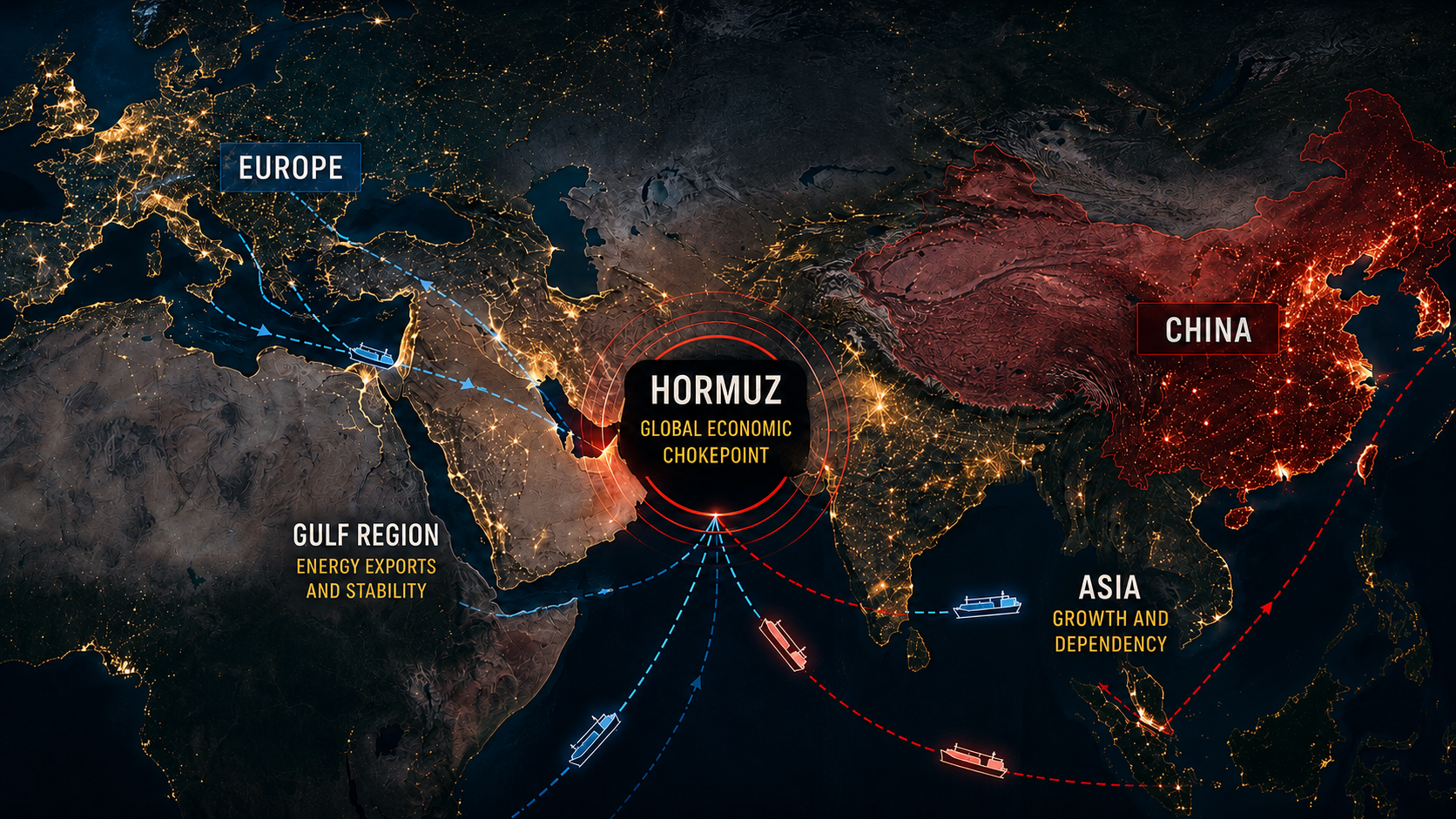
This Chokepoint Check assesses current pressure on the Strait of Hormuz, Bab al-Mandab and the Gulf region’s critical water, power, port and energy infrastructure. The key question is not only whether a route remains geographically open, but whether transport, insurance coverage, energy supply and site operations remain operationally viable.
Diplomatically, there is movement for the first time – operationally, however, Hormuz remains far from normalisation.
Kpler recorded only five commodity vessels on Tuesday, compared with a 10-day average of 15. In parallel, Iran and Oman are discussing a temporary joint navigation corridor and mine-clearing operations. A full reopening has not yet been agreed.
The southern corridor remains under pressure, but shows no new operational deterioration today.
Kpler recorded 31 commodity-vessel transits through Bab al-Mandab on Tuesday. Traffic therefore remained broadly stable compared with recent days. No sufficiently confirmed new attack signal was identified for this corridor on August 25 or 26.
No new facility strike – but existing energy disruptions are now translating into extreme export losses.
New data published on August 26 put the decline in Qatar’s LNG exports since the start of the war at around 96 percent. Qatar exported only 18 LNG cargoes compared with 509 during the reference period. The resulting economic loss is estimated at around USD 24 billion.
Oman and Iran agreed on August 25 on a negotiating framework for a temporary joint navigation corridor through Hormuz as well as a joint mine-clearing project.
Technical talks on a permanent corridor, traffic management and security services are expected to follow. An actual reopening has not yet taken place.
An implemented corridor could reduce transport and insurance risks. For chartering and supply planning, however, the development remains an option rather than an operational reality.
Verification Status: confirmed through the joint Omani-Iranian statement. Implementation and timing remain open. Times of Oman / ONA, 25.08.2026 · directly relevant on 26.08. · SchaafMedia: Middle East Escalation Check from August 24, 2026
According to Kpler, only five commodity vessels passed through Hormuz on Tuesday, compared with a 10-day average of 15. Bab al-Mandab recorded 31 transits.
Despite ongoing diplomacy, Hormuz remains operationally heavily constrained. Individual AIS shutdowns may conceal some movements, but do not alter the overall picture.
Low and unpredictable transit volumes continue to prevent reliable chartering, delivery and procurement planning for energy and commodities companies.
Verification Status: confirmed through current preliminary Kpler data. Reuters / Kpler, 26.08.2026 · SchaafMedia: Chokepoint Check – Hormuz, Trade Routes & Supply Chain Risks
At least three Indian refiners and one global energy company intend to avoid vessels on Iran’s list of 45 non-compliant ships.
Iran’s transit regime is therefore producing clearly identifiable changes in commercial behaviour. Tankers used for ship-to-ship transfers in the Gulf of Oman are also affected.
Shipping companies, refiners and charterers must adjust fleet selection and STS logistics. Due-diligence, insurance and diversion costs are rising.
Verification Status: confirmed through several company sources with direct knowledge. Iran has not yet implemented all threatened measures. Reuters, 26.08.2026 · SchaafMedia: Iran Check – 5 Escalation Signals from August 25, 2026
Current data show Qatar’s LNG exports down around 96 percent since the start of the war: 18 cargoes compared with 509 during the reference period.
Today’s finding does not represent a new facility attack, but rather the latest quantification of the continuing physical and maritime export disruption.
LNG procurement in Europe and Asia remains structurally constrained. US LNG is replacing part of the lost supply while European storage levels remain unusually low.
Verification Status: confirmed through current ICIS data and Reuters calculations. The revenue loss is estimated at around USD 24 billion. Reuters / ICIS, 26.08.2026 · SchaafMedia: Oil as a Weapon – Why Energy Dominates Geopolitics and Markets in 2026
Washington is expanding economic pressure on Iran. New sanctions include Iran-linked companies in China and Hong Kong.
Major Chinese financial institutions have so far been spared. The US is therefore attempting to isolate Iran further without simultaneously triggering a broader confrontation with Beijing.
Companies with Iran-China exposure face additional sanctions, payment and compliance risks. Oil trade remains a central point of friction.
Verification Status: confirmed for the new US sanctions campaign and the still limited inclusion of major Chinese actors. Associated Press, 26.08.2026 · SchaafMedia: Iran War – How the West Fights and Loses Its Dominance
Hormuz remains lightly used while Iran places regulatory pressure on 45 vessels.
Refiners and energy companies avoid listed tankers and adjust STS logistics.
Hormuz transit remains low while Qatar loses almost all of its LNG exports.
Insurance, energy supply, chartering capacity and procurement remain under simultaneous pressure.
Hormuz remains heavily underutilised, while Iran’s blacklist is already changing actual vessel and chartering decisions.
Route geographically open · operationally still unreliableNo new confirmed facility attack was identified for August 25 or 26. Qatar’s LNG export collapse nevertheless continues to demonstrate severe operational consequences.
No new strike · existing damage continues to drive extreme capacity lossLow Hormuz transit, Qatar LNG disruptions, vessel restrictions and US-China sanctions risks are operating simultaneously.
Maritime, energy and economic risks remain fully interconnectedOverall risk remains critical. What is new is a concrete diplomatic opening for Hormuz, although it has not yet been implemented operationally. At the same time, Iran’s vessel blacklist is already affecting real business decisions, while Qatar’s LNG disruption demonstrates the continuing systemic pressure. De-escalation is becoming more tangible for the first time, but still does not dominate the operational risk picture.
Note: This assessment was produced with support from our Geo-AI. AI can make mistakes. The analysis is intended as a source-based radar for potential escalation signals and does not replace fully verified intelligence, security, insurance or investment advice. In rapidly evolving situations, status, source availability and risk assessments may change at short notice.
Independent of the subject covered in this article, this separate Executive Briefing provides an in-depth analysis of another critical risk domain affecting European companies.
The 27-page Executive Briefing “Black Swan Risk Mapping for Europe’s Next Mobility and Infrastructure Shock” examines how geopolitical, infrastructural and administrative developments that are currently viewed in isolation could reinforce one another.
Based on the GFDD Framework™, the report shows how these dynamics could affect operational continuity, access to critical resources and the strategic resilience of companies.
The briefing includes a structured systemic-shock analysis and a directly applicable Business Exposure Checklist for CEOs, CFOs, COOs, investors and strategy teams.
You are currently viewing a placeholder content from X. To access the actual content, click the button below. Please note that doing so will share data with third-party providers.
More Information