Executive Intelligence. Industrial Risk. Geopolitics.
Strategic Sparring
for Decision-Makers
Risk intelligence across technology, law, markets and power dynamics.

Verdeckte Geschäftsrisiken, strategische Widersprüche und kritische Abhängigkeiten frühzeitig erkennen.
Kostenlose Analyse starten →
Verdeckte Machtstrukturen, Führungsrisiken und organisatorische Blockaden frühzeitig erkennen.
Kostenlose Analyse starten →
Geopolitische Risiken, globale Abhängigkeiten und kritische Lieferkettenrisiken frühzeitig erkennen.
Kostenlose Analyse starten →
Identify hidden business risks, strategic contradictions and critical dependencies at an early stage.
Start Free Analysis →
Identify hidden power structures, leadership risks and organizational blockers at an early stage.
Start Free Analysis →
Identify geopolitical risks, global dependencies and critical supply-chain vulnerabilities at an early stage.
Start Free Analysis →
Verdeckte Geschäftsrisiken, strategische Widersprüche und kritische Abhängigkeiten frühzeitig erkennen.
Kostenlose Analyse starten →
Verdeckte Machtstrukturen, Führungsrisiken und organisatorische Blockaden frühzeitig erkennen.
Kostenlose Analyse starten →
Geopolitische Risiken, globale Abhängigkeiten und kritische Lieferkettenrisiken frühzeitig erkennen.
Kostenlose Analyse starten →
Identify hidden business risks, strategic contradictions and critical dependencies at an early stage.
Start Free Analysis →
Identify hidden power structures, leadership risks and organizational blockers at an early stage.
Start Free Analysis →
Identify geopolitical risks, global dependencies and critical supply-chain vulnerabilities at an early stage.
Start Free Analysis →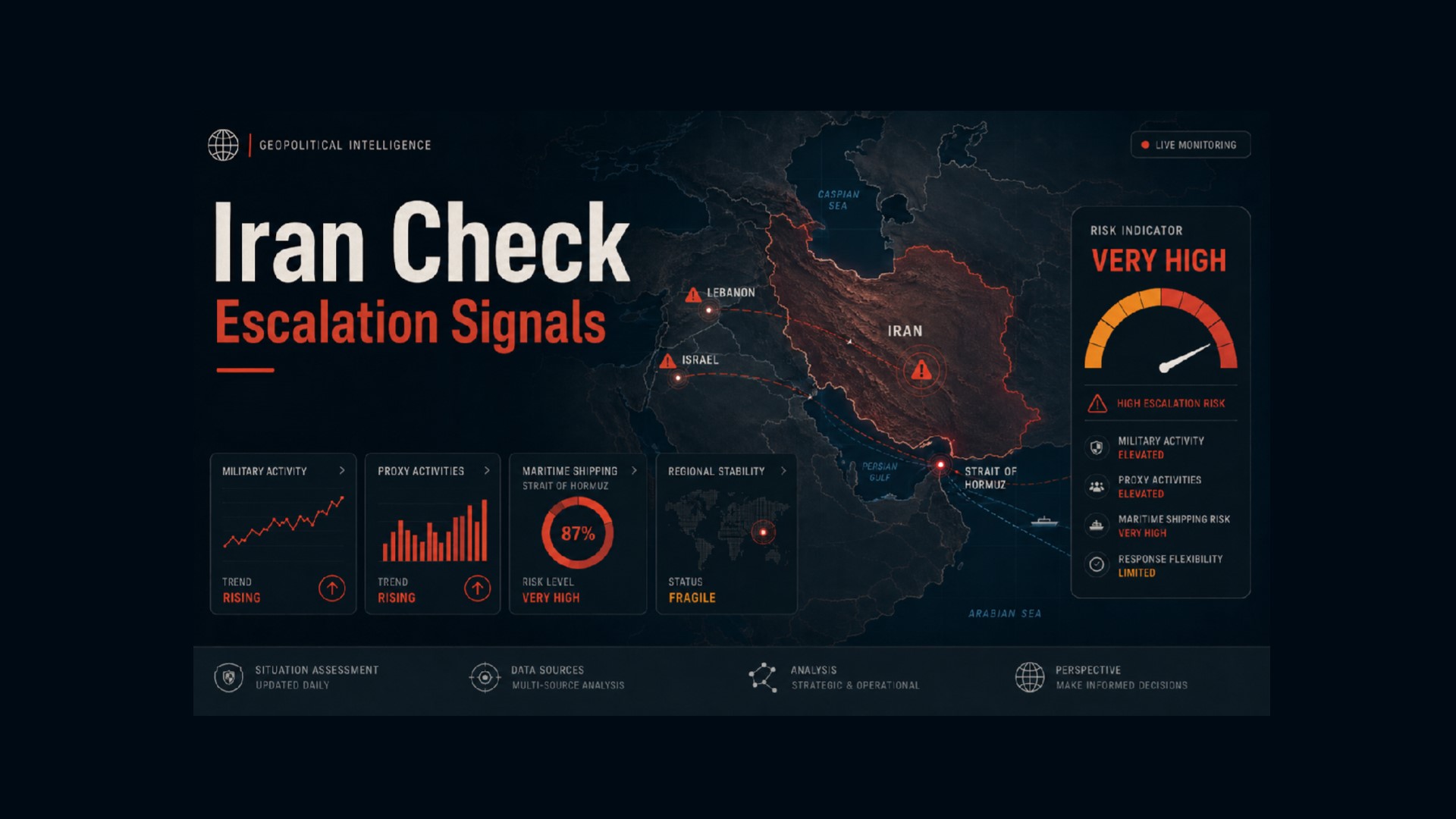
This escalation radar summarises five relevant signals as of August 27, 2026. It focuses on substantiated statements by official bodies, verified events and monitoring sources with potential implications for energy prices, supply chains, markets, maritime security, aviation and regional stability.
Iran and Oman are negotiating a temporary shipping corridor, joint traffic rules and revenue-sharing arrangements. Tehran also says military vessels should not be allowed to pass through the strait. Hormuz is therefore increasingly shifting from free passage towards politically negotiated access.
Ten visible merchant vessels transit Hormuz on Wednesday, up from eight the previous day. Before the war, around 20 million barrels of oil per day passed through the strait; recently, the figure has been only about five million.
UKMTO confirms another tanker strike near Khasab on August 27. The attack itself occurred on August 25. An unknown projectile caused a fire; the crew remained unharmed.
| Actor | Type | Severity | Status | Source / Verification Status | Business Impact |
|---|---|---|---|---|---|
| Iran / Oman / United States / Strait of Hormuz | Iran-Oman model envisages temporary corridor and exclusion of military vessels | Critical · Level 5/5 | Iran and Oman are working on a temporary traffic model for Hormuz. Inbound merchant vessels would use Iranian waters, while outbound vessels would partly use Iranian and Omani waters. Joint traffic management, mine clearance and a possible division of revenues are also being discussed. Tehran also says military vessels should be excluded entirely. Iran continues to tie any reopening to US concessions. Washington rejects parts of the model. Power dynamics: Hormuz is therefore evolving from a primarily militarily contested chokepoint into an institutionally negotiated security and access regime. | Confirmed by AP News, August 27, 2026 . Verification status: confirmed regarding the negotiated traffic model, the planned exclusion of military vessels and the continuing differences with Washington. No final, binding Hormuz agreement has yet been concluded. Background: Schaaf Media · Middle East Escalation Check from August 26, 2026 . | Critical business impact on merchant shipping, US and allied naval forces, tankers, LNG, insurance, transit costs and contract planning. Permanently politicised access would fundamentally change the previous operational logic of Hormuz. |
| Iran / Oman / international shipowners / Hormuz / Bab el-Mandeb | Hormuz traffic rises slightly – oil flows remain at crisis levels | Critical · Level 5/5 | Ten visible merchant vessels transit Hormuz on Wednesday, up from eight on Tuesday. Traffic therefore remains below the ten-day average of around 15 vessels. The transits include fuel tankers, an LPG carrier as well as smaller tankers and cargo vessels. At the same time, oil flows remain at only around five million barrels per day. Before the war, the figure was roughly 20 million barrels per day. Bab el-Mandeb also weakens again: only 19 merchant vessels transit the strait, down from 24 the previous day. Power dynamics: A few additional transits do not amount to operational normalisation. | Confirmed by Reuters, August 27, 2026 . Verification status: confirmed regarding ten visible Hormuz transits and 19 transits through Bab el-Mandeb. AIS shutdowns may mean that some vessel movements are not captured. Further reading: Schaaf Media · Hormuz Blockade 2026: Strategies for the Chokepoint Shock . | Critical business impact on crude oil, LPG, LNG, tanker charters, freight rates, war-risk premiums, Suez and Europe-Asia supply chains. The slight recovery in traffic is not sufficient to offset the structural capacity loss. |
| Oman / Hormuz / international shipowners / tanker traffic | New UKMTO warning confirms another tanker strike near Khasab | Critical · Level 5/5 | UKMTO issues a new official warning on August 27 regarding another tanker attack near Khasab in Oman. The underlying incident occurred on August 25. An unknown projectile struck the tanker and caused a fire, which was later extinguished. All crew members are safe; no environmental impact has been reported. The attacker, vessel nationality and projectile type remain unknown. Power dynamics: Even as negotiations continue over a new Hormuz corridor, its operational security remains unresolved. Institutional rules do not automatically eliminate the physical attack risk. | Confirmed by Anadolu Agency / UKMTO, August 27, 2026 . Verification status: The attack occurred on August 25; the new development on August 27 is the official UKMTO warning and confirmation. Responsibility remains unresolved. Background: Schaaf Media · Iran Check: 5 Escalation Signals from August 25, 2026 . | Critical business impact on crew safety, tankers, insurability, war-risk premiums, charter contracts and transit decisions. Shipowners must continue to distinguish between politically permitted and genuinely safe passage. |
| Qatar / Iran / United States / Sheikh Mohammed Al Thani / Hormuz | Qatar launches new mediation effort between Iran and the United States | High to critical · Level 4/5 | Qatar’s Prime Minister and Foreign Minister, Sheikh Mohammed bin Abdulrahman Al Thani, travels to Tehran on August 27. The aim is to revive direct and indirect diplomacy between Iran and the United States. The talks focus on de-escalation, conditions for renewed negotiations and restoring shipping through Hormuz. Qatar was already involved in the June ceasefire framework. Power dynamics: Alongside Pakistan and Oman, a third regional actor is now taking on a clearly defined mediation role. The diplomatic architecture is broadening, even though Washington and Tehran have still not achieved a direct political breakthrough. | Confirmed by The National, August 27, 2026 . Verification status: confirmed regarding the Tehran visit, Qatar’s mediation effort and the Hormuz focus. No new direct US-Iran negotiating date or peace agreement has yet been confirmed. Background: Schaaf Media · Middle East Escalation Check from August 26, 2026 . | High to critical business impact on oil prices, LNG, Qatar, Hormuz scenarios, political risk premiums and investment planning. A credible mediation breakthrough could materially change maritime risk; for now, however, the outcome remains open. |
| Iran / China / United States / Qalibaf / sanctions conflict | Iran positions strategic partnership with China against US pressure | High to critical · Level 4/5 | Parliament Speaker Mohammad Baqer Qalibaf demonstratively reaffirms Iran’s strategic partnership with China on August 27. He welcomes Beijing’s opposition to the new US sanctions and says Iran-China relations do not require third-party approval. China had previously rejected Washington’s policy of maximum economic pressure. Power dynamics: The US-Iran economic confrontation is therefore becoming more closely linked to the strategic competition between Washington and Beijing. For Iran, China remains the most important economic counterweight to the US isolation strategy. | Confirmed by Tasnim News Agency, August 27, 2026 . Verification status: confirmed regarding Qalibaf’s statement today on the strategic Iran-China partnership. The source is Iranian; the underlying Chinese rejection of US sanctions policy had previously been stated publicly by China’s Foreign Ministry. Further analysis: Schaaf Media · Iran War: How the West Is Fighting While Losing Its Dominance . | High to critical business impact on China-Iran trade, oil, banks, secondary sanctions, payment channels, export controls and global supply chains. The more strongly Beijing resists US sanctions pressure, the more difficult Washington’s strategy of full economic isolation becomes. |
The most important structural shift on August 27, 2026 is the possible institutionalisation of a new Hormuz order. Iran and Oman are no longer negotiating only individual safe passages, but traffic rules, revenues, mine clearance and the exclusion of military vessels. The question of who gets to decide access to Hormuz is therefore increasingly becoming part of the post-war order itself.
Operationally, this political convergence remains fragile. Visible traffic rises to only ten vessels and remains far below normal levels. At the same time, UKMTO confirms another tanker strike near Khasab. Political transit rules and actual maritime security therefore remain clearly disconnected.
The second maritime axis also remains under pressure. Bab el-Mandeb falls to only 19 visible merchant vessels. Hormuz, the Red Sea and Suez therefore remain interconnected risk zones for energy and Europe-Asia supply chains.
Diplomatically, however, the number of mediators is expanding. Qatar travels to Tehran today, while Oman continues to work on the Hormuz architecture. At the same time, Iran is openly positioning its strategic partnership with China against US sanctions pressure. The mandatory alliance review shows no newly confirmed Iranian status change regarding the Mecca Pact today. EASA CZIBs for Iran, Iraq, Jordan, Lebanon, the Persian Gulf and the Gulf of Oman remain active until August 31, 2026; no new tightening was issued on August 27.
The five most important signals for a European and German risk assessment are: the Iran-Oman model for a temporary Hormuz corridor with a possible exclusion of military vessels, the continued severe restriction of actual traffic through Hormuz and Bab el-Mandeb, today’s official confirmation of another tanker strike near Khasab, Qatar’s new mediation effort in Tehran, and Iran’s demonstrative deepening of its strategic partnership with China in opposition to US sanctions pressure.
Note: This assessment was prepared with the support of our Geo AI. AI can make mistakes. The analysis is intended as a radar for potential escalation signals and does not replace a fully verified intelligence assessment.
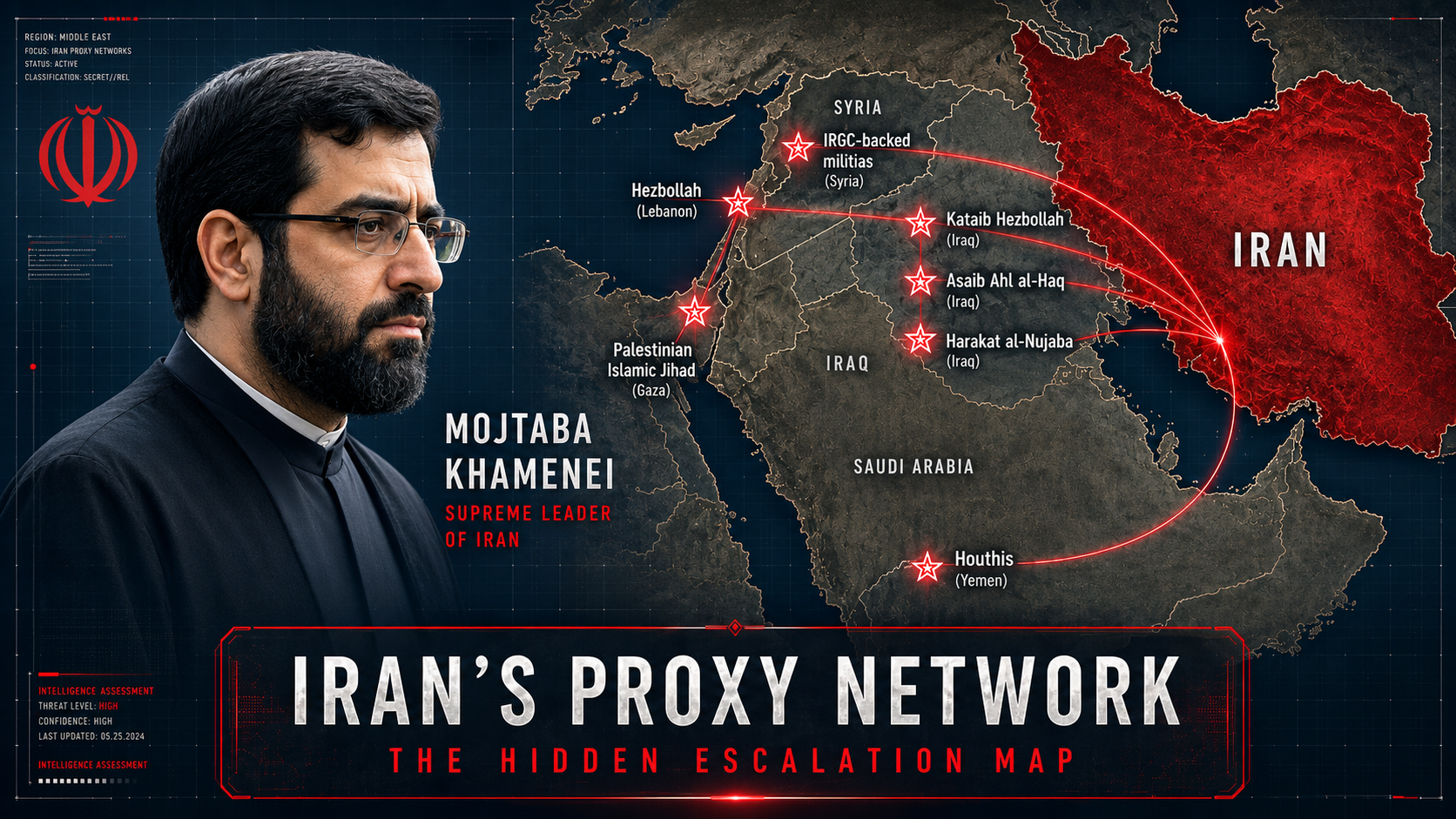
What decision-makers should watch now — before proxy escalation becomes a cost, compliance or supply-chain shock.
This 17-page executive briefing translates Iran’s proxy network into concrete business risks: energy price exposure, maritime chokepoints, war-risk premiums, sanctions, shadow fleets, supply-chain disruption and early-warning indicators for board-level decisions.
You are currently viewing a placeholder content from X. To access the actual content, click the button below. Please note that doing so will share data with third-party providers.
More Information